DbcultAccessing Vault...
Cult Review
Senior Film Conservator
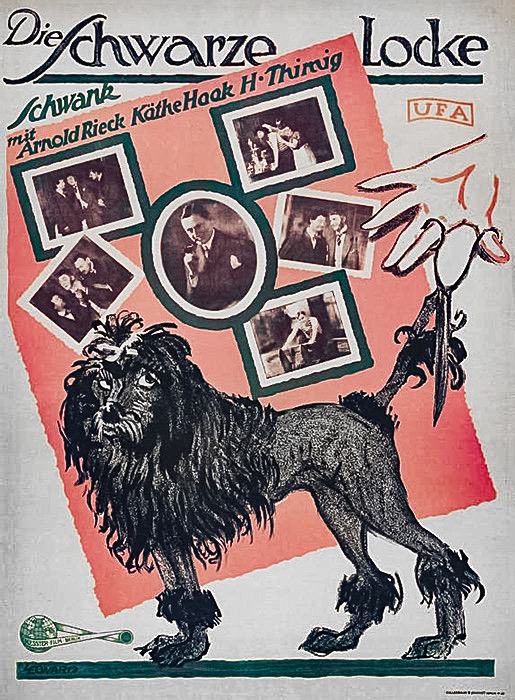
In the pantheon of early 20th-century German cinema, few artifacts remain as hauntingly evocative yet structurally complex as the 1917 production, Die schwarze Locke. This film, emerging from a period of profound transition within the European filmic landscape, serves as a bridge between the theatrical histrionics of the 19th century and the nascent psychological realism that would eventually define the Weimar era. To watch this film today is to engage with a visual grammar that was still in the process of being codified, where every gesture carries the weight of an era teetering on the brink of modernity.
The narrative architecture of the film is built upon the fragile foundation of a single lock of hair. While contemporary audiences might find such a premise quaint, one must view it through the lens of early 20th-century romanticism, where physical tokens served as the primary currency of emotional exchange. Unlike the grand urban vistas of The Eternal City, which sought to capture the breadth of civilization, Die schwarze Locke focuses its gaze inward, miniaturizing its drama to the scale of a domestic interior. This intimacy allows the performers to explore nuances of expression that were often lost in the more expansive productions of the time.
At the heart of this production is the legendary Käthe Haack. Even in this early stage of her illustrious career, Haack possesses a luminosity that transcends the technical limitations of 1917 cinematography. Her ability to convey interiority through the subtle tilt of a head or a momentary hesitation in movement is nothing short of revelatory. She anchors the film's more melodramatic tendencies in a recognizable human vulnerability, a feat that sets her apart from her contemporaries who often relied on broader, more pantomimic techniques.
Opposite her, Hermann Thimig provides a performance of remarkable theatrical gravity. Coming from a dynasty of actors, Thimig brings a sense of discipline and poise to the screen that contrasts beautifully with the film's more fluid emotional beats. His presence ensures that the stakes of the 'black lock' never feel trivial; he treats the unfolding drama with the solemnity of a classical tragedy. When compared to the rugged masculinity found in The Man from Nowhere, Thimig’s performance is a masterclass in the refined, almost delicate pressures of the European upper class.
The titular 'black lock' functions as a narrative engine, driving the plot through a series of escalating tensions. In the silent era, objects frequently had to do the heavy lifting of dialogue, and here, the lock of hair is treated with a reverence that borders on the fetishistic. It is a piece of the beloved, a physical manifestation of a memory that cannot be articulated through intertitles alone. The way the camera lingers on this object suggests a precursor to the 'Kuleshov effect,' where the meaning of the lock shifts depending on whose hand holds it and whose eyes gaze upon it.
This use of symbolic objects invites comparisons to The Waxen Doll, where an inanimate figure becomes the locus of human desire and projection. However, while The Waxen Doll leans into the uncanny, Die schwarze Locke remains grounded in the social consequences of its central motif. The lock is not just a romantic token; it is a liability. In a world of rigid decorum, it represents a breach of privacy, a stain on a reputation, and a catalyst for a scandal that could dismantle a family's standing in an instant.
Visually, the film is a fascinating study in the use of light and shadow. The interiors are often framed with a sense of enclosure, mirroring the social constraints placed upon the characters. The cinematography utilizes a soft-focus aesthetic in moments of romantic reflection, only to sharpen into harsh, high-contrast lighting during scenes of confrontation. This visual duality highlights the film's central theme: the conflict between our private passions and our public personas.
While it may lack the maritime scale of Plimsolleren, the film excels in its use of deep space within the frame. Characters are often positioned in the background, obscured by furniture or doorways, suggesting a world where someone is always watching, and secrets are never truly safe. This sense of voyeurism adds a layer of suspense that elevates the film beyond mere melodrama, touching upon the psychological thriller elements found in The Mystery of a Hansom Cab.
The social dynamics portrayed in Die schwarze Locke are emblematic of a world on the verge of collapse. Released in 1917, the film was produced during a time of immense political upheaval, yet it focuses on the minutiae of bourgeois life. This insularity is a choice, perhaps a form of escapism, or perhaps a critique of a class that remained obsessed with its own petty dramas while the world outside burned. In this regard, it shares a thematic DNA with The Auction of Virtue, which similarly explores the commodification of morality and the transactional nature of social standing.
Furthermore, the film’s exploration of guilt and redemption echoes the moral weight of The Eternal Sin. Both films grapple with the idea that the past is never truly buried; it exists as a vestigial force, ready to re-emerge at the most inopportune moment. In Die schwarze Locke, the lock of hair is the physical manifestation of this haunting past, a ghost that refuses to be exorcised until the truth is brought to light.
The pacing of the film is deliberate, eschewing the rapid-fire editing of modern cinema for a more rhythmic, almost musical progression. Each scene is allowed to breathe, giving the audience time to absorb the emotional state of the characters before the next development occurs. This allows for a depth of characterization that is often missing from more plot-driven silents like Won on the Post. Instead of relying on external action, the tension in Die schwarze Locke is generated through the internal friction of its protagonists.
Even the comedic interludes, likely provided by Arnold Rieck, serve to heighten the surrounding drama by providing a momentary release of tension. This balance between lightness and gravity is a hallmark of sophisticated early cinema, ensuring that the film never becomes bogged down in its own pathos. It possesses a certain optimistic streak, reminiscent of Little Miss Optimist, suggesting that despite the misunderstandings and the social pressures, there is always a path toward resolution and clarity.
To understand Die schwarze Locke, one must also consider the contributions of the supporting cast, such as Grete Weixler and Julius Markow. These actors round out the social world of the film, providing a sense of community and context that grounds the central romance. Their performances contribute to the film's overall sense of authenticity, making the world of 1917 Germany feel lived-in and tangible. This attention to social detail is something it shares with Tovarishch Abram, although the two films operate in very different cultural registers.
The film also stands as a testament to the resilience of the German film industry during the Great War. Despite the hardships of the time, the production values remain high, with elaborate sets and costumes that reflect the aspirations of its audience. It is a work of craftsmanship that refuses to yield to the chaos of its era, much like the stoic protagonists of A Soldier's Oath. It reminds us that even in the darkest times, the pursuit of art and the exploration of the human heart remain essential.
Ultimately, Die schwarze Locke is a film about the power of the small. It demonstrates that a grand narrative can be built from the most minor of materials—a lock of hair, a misplaced letter, a lingering glance. It eschews the 'spreading evil' of grand moralistic tales like The Spreading Evil in favor of a more intimate, nuanced look at the complexities of human relationships. In doing so, it achieves a timelessness that many of its more contemporary-focused peers lack.
While it may not have the rugged charm of An American Gentleman or the stark anatomical curiosity of Our Bone Relations, Die schwarze Locke offers something far more precious: a window into the soul of a bygone era. It is a film that rewards patient viewing, inviting the audience to look past the scratches on the celluloid and the silence of the soundtrack to find a story that is as vibrant and relevant today as it was over a century ago. It is a cornerstone of silent melodrama, a showcase for the nascent brilliance of Käthe Haack, and a poignant reminder of the enduring power of the cinematic image to capture the ephemeral nature of love and memory.
In the final analysis, the film stands as a triumph of mood and character. It proves that silent cinema was never truly 'silent'—it spoke through the intensity of its performances, the precision of its visual metaphors, and the universal language of the human face. Die schwarze Locke remains a vital piece of film history, a black curl of memory that continues to fascinate and move those who are willing to look closely enough.
IMDb —
1934
Community
Log in to comment.