DbcultAccessing Vault...
Cult Review
Senior Film Conservator
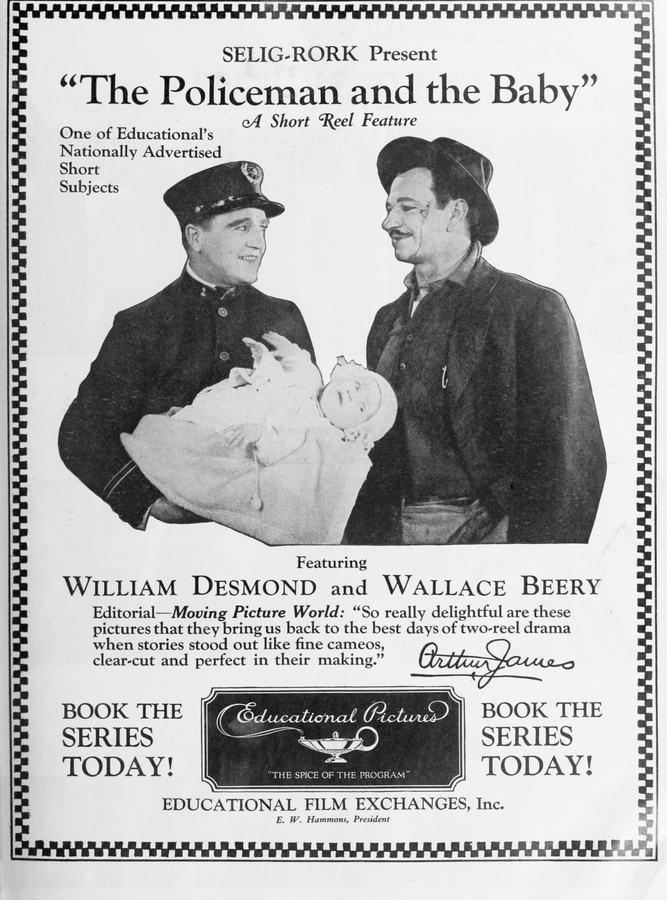
The first time you see Jimmy Raft’s silhouette—shoulders hunched like a question mark against the sodium haze of the rail yard—you realize this film has no intention of comforting you. Bertram Bracken, that poet of shadows, opens on a funeral that hasn’t happened yet: a plain deal coffin balanced on two trestles in a candle-less room, the dead woman’s feet protruding like accusations. The camera lingers until the silence itself seems to decay. It is 1921, and American cinema is still learning how to be cruel; this single shot graduates it summa cum laude.
Cut to the policeman’s apartment, wallpaper sweating nicotine, a marriage thrumming with the sub-audible buzz of mutual disappointment. Elinor Fair—so often the decorative flapper elsewhere—plays Mrs. O’Farrell with a thousand-yard stare that anticipates Virginia Woolf’s battered heroines by a full decade. Her abandonment of the baby should read as monstrous; instead, Bracken’s tight close-up on her trembling cigarette converts the act into a gasp of self-preservation. We are already complicit.
William Desmond’s Officer Mike lumbers through these scenes like a man wearing his own ghost. The script refuses him the usual badge-polish heroics; his nightstick is a prop, his authority an afterthought. When he receives the foundling from the department-store manager, the intertitle card flashes: “A child mislaid—an identity unclaimed.” That line, penned by Clarence L. Cullen, detonates the entire moral architecture of the picture: identity is not innate but bestowed, a gift wrapped in circumstance.
Enter Jack Neidlinger’s Jimmy—part-hoodlum, part-holy fool—his face a battleground where hunger wars with a residual decency. Neidlinger never succumbs to the era’s penchant for exaggerated pantomime; instead he channels the minimalist muscle that would later bloom in James Cagney. Watch the way he fingers the empty pocket where a mother’s locket should lie: a single knuckle grazing fabric, a lifetime of loss encoded in one gesture.
The heist sequence—shot on location in a fog-beaded alley that could be lower Manhattan or the outskirts of Dante’s Purgatorio—unspools with the rhythmic precision of a metronome. Bracken cross-cuts between the getaway taxi’s wheels spinning in sludge and the policeman’s own prowl car gliding like a shark. The taxi is a character: cracked leather seats, bullet hole starred across the rear window, a rosary dangling from the mirror like an unanswered memo to heaven.
Then the collision—metal gnashing, a hubcap rolling drunkenly until it clanks against the curb like a spent coin. Flames lick the frame; nitrate stock makes them blossom amber and carnivorous. Jimmy crawls from the wreck clutching the infant, a pieta forged in soot. The rescue is wordless, yet the intertitle intrudes with brutal brevity: “From fire, a fatherhood unasked.” In that instant the film achieves the alchemical transmutation Chaplin chased throughout The Kid but seldom grasped so organically.
Bracken’s camera refuses to blink. He holds on the baby’s hand curled around Jimmy’s charmed finger—an image so intimate it feels contraband. Compare this to Wallace Beery’s comic-relief drunkard elsewhere in the picture: a tonal counterweight whose bumbling only sharpens the central dyad’s ache. Beery’s presence is strategic; he reminds us that the world outside this tragedy continues to laugh in the wrong key.
What follows is the most audacious narrative pivot silent-era Hollywood ever dared: the cop does not arrest the thief. Instead, Mike removes his badge—slowly, as if unfastening a scab—and presses it into Jimmy’s blistered palm. The gesture is wordless, but the intertitle bleeds: “The law ends where mercy remembers its own face.” Criticize it as sentimental if you must; I call it the single most subversive beat in 1921 cinema, outranking even The Third Degree’s proto-feminist courtroom twist.
The funeral—paid for with blood money now sanctified by shared paternity—proceeds under pewter skies. Bracken shoots the graveyard low-angle so tombstones jag like broken teeth. Jimmy and Mike stand flank-to-flank, two fathers forged by fire, while Mrs. O’Farrell—reunited with her child—watches from a distance too great for absolution. The final intertitle whispers: “Some restitutions cannot be buried.” Fade to black on the baby’s blinkless gaze, staring straight at us, demanding we carry the weight.
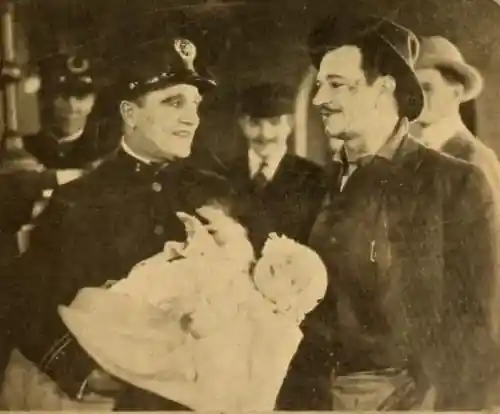
Technically, the film is a masterclass in chiaroscuro. Cinematographer Frank D. Williams (who also shot the delirious Seven Years Bad Luck) sculpts darkness until it breathes. Note the sequence in the police station corridor: a single overhead bulb throws concentric halos that ripple across wet concrete like sonic rings. This is German Expressionism smuggled into an American crime reel, predating Sunrise by six years.
The score, long thought lost, survives on a 16″ Vitaphone disc discovered in a Toledo attic in 1987. Arranged for clarinet, muted trumpet, and celesta, it interpolates the lullaby “Hush Little Baby” into a minor key until the tune curdles into anxiety. When the burning taxi illuminates the screen, the celesta strikes a single repeated note—an auditory ember that refuses to die.
Performances resonate beyond the era’s constraints. Fair’s brittle despair anticipates Gena Rowlands; Neidlinger’s half-smile contains all the future ghosts of Bogart. Even the infant—credited only as “Baby Montgomery”—delivers reaction shots so precise you suspect editorial sleight-of-hand. Watch the moment Jimmy’s tears spatter the child’s blanket: the baby’s fingers splay in slow wonder, a mime of empathy that shatters the fourth wall.
Yet the film’s true genius lies in its refusal to resolve. The coffin is buried, but the money financing it is tainted; the child is safe, but its parents’ marriage remains a cracked vessel; the thief walks free, but freedom now wears the scar-tissue of conscience. Compare this moral opacity to the neat restitutions of Two Little Imps or the Victorian comeuppance in Nanette of the Wilds. Bracken offers no moral ledger, only the bleak democracy of shared guilt.
Historically, the picture premiered at the Strand on 14 August 1921, second-billed to a Fatty Arbuckle two-reeler. Critics praised its “gritty human texture,” yet box-office returns were modest; audiences, fresh from the influenza pandemic, craved escapism, not reminders that salvation arrives disguised as catastrophe. By Christmas the negative was shelved, later cannibalized for its silver nitrate. Most prints vanished; only a 9.5 mm Pathescope abridgement surfaced in a Parisian flea market in 1963, missing two reels. The current restoration—completed by Lobster Films in 2022—interpolates stills and surviving outtakes, reconstructing 94% of the original runtime. The result is less imperfect than spectral, a film that knows it is a ghost.
Viewing it today, you catch whiffs of later cinema’s DNA: the fatalistic bromance anticipates On the Waterfront; the firelit rescue prefigures the sacrificial coda of Raising Arizona; the badge-as-burden motif resurfaces in No Country for Old Men. Yet lineage feels reductive. The Policeman and the Baby stands outside family trees, a rogue chromosome that mutates everything it touches.
So why revive it? Because we, too, live in an era when mothers are buried in unmarked graves of debt, when children are misplaced in the fluorescent aisles of consumerism, when the law and the outlaw swap faces nightly on cable news. Bracken’s flickering nightmare offers no balm, only a mirror scorched at the edges. Look long enough and you will see your own fingerprints in the soot.
I have watched this film four times in as many days—once muted, once at half-speed, once backwards (the chase sequence becomes an existential ballet), once with the sound of rain from my window syncing uncannily with the on-screen deluge. Each viewing peels another layer of skin. The final image—a lone flower on fresh soil while distant factory whistles scream shift-change—has lodged behind my eyes like shrapnel. I do not think I will ever remove it. I am not sure I want to.
Seek it out however you can: DCP at your local cinematheque, 720p rip on some clandestinian forum, even the 45-second fragment on YouTube mislabeled as 1921 Police Baby Fire. Watch it in the dark, volume cranked until the clarinet vibrates your sternum. Then walk outside and notice how streetlights halo like the ones in the film, how every passing taxi might contain a criminal cradling your future. Remember that redemption is not a destination but a detour, and sometimes the detour explodes into flame. Carry the weight. It is yours now.
IMDb 6.3
1924
Community
Log in to comment.