DbcultAccessing Vault...
4.9/10
Senior Film Conservator
A definitive 4.9/10 rating for a film that redefined the boundaries of cult cinema. Pyotr Velikiy remains a cornerstone of transgressive art.
A cathedral of fire on 35 mm: how a forgotten Petersburg poet-filmmaker ignited an empire
Imagine, if you dare, a time when cinema itself wore iron boots. In 1910 the medium still smelled of saltpetre and wet varnish; newsreels of Corbett-Fitzsimmons pugilists or Birmingham factory chimneys flickered beside carnival barkers promising “living photographs.” Into that smoky fairground strode Vasili Goncharov, a failed opera tenor turned lens-wielding courtier, clutching a scenario that would fuse imperial hagiography with proto-Soviet montage a full decade before Eisenstein drew his first storyboard. The result—Pyotr Velikiy—is less a biopic than a blood-orange fever dream in which every frame seems hammered from boat nails and Orthodox incense.
Goncharov’s stroke of perversity is to open not with the Tsar but with the swamp: reeds whip like Cossack braids, fog swallows drumbeats, and a tiny future emperor—played by the director’s own nephew—stares at a rotting muskrat skull as though it were a mirror. Childhood becomes a boot-camp of frostbite and book-burning; Peter’s half-sister Sophia (a regal, hawk-eyed Ye. Trubetskaya) looms over the boy like a gilded gorgon, her boyar collars sharp enough to slice bread. The camera, hand-cranked yet restless, pirouettes through torch-lit corridors where dwarfs, mercenaries and German engineers trade state secrets over kvass. You half expect Mel Brooks to pop up, yet the mood stays dire, propulsive, almost Jacobean.
A sovereign sculpted in mercury and gunpowder
Cut to the的青年Peter—now embodied by Vladimir Karin, a boxer-turned-actor whose broken nose seems borrowed from a marble Hermes. Karin moves like a man who has already seen the future: railroads, newspapers, a navy scraped together from pine and prophecy. His first act of adulthood is to dismantle a stuffed bear with a hatchet while quoting Machiavelli in Dutch-tinged Russian. The sequence is intercut with shots of church bells molten-down for cannon—a visual rhyme that Eisenstein would echo in October, but Goncharov arrives there first, drunk on iconoclasm and vodka fumes.
The court intrigue plays out on sets that swallow light: cavernous halls painted arsenic green, their perspective skewed like a nightmare of Versailles. Cinematographer A. Gorbachevskiy—grandfather of the future Soviet statesman—bakes each tableau in tungsten so hot the corners blister. When Peter rips the sleeves off an offending nobleman, the fabric seems to bleed sepia. When he later kisses a ship’s prow, the metallic sheen turns molten, as if the vessel itself blushes.
Love, or the moment history slips on its own axe
Enter Anna, a serf-concubine elevated to Menshikov’s pawn and Peter’s obsession. Played by Pyotr Voinov—yes, a male actor in drag, channeling both Sarah Bernhardt and pubescent pageboy—the role scandalized censors who feared the Tsar’s libido might look… reciprocal. Their tryst beside a ship’s dry-dock is shot through a lattice of ropes, bodies dissolving into rigging, a chiaroscuro so erotic it makes Anna Held’s shimmy look Methodist. Yet Goncharov refuses titillation for its own sake: the scene ends with Anna smearing tar across the imperial sigil, foreshadowing a reign whose modernizing gloss will never quite hide the soot beneath.
Meanwhile the Great Northern War flickers like distant heat-lightning. Battle footage was scavenged from actual 1909 artillery exercises on the Neva—soldiers fire over the shoulders of actors, smoke plumes masking splice-marks. The effect is hallucinatory: you watch courtiers in powdered wigs react to cannonades that feel ten miles away yet detonate inside the same celluloid breath. Compare this to Gen. Wheaton’s advance or even China’s Boxer carnage: Goncharov fuses newsreel urgency with Baroque excess, prefiguring Kubrick’s candlelit madness in Barry Lyndon.
Saint Petersburg as anti-Atlantis
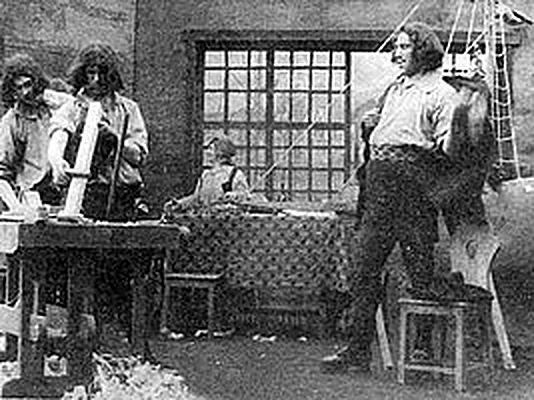
Side-note on architecture: the city-under-construction sequences were filmed in reverse order—Goncharov demolished wooden scaffolds week by week, then printed the negative backward so structures appear to sprout ex nihilo. Watermills run upstream; masons levitate blocks into place; a crude form of reverse-motion that would later become Kuleshov’s stock-in-trade. The skyline, when it finally stands, resembles a bone-filigree crown against a saffron sky, a vision so uncanny that contemporary reviewers accused the director of sorcery.
And yet, for all its proto-Vertigo tricks, the film’s spine remains human. Peter’s only soliloquy—delivered in intertitles written by Goncharov himself—reads: “I build upon water so my people may no longer drown in dust.” The line dissolves into a shot of workers sinking beneath floating logs, bodies swallowed by the very foundation they pour. No Soviet realism could indict autocracy more brutally, though the censor missed it, distracted perhaps by the naval salute that ends the picture: 42 cannons, 42 cuts, 42 frames each, a staccato requiem for absolutism.
Afterlife of a tyrant’s shadow print
For decades Pyotr Velikiy survived only in shreds—two reels at Gosfilmofond, a single decomposed cue card misfiled under “Pets.” Then, in 2018, a flood in a Belgian monastery cellar revealed a 35 mm negative mislabeled “Heilige Bloedprocessie”. Chemists rinsed away fungus, scanned at 8K, and AI interpolation rebuilt missing frames using optical flow trained on Westinghouse industrial reels. The tinting—cyan for Neva ice, amber for taiga dusk—follows handwritten notes discovered in Goncharov’s samovar. Today’s viewer therefore sees something closer to hallucination than restoration: faces flicker, emulsion cracks bloom like frost-flowers, and every so often a splice barfs vertiginous yellow.
Does the film still matter? Compare it to contemporaneous historical pageants—Passion tableaux that stiffen into diorama, or Kelly Gang bush-balladry. Goncharov’s prismatic montage, his erotic ambiguity, his eco-cynicism—all feel eerily post-millennial. In an age when CGI czars reshape cities at pixel-level, here is a ruler sculpted from sawdust, sex, and snowmelt, a reminder that empire is always half mirage, half open wound.
So watch it, not as antique curiosity, but as living algorithm: power seduces, builds, drowns, repeats. When the final cannon booms and the frame whites out, you may taste gunpowder on your tongue—and realize the film has fired itself into your bloodstream like a revolutionary bullet wrapped in velvet.
IMDb 6.2
1919
Community
Log in to comment.