DbcultAccessing Vault...
Cult Review
Senior Film Conservator
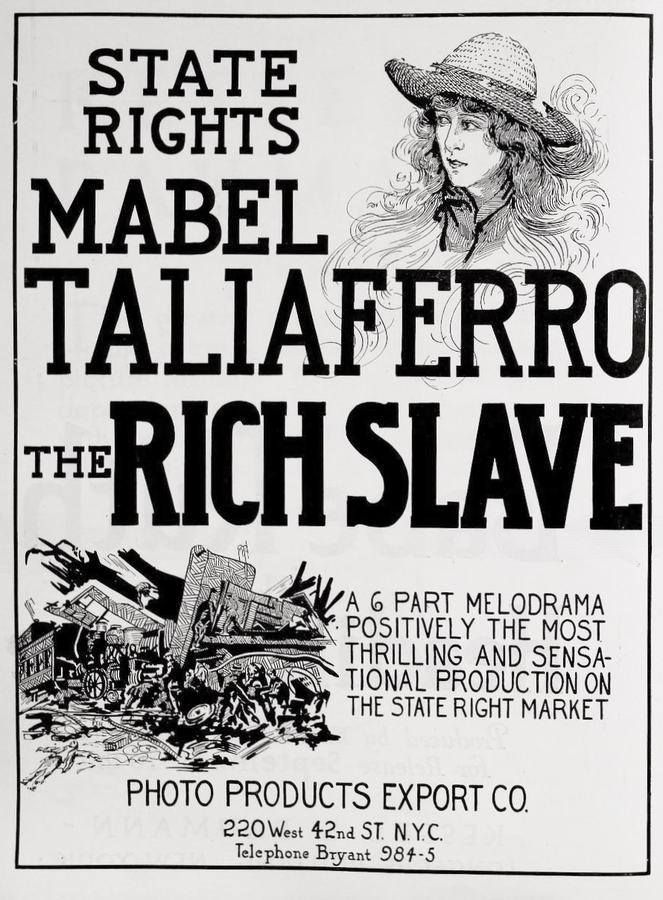
Lurid one-sheets promised "A Thrilling Avalanche of Emotions!" yet no avalanche arrives as frigid as the truth The Rich Slave smuggles beneath its pulp corset: America’s habit of monetizing the bodies it purports to rescue. Director/writer Lloyd Lonergan, moonlighting from his day job at The New York Times, wields intertitles like shivs, peeling the epidermis of melodrama until the raw musculature of capital shows.
The film survives only in fragmentary 35 mm reels—nitrate kisses scorched umber—but even these tatters howl. Frames flicker like tallow candles; perforations chomp along sprockets as if the very apparatus were hungry. Yet scarcity fertilizes mystique: every surviving foot becomes relic, every iris-in a Eucharist.
Begin with the name—No. 17—stenciled on a cedar bunk. The digit is both inventory tag and proleptic prison brand, forecasting how social-security numerals will later tattoo citizens into databases. Gladys Claypool, played with porcelain fragility by Mabel Taliaferro, owns nothing, not even her syllables; guardianship papers list her as "female minor, approximate value: future earnings contingent on iron deposits."
Enter the syndicate: bankers who breathe through gills of stock scrip, their top-hat shadows longer than the children they barter. They require a corporeal key—the orphan—to unlock deeds hidden inside her lineage. Lonergan’s script refuses mustache-twirling caricature; instead, the financiers exhibit bureaucratic banality, signing death warrants with the same yawn they lend to coffee ledgers.
So the transaction germinates: a nurse, Vinnie Burns in cold-blooded pearls, promises to extract the girl for thirty pieces of silver—enough to settle her own morphine tab. But the superintendent (Herbert Standing Jr.) sniffs profit; he corners the nurse, bargaining for a slit of her purse. Their pas-de-deux of complicity, shot in medium two-shot inside a doss-house office, plays like a ledger balancing human vertebras against copper futures.
Cinematographer Romaine Fielding lenses orphanage corridors with chiaroscuro borrowed from Danish interiors: children stacked like cordwood, faces half-erased by darkness, only eyes gleaming—commodity futures glistening. When the narrative train barrels westward, the aspect ratio itself seems to widen, as if the horizon were an accounting book whose margins overflow.
Note the repeated visual trope of hands: Gladys’s fingers curled around rusty bunk rails; the nurse’s gloved hand sliding coins across walnut desktops; the superintendent’s palm opened expectantly. Lonergan orchestrates a Morse code of extremities, reminding that ownership is first apprehended through touch, then through contract.
Intertitles arrive sparse, almost aphoristic:
"Freedom purchased still bears interest."
Read that line today and hear student-loan servicers humming.
Mid-film, the drifter—Robert Forsyth, equal parts Hawkeye and hobo—bundles Gladys aboard a Chicago-bound express. Cue the sabotage sequence: switch-levers tied with shoelaces, tracks greased with whale-oil, an entire train destined for gorge below. Lonergan crosscuts between pistons, screaming steam, and infant shoes tumbling from satchels. The wreckage, however, is not disaster but revelation: out of splintered passenger cars, the girl’s protector rises, limping but alive, clutching a singed document that will later prove her birthright.
Here the film weaponizes deus-ex-machina as social critique: only through industrial cataclysm can the underclass reclaim lineage. Contrast this with Crashing Through to Berlin where trains equal patriotic thrust; Lonergan derails that nationalist symbolism, exposing rail barons as both empire builders and child merchants.
Silent-era acting often skews semaphore, yet Taliaferro’s Gladys quivers with microscopic tremors: a blink that withholds rather than releases tears, shoulders that rise millimeter by millimeter as awareness of betrayal calcifies. In one lingering close-up, her pupils dilate while reflected lamplight flickers—an entire ledger of trust subtracted to zero.
Compare Mabel Taliaferro’s minimalist tremulations to Barney Gilmore’s histrionic superintendent—eyebrows miming semaphore distress signals. The tonal disjunction accentuates class schism: the powerful perform for spectators; the dispossessed perform survival.
Vinnie Burns’s nurse courts comparison with The Vamp’s predatory siren, yet Lonergan complicates her villainy. She pockets bribes to fund her own escape from gendered servitude—medical diploma unattainable, wages capped at one-third male counterparts. Her crime is capitalism’s mirror: she traffics a child because the system traffics her labor. When she ultimately plummets off a warehouse sill, the film denies catharsis; her body lies crumpled beside a bill-posting announcing Children for Adoption: Cash Incentives.
Modern screenings retrofit compilation scores: nostalgic parlour tunes, maybe a plunked-out Scott Joplin. Resist. A conscientious accompanist should summon dissonance—prepared piano strings threaded with paperclips, bowed saws mimicking train whistles—anything to remind that the children onscreen had no soundtrack cushioning their trauma.
Only 28 minutes survive, archived at the Library of Congress under climate-controlled lock. Rumor claims an additional reel languishes in a Buenos Aires basement, victim of 1950s asbestos mislabeling. Digital restoration paused after budget cuts; crowd-funding attempts falter because the word slave triggers algorithmic shadow-bans. Meanwhile, 4K scans of Hop to It, Bellhop circulate unimpeded—proof that comedy ages softer than indictment.
Stack The Rich Slave beside A Daughter of the Law and watch how both weaponize waifs to indict juridical theater. Yet where Daughter ultimately reassures—law as patriarchal savior—Lonergan’s film lands on ambiguity: the grandfather’s signature validates wealth but cannot unsuture scar tissue. Or pair it with Dämon und Mensch for trans-Atlantic fatalism; both posit that redemption requires structural, not personal, overhaul.
Days after screening, the orphanage ledger resurfaces in memory: ink blots shaped like smallpox scars. One recognizes the same accounting mentality in modern private detention centers billing the state per diem for brown-skinned minors. The past isn’t prologue; it’s a stencil.
There is no final reel in which Gladys tap-dances into trust funds. The surviving fragment ends mid-embrace: prairie drifter clutching child before a horizon still unmarred by barbed wire. Fade-out. The projector crackles like burning fat. House lights rise, yet the audience—us—remains shackled to the ongoing narrative of bodies priced, traded, erased.
If you find the complete print, don’t merely screen it—prosecute it.

IMDb 6.9
1931
Community
Log in to comment.