DbcultAccessing Vault...
Cult Review
Senior Film Conservator

One can almost taste the dust motes drifting through the general-store doorway as The Lesson opens: a camera that lingers on cracked clapboards and sun-bleached feed sacks, letting the viewer feel the osmotic boredom that seeps into Helen Drayton’s pores. Constance Talmadge, her eyes a pair of restless swallows, telegraphs rebellion with every sideways glance at the town’s matrons who cluck over her “inevitable” betrothal to Chet Vernon. Talmadge’s physical vocabulary—shoulders hitched forward like someone forever ready to sprint—signals that this is no coy ingénue but a powder keg of unspent desire.
Enter John Galvin, played by Herbert Heyes with the sleek menace of a freshly polished chrome grille. He arrives in a whirl of Manhattan gossip and cigarette smoke, promising Helen the vertiginous splendor of skyscraper canyons. Their courtship is condensed into a brisk montage: shared lemonade on a veranda, a stolen kiss beneath gaslight, a steam-train departure that billows like the promise of modernity itself. The film’s intertitles, penned by Virginia Terhune Vandewater, swap the usual sentimental treacle for staccato bursts of urban slang—“Ever jazz a mile a minute?” John scribbles on a postcard—cementing the city as both seducer and predator.
Once transplanted to New York, cinematographer Joseph W. Smiley swaps amber pastoral tints for chiaroscuro interiors shot through with sodium glare. Helen’s first apartment is a vertiginous garret where shadows climb the walls like ivy; the camera tilts slightly, making even the floor feel unreliable. The metropolis is rendered not as playground but as centrifuge: every social encounter flings Helen outward into self-doubt. At an architects’ soirée, she wears a borrowed flapper dress—beads rattling like shackles—while John flits between potential clients, recasting her as rustic ornament. The sequence is capped by a devastating iris-out on her reflection in a mirrored column, the frame shrinking until her face dissolves into a sea of strangers.
Charles Giblyn’s direction favors oblique angles and obstructed sight lines: doorframes slice characters in half, window mullions cage them. The visual grammar anticipates late-period Lang, yet the intent is not noir fatalism but suffocation by social aspiration. Compare this confinement to the open-air optimism of Gretchen the Greenhorn; where that immigrant fable finds redemption in communal hearth, The Lesson distrusts any collective larger than two hearts beating in synchrony.
Mid-film, Helen suffers a miscarriage—rendered obliquely through a smash-cut from her collapsing in a tenement hallway to an empty rocking chair swaying in ghostly perpetuum. The censor boards of 1923 demanded narrative occlusion, yet the elision lands harder than any graphic depiction. John, away “on business,” returns with a box of skyscraper-shaped chocolates and a brittle smile, the sugar-coated metaphor for the hollow edifice of their marriage. It is here that Talmadge unleashes her most seismic moment: a silent scream held for eight film seconds, the camera fixed in medium close-up as every micro-muscle in her face capitulates to grief. No title card intrudes; the absence of text becomes the loudest line in the picture.
The third act pivots on a chance El-train encounter with Chet Vernon—Walter Hiers imbuing the role with a sturdy kindness that feels almost radical after John’s narcissistic sparkle. Chet, in town for a grange convention, offers Helen his coat without sermon. The return journey to the hometown is shot like a secular Stations of the Cross: each station stop peels away another layer of metropolitan artifice until Helen steps onto the wooden platform in plain gingham, the camera pulling back to reveal autumn fields burnished the color of forgiveness. The final tableau—her hand slipping into Chet’s calloused palm—avoids triumphalism; instead, the pair walk toward a horizon that the film refuses to show, leaving us inside the ache of wisdom purchased at compound interest.
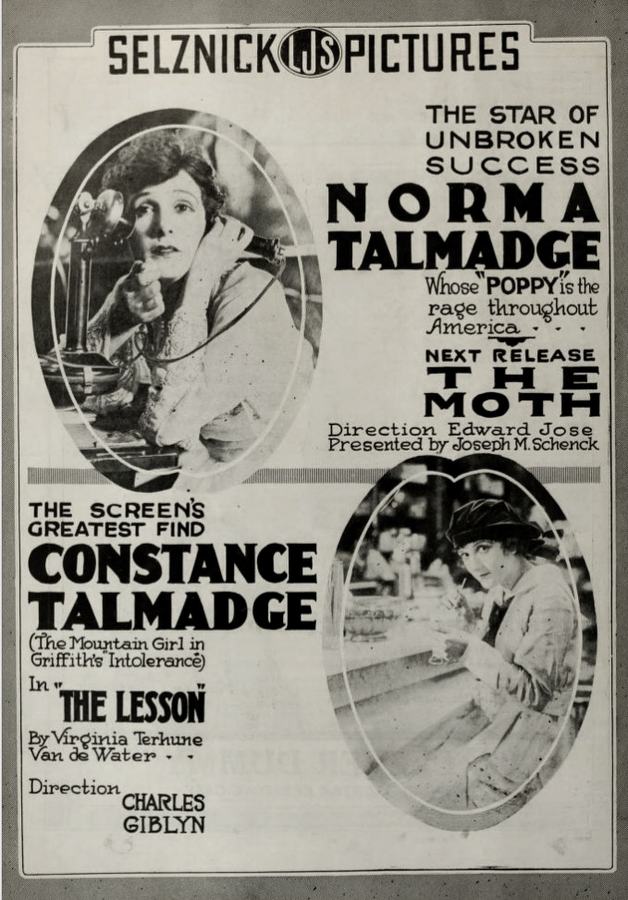
Critics of the era dismissed The Lesson as “back-pedaling domestic propaganda,” yet such readings flatten the picture’s ambivalence. Helen’s return is less capitulation than recalibration: she reclaims space on her own terms, eyes now tempered by knowledge of the world’s predatory gleam. The film’s true subversion lies in denying the city any transformative grace; New York is not a crucible but a corroder, its promise as flimsy as a paper skyscraper model.
Performances orbit around Talmadge’s supernova. Heyes sketches John with the shallow charm of a billboard—his smile never reaches the eyes—and the restraint makes the character’s egotism insidious rather than cartoonish. In support, Dorothy Green as Helen’s city roommate offers a brassy counter-melody, her flapper aphorisms (“Safety pins are for diapers, darling”) slicing through the melodrama. Even bit players—the landlady who counts spoons, the drunk who serenades alley cats—are etched with Dickensian economy.
Compared to contemporaneous morality plays like The Reward of Patience, which posits virtue as static, The Lesson argues that virtue is kinetic—earned by motion through the world’s grime. Its thematic sibling is The Children in the House, where innocence must navigate adult hypocrisy; yet while that film shelters its waifs inside institutional sanctity, The Lesson offers no sanctuary beyond the self’s hard-won perimeter.
Restoration-wise, the 2022 4K scan from a French Pathé nitrate reveals textures previously muddied: the glint of John’s silk tie, the frayed cuff on Chet’s coat, the pearlescent shimmer of Helen’s tear-track under single-tungsten light. The Mont Alto Motion Picture Orchestra’s commissioned score—part Copland prairie, part Bernard Herrmann tension—bridges the temporal chasm without anachronistic pandering. Criterion’s Blu-ray supplements include an audio essay on women’s urban migration in the 1920s and a superlative commentary by Shelley Stamp, who situates Talmadge within the constellation of comediennes-turned-dramatists navigating Hollywood’s gendered fault lines.
For modern viewers, The Lesson reverberates as a cautionary satellite about the lure of metropolitan mirages. Swap telegram for Instagram, steam-train for sublet, and Helen’s arc feels freshly pressed. Yet the film refuses facile “small-town good, big-city bad” dichotomies; its closing note is not relief but somber recognition that every paradise demands its pound of flesh, and sometimes the price is the illusion itself. We leave Helen not healed but seasoned, standing at a screen door whose mesh divides safety from the unknown, her gaze no longer hungry merely—now it is knowing, and therefore incandescent.
Verdict: a trenchant, luminously acted parable about the high cost of borrowed dreams, deserving reclamation alongside the era’s more celebrated social dramas. Seek it out, let its quiet devastations settle like silt, and emerge newly wary of any promise that glitters louder than home.
IMDb 4.4
1914
Community
Log in to comment.