DbcultAccessing Vault...
Cult Review
Senior Film Conservator
A one-reel bullet fired straight into Gilded-Age hypocrisy
The year is 1913; Griffith’s shadows still lengthen over nickelodeon curtains, yet out of Kalem’s Manhattan studio slinks a pulp firecracker that refuses to behave like polite melodrama. The Riddle of the Tin Soldier clocks in at a brisk fifteen minutes, yet it stuffs its lean frame with class warfare, proto-feminist detection, opium-tinged exoticism, and a toy soldier that becomes both talisman and evidence. Viewed today, the film feels like someone spliced Dickensian social outrage with Nick Carter dime-novel adrenaline, then ran the splice through a hand-cranked projector smelling of nitrate and fresh ink.
Ethel Andrews—played by Marguerite Courtot with the porcelain certainty of a girl who has never been told no—believes the poor are a lesson waiting to be taught. So she abducts her five-year-old brother, the moppet-faced Archie, and deposits him in a Lower-East-Side warren where wallpaper peels like sunburn and the air tastes of scorched onions. To cloak the stunt, she forges a ransom demand: ten thousand dollars or the boy vanishes. The joke curdles when real wolves—leather-clad gangsters who reek of basement gin—snatch both children, turning pedagogy into peril.
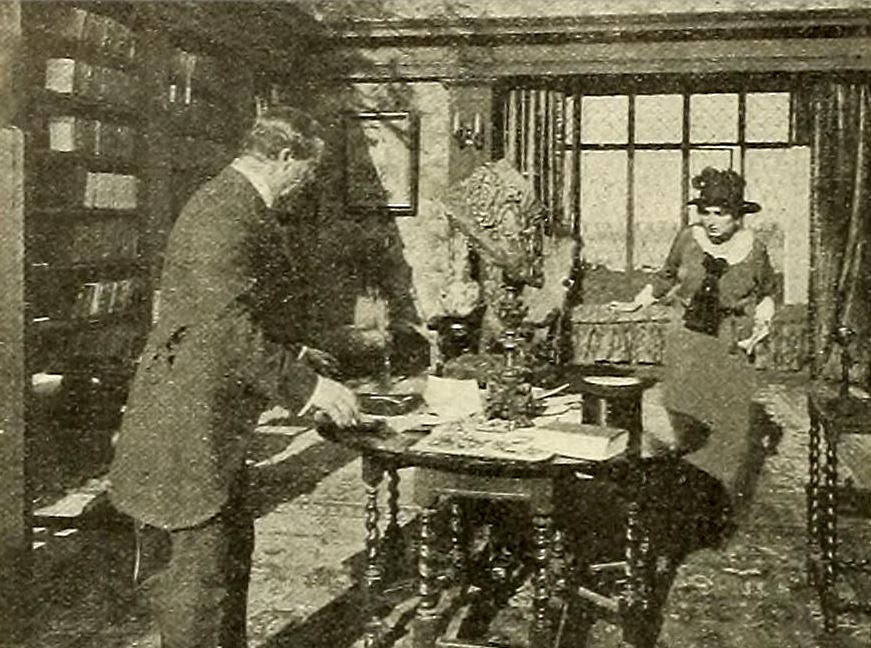
Enter Alice Joyce’s Madelyn Mack, billed in the trade sheets as “the girl detective,” trench coat cinched, eyes flickering with the calm arithmetic of someone who has already solved tomorrow’s crossword. Her methodology: read detritus like scripture. A shattered tin soldier—blue paint blistered, bayonet snapped—becomes her lodestar; the scent of Jasco berry cigarettes—an Oriental narcotic sold in apothecary shadows—her bloodhound trail. When a slingshot propels the gangsters’ second demand through the bay window of the Andrews library, splintering mahogany and upending every tidy hypothesis, Mack deciphers the watermark the way a sailor reads constellations.
What follows is a city symphony in miniature: tenement roofs crenellated like medieval fortresses; alleyways dripping laundry pennants; a suburban cottage where moonlight pools on parlor floorboards, illuminating children bound with theatrical rope. Mack hot-wires a telephone line by stripping her own hairpin, twisting copper around a pocket transmitter, and whispering coordinates to precinct switchboards. The cavalry arrives in a shutter-flash of gunpowder, smoke, and—because this is still 1913—a tableau of familial reconciliation so abrupt it feels like a curtain dropped by providence.
Director/scribe Hugh C. Weir, better known for serial cliffhangers, borrows the grammar of European tableau—deep interior spaces, chiaroscuro borrowed from Danish Det sorte Drøm—but cross-pollinates it with American velocity. Note the shot where Mack, tailing the berry-scented thug, is framed through a wagon wheel: spokes radiate like a spider web, the camera assuming the perspective of the fly. Or the moment when the ransom note, folded into a paper slug, hurtles through the library window in a single, undercranked take; the glass fracture blooms outward like a zinc-white chrysanthemum. These flourishes cost pennies yet resonate like cathedral glass.
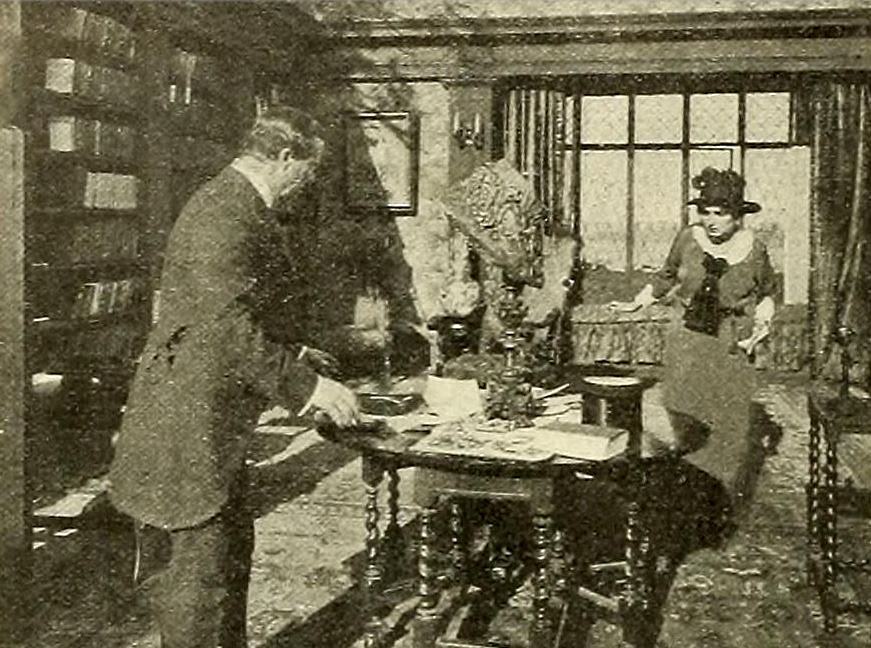
Color tinting amplifies the moral spectrum: amber for tenement squalor, viridian for Mack’s nocturnal escapades, a sudden blush of rose during the reunion—a chromatic sigh of relief. The surviving 16 mm print (Library of Congress, 2016 restoration) bears the scars of time—scratches that resemble lightning over nitrate—but the tinting remains defiantly legible, a bruised rainbow.
Historians often plant flags on What 80 Million Women Want (1913) or A Militant Suffragette as suffrage-era cinema, yet Tin Soldier sneaks past sentries with a stealthier manifesto. Madelyn Mack does not protest; she performs authority. She interrogates police officers, commandeers vehicles, negotiates ransoms, and—most subversively—returns the ten-thousand-dollar check to Ethel, redistributing patriarchal guilt into social philanthropy. The gesture lasts only a title card, but in 1913 it plays like an earthquake.
Compare her to the detectives populating rival one-reelers: square-jawed men who solve crimes by punching them. Mack’s weapon is pattern recognition, a proto-Bletchley reflex. She wins not through brute force but by decoding the semiotic residue of urban life—toy shards, cigarette ash, paper fiber. In that sense she is closer to Poe’s Dupin than to Nick Carter, gender notwithstanding.
Ethel’s pedagogical kidnap is monstrous yet comprehensible: the wealthy have long treated the poor as pedagogical exhibits. The tenement becomes a diorama, its inhabitants fauna. Weir undercuts this by letting the working-class gangsters expose the naïveté: they understand market value better than the heiress. Ten grand is not a moral lesson; it is liquidity. When they stuff Ethel into the same dank room as her brother, the film stages a cruel social inversion: the observer becomes exhibit, the exhibit observer.
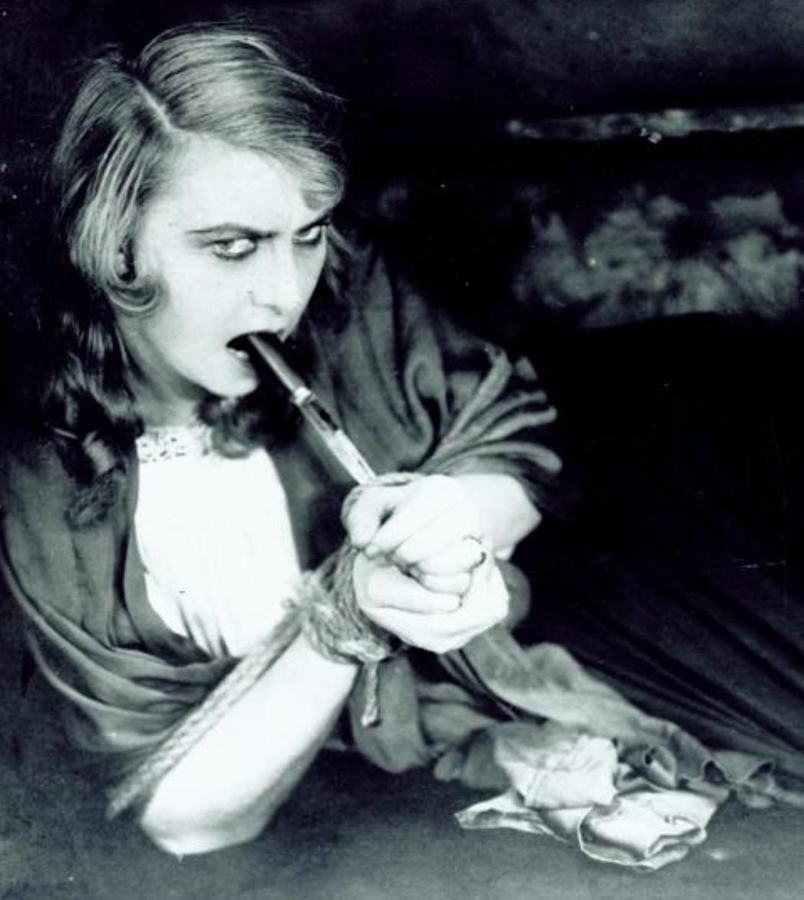
Surviving stills show Courtot’s face streaked with grime—an uncommon verisimilitude for 1913, when even fallen women retained salon curls. The grime is ideological; it literalizes the contamination anxiety that undergirds Progressive Era charity. Yet the film refuses to relish her humiliation. The close-up that captures her epiphany—eyes widening until they reflect the gas-jet like twin moons—invites empathy rather than schadenfreude.
Jasco berry, a fictional Orient import, functions as olfactory shorthand for perilous exoticism—a trope inherited from stage melodramas where Chinatown opium dens signposted moral contagion. Yet Weir complicates the cliché: the smoker who exhales this perfumed doom is not a Fu Manchu surrogate but a Bowery thug whose ethnicity remains unmarked. The scent becomes a class, not racial, identifier—poor men’s clove cigarette. Still, the film cannot escape the gravitational pull of yellow-peril iconography; the intertitle describes the drug as “Oriental,” a word that in 1913 carried the weight of empire. Modern viewers will wince, yet the artifact deserves contextual clemency: even Griffith’s Dante’s Inferno trafficked in oriental grotesque.
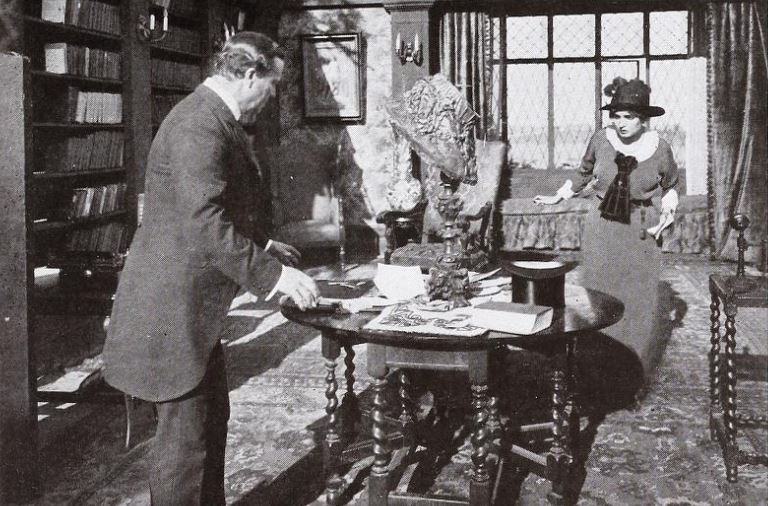
Alice Joyce operates in the microscopic register: the way her gloved thumb rubs the tin soldier’s fracture, the fractional pause before she pockets it—details legible only because the camera dares a medium-close shot rare for 1913. Opposite her, Henry Hallam’s Andrews is grand guignol: arms flung wide as if crucified by paternal anguish. The disparity creates a stylistic dialectic that keeps the film from tumbling into monotonous pantomime. Courtot oscillates between registers—hauteur in silk-lined drawing rooms, feral panic in captivity—suggesting that class poise is merely another performance, easily shredded under duress.
Most festival screenings slap a jaunty ragtime piano, but the film’s tonal whiplash—kidnapping, social critique, shoot-out—demands polyphony. In a 2019 MoMA retrospective, accompanist Ben Model deployed toy-piano tinkles for Archie’s motif, shifting to minor-key accordion during tenement sequences, climaxing with prepared-piano percussion (nuts, bolts, and yes, a tin soldier rattling inside the soundbox) for the siege. The effect uncorks the latent modernism: suddenly this curio feels coterminous with Stravinsky’s Rite of Spring, also premiered in 1913.
Place Tin Soldier beside Traffic in Souls (also 1913) and you witness antipodal approaches to urban crime: the latter wallows in prurient exposé, the former opts for proto-noir sleuthing. Stack it against European imports like Fantômas and the difference is tempo: Feuillade’s serial luxuriates in criminal chic, Weir’s reel hurries toward moral bookkeeping. Only What Happened to Mary shares its hybrid DNA: episodic cliffhanger grafted onto proto-feminist detection, though Mary lacks Mack’s sociological bite.
No negative survives; only a 16 mm reduction struck for the home-movie library circuit circa 1922. The rediscovery tale is itself detective lore: a Rochester estate sale, a rusted Pathé projector, a tin box mislabeled “Kidnap Drama.” The Library of Congress rescued the sole reel in 2014, scanning it at 2K, stabilizing the warping with digital treacle. Purists decry the tinting reconstruction—magenta substituted for lost orange—but without such forgery the film would exist only in paper synopses. Cine-archaeology, like Mack’s investigation, pieces truth from fragments.
Watch any post-1970 female detective—from The Silence of the Lambs’ Clarice to Killing Eve’s Villanelle—and you’ll spot Mack’s chromosomal echo: the insistence that intuition is forensic, that empathy can be weaponized. The tin soldier itself becomes a pop-culture sigil, resurfacing in comics, steampunk cosplay, even a 2018 indie-rock concept album. Each iteration testifies that artifacts, no less than detectives, can be followed by the scent they leave behind.
Is the film perfect? Hardly. Its class politics resolve too neatly; its Orient smoke veers into xenophobic shorthand; its runtime truncates emotional crescendos into cough-like bursts. Yet its imperfections radiate the crackle of invention—of a medium still surprised by its own voice. For fifteen minutes it makes the nickelodeon feel vast, the way a toy soldier can contain the memory of an entire war.
If you excavate only one pre-Griffith curio this year, let it be this riddle. Trace the fracture lines in the tin; sniff the ghost of Jasco berries; watch a woman rewrite the grammar of detection. The soldier may be missing his bayonet, but the film still draws blood.
IMDb —
1934
Community
Log in to comment.