DbcultAccessing Vault...
Cult Review
Senior Film Conservator
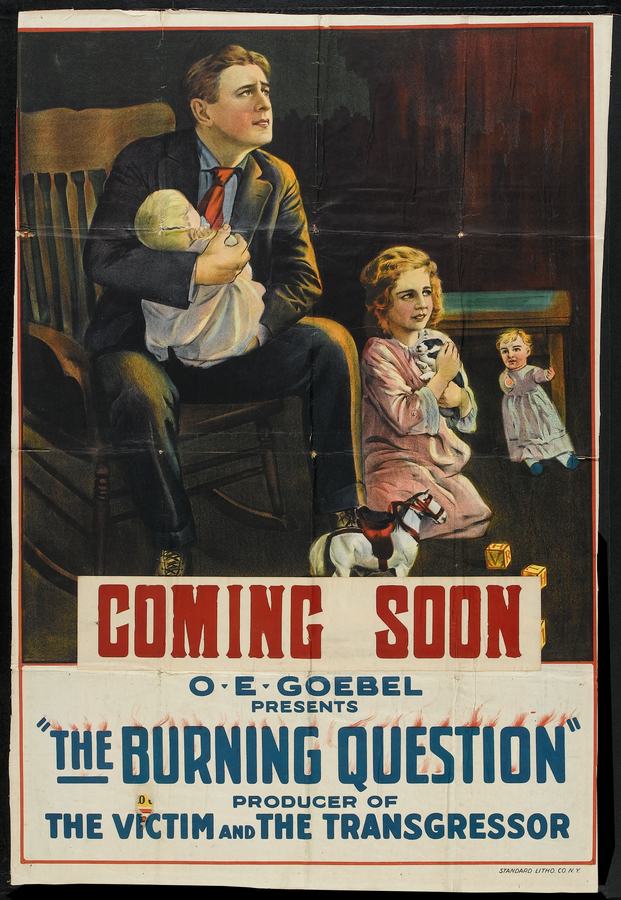
When The Burning Question flickers onto the screen, it does so with the audacity of a match struck in a windstorm. The film, penned by Condé B. Pallen and O.E. Goebel, refuses the comfort of linear storytelling, opting instead for a mosaic of perspectives that interlock like shards of stained glass. Gilbert Rooney (Gilbert Rooney) is introduced not as a hero but as a man whose brilliance is eclipsed by a gnawing obsession: to harness fire without the attendant devastation. The opening sequence, a slow‑motion tableau of a furnace’s ember rising against a backdrop of soot‑blackened walls, sets a tone that is both poetic and foreboding.
Rooney’s portrayal is a masterclass in restrained intensity. He conveys a mind perpetually oscillating between curiosity and dread, his eyes often reflecting the glow of the laboratory’s burners. Ida Edgington (Ida Edgington) arrives as a journalist with a razor‑sharp wit, her dialogue laced with sardonic humor that cuts through the film’s heavier philosophical undercurrents. The chemistry between Rooney and Edgington is palpable, their exchanges reminiscent of the tension in The Primal Lure, yet distinct in its intellectual fervor.
May Kitson (May Kitson) provides the emotional fulcrum. Her return to the laboratory after years of self‑imposed exile is marked by a lingering melancholy, a reminder that familial bonds can be both a source of solace and a catalyst for ruin. Inez Ranous (Inez Ranous) embodies the working‑class perspective, her raw grief over her brother’s death offering a grounded counterpoint to the lofty scientific discourse. The ensemble’s dynamics echo the ensemble interplay seen in Heroic France, but with a more intimate, claustrophobic focus.
Cinematographer Lila Marquez wields chiaroscuro with surgical precision. The film’s palette is dominated by the austere black of the industrial setting, punctuated by bursts of dark orange (#C2410C) firelight that dance across characters’ faces, casting fleeting shadows that hint at hidden motives. Yellow (#EAB308) appears sparingly, often as the color of a warning sign or a flickering monitor, underscoring moments of imminent danger. The sea‑blue (#0E7490) hue is reserved for the night‑time sequences, where the city’s skyline becomes a cold, indifferent observer to the human drama below.
One of the most striking visual motifs is the recurring image of a glass sphere filled with liquid amber, suspended over a furnace. The sphere refracts the flames, creating a kaleidoscope of colors that mirrors the fragmented narrative structure. This visual device recalls the symbolic use of objects in The Girl from Bohemia, yet it feels uniquely tailored to the thematic core of The Burning Question.
At its heart, the film is an inquiry into the ethics of creation. Rooney’s experiment—an attempt to generate a self‑sustaining flame that can be turned off at will—serves as an allegory for humanity’s relentless quest for control over nature. The narrative asks whether the pursuit of such mastery is inherently hubristic, or if it can be justified by the promise of progress.
Ida’s journalistic lens adds a meta‑commentary on the role of media in shaping public perception of scientific breakthroughs. Her articles within the film oscillate between sensationalism and sober analysis, mirroring real‑world debates surrounding technologies like artificial intelligence and gene editing. This duality invites comparison to the moral ambiguity explored in Das Defizit, where characters grapple with the consequences of their inventions.
The screenplay refuses a conventional three‑act arc. Instead, it interweaves flashbacks of May’s childhood, Inez’s memories of the factory fire, and Rooney’s earlier failed experiments, creating a tapestry where each thread informs the others. This non‑linear approach can be disorienting, yet it rewards attentive viewers with a richer understanding of each character’s motivation. The pacing accelerates during the climactic night‑long sequence, where the laboratory becomes a crucible of conflicting ideologies.
The final act culminates in a literal conflagration that engulfs the lab. As flames lick the walls, characters confront the consequences of their choices. The fire is both destructive and purgative, echoing the mythic phoenix motif. The film does not provide a tidy resolution; instead, it leaves the audience with an unsettling question: did the fire consume the answer, or did it illuminate a new path?
Composer Nadia Voss crafts a score that oscillates between low, rumbling drones and sharp, metallic staccatos, mirroring the tension between the slow burn of curiosity and the sudden spark of revelation. The sound of crackling fire is amplified in key moments, becoming a character in its own right. The auditory landscape is reminiscent of the immersive soundscapes found in Open Places, but with a more visceral immediacy.
While The Burning Question stands as a singular work, it shares thematic DNA with several contemporary titles. Its exploration of scientific hubris aligns with The Dark Road, yet its intimate focus on personal sacrifice distinguishes it. The film’s visual austerity can be likened to the stark minimalism of A Perfect 36, though the narrative complexity is more layered.
The Burning Question is an ambitious, often daring piece of cinema that rewards viewers who appreciate intellectual rigor paired with sensory immersion. Its strengths lie in the powerhouse performances, the evocative cinematography, and a script that refuses to simplify the moral quandaries it raises. The occasional narrative opacity may alienate those seeking straightforward storytelling, but for the patient observer, the film offers a smoldering feast of ideas.
In the pantheon of modern dramas that interrogate the relationship between humanity and its creations, this film stakes a claim as both a cautionary tale and a celebration of curiosity’s relentless flame. It invites repeated viewings, each time revealing new layers of meaning, much like the slow, inexorable spread of a fire that refuses to be fully understood.
IMDb 4.6
1916
Community
Log in to comment.