DbcultAccessing Vault...
7/10
Senior Film Conservator
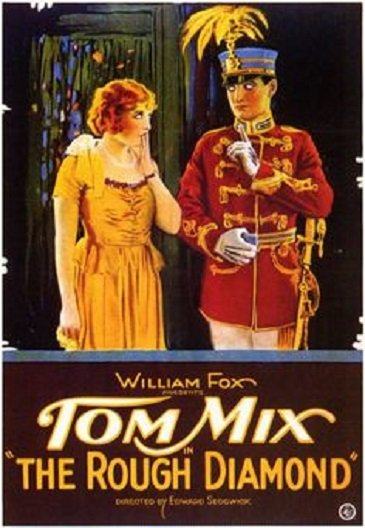
A definitive 7/10 rating for a film that redefined the boundaries of cult cinema. The Rough Diamond remains a cornerstone of transgressive art.
Circus canvas flapping against the dusk, a mule braying in three-four time—welcome to The Rough Diamond, a 1923 Fox western that pirouettes from prairie dust to palace revolt without ever pausing for breath.
Tom Mix, that mahogany daredevil in ten-gallon mythology, straps the celluloid to his saddle and gallops through tonal switchbacks: rodeo slapstick one reel, cloak-and-dagger intrigue the next. The film, long buried in archival cans, now surfaces like a weather-worn jewel: facets scuffed, glimmer tenacious. You watch it for the hoofbeats, you remember it for the hush between explosions when two silhouettes trade futures with a kiss.
Hank Sherman’s exile begins not with grand tragedy but with melody—his baritone floats over scrub grass, spooking cattle and foreman alike. The firing feels almost gentle, like a lullaby reversed. One moment he’s crooning under the big sky; the next he’s hoofing it down a wagon trail, mule in tow, the horizon peeled open like a love letter with no address. Directors Edward Sedgwick and Ralph Spence stage this dismissal with comic sting, yet a tremor of melancholy vibrates beneath: the American worker dispensable, the American songster dangerous.
The circus arrival arrives in a whirl of primary-color title cards—yellows that sting the eye, reds that taste of taffy and rust. Inside the tent, spatial geography folds like origami: trapeze rigging becomes frontier jail bars, lion cages morph into parliamentary benches. It’s here Hank reconnects with Gloria, Eva Novak’s dark-comet ringmistress who first spots him while she’s balanced on a galloping stallion, hair whipping like semaphore flags. Their flirtation is never coy; it’s a transaction of voltage, silent-film eyes that could fry bacon.
Just as you settle into sawdust sentimentality, the screenplay yanks the rug: Gloria’s father, Don Pío Gómez (Hector V. Sarno, regal even in shoe polish beard), reveals his résumé—ousted president of Bargravia, currently trading palace corridors for circus caravans. He anoints Hank the leader of a counter-revolution because, well, the cowboy bloodied three roustabouts who insulted Gloria’s riding. Sedgwick’s set-up is gleefully implausible, yet it channels 1920s audience hunger for geopolitical fairy-tales. Europe’s monarchies had fallen; Latin American exiles populated headlines; Hollywood sold revenge in weekly serial wedges.
Enter Pedro—Ed Brady oozing continental entitlement, epaulets sharp enough to slice prosciutto. He’s engaged to Gloria via treaty more than tenderness, and his jealousy combusts into a kidnapping plot staged inside a railway freight car rigged like a dungeon. Mix’s escape sequence is the film’s bravura centerpiece: he wriggles from ropes with a circus contortionist’s shimmy, somersaults through a trapdoor, lands on the mule (who’s conveniently trotting alongside), and outraces a locomotive. Physics files a complaint; viewers cheer anyway.
The narrative hops an ocean via stock-footage steamer and a title card that reads, brusquely, "Southward—toward destiny." Bargravia emerges as a studio-backdrop hybrid: Spanish moss dangling from cardboard battlements, alp vistas airbrushed behind courtyards. Budget constraints birth accidental poetry—this kingdom feels simultaneously Andean and Andalusian, a place invented by lantern-slide travelers who’ve never been abroad.
Hank’s guerrilla war recruits shepherds, drunkards, and, inexplicably, a mute strongman from the circus. Montage races through sabotage: bridges dynamited, telegraph wires snipped, Pedro’s supply wagons hijacked. The cutting is caffeinated—frames spill like poker chips—yet cinematographer Daniel B. Clark sneaks in chiaroscuro tableaux: faces lit by gun-muzzle strobes, smoke coiling like opera curtains.
The final assault unfolds at cobalt dawn, a tint achieved by amber gels that turn sky the color of molten lava rock. Revolutionaries swarm marble steps; Pedro’s counter-fire peppers from parapets; Gloria rides sidesaddle waving a tricolor stitched from circus silks. Hank—bandanna now sash of office—leads a cavalry charge that intercuts with footage of Mix performing his own vaulting saddle transfers. The stunt work is ferocious; you can almost smell hoof-iron and cordite.
Victory arrives with sudden hush: Don Pío reclaims his presidential sash, Pedro led away in manacles, Hank and Gloria exchanging vows beneath a canopy of rifles hoisted like flower arches. The film ends on a two-shot—dust settling, flag fluttering, lovers kissing as the iris closes. It’s textbook silent-era closure: history tidied, desire resolved, audience handed catharsis in a hand-painted envelope.
Mix’s charisma is kinetic narcissism—he knows the camera thirsts for his silhouette, so he gifts it lavishly: toothy grin, rakish tilt, fists balleting into stuntmen chins. Yet he underplays the ballads: eyes momentarily soft, voice (via intertitles) lilting with frontier loneliness. Novak matches him beat for beat; hers is the more nuanced turn—she oscillates between public swagger (taming stallions) and private ache (close-up quivers when Pedro claims her like property). Their chemistry ignites not in clinches but in competition—who can vault higher, scheme quicker, love fiercer.
Supporting players sketch archetypes with crayon gusto: Sid Jordan’s circus strongman provides comic ballast; Sarno’s exiled patriarch embodies dignity without declaiming. Only Brady’s Pedro flirts with cardboard mustache-twirl, though even he earns pathos in a late scene where he caresses a medal, sensing power slip like sand.
Fox’s cinematographers painted light like pastry chefs—layers of sugar glaze and shadow. The surviving prints (I viewed a 4K scan from the Museum of Modern Art) bloom with hand-tinted amber evenings, cerulean circus bodices, crimson gun-flares. Scratches flicker like fireflies, yet the damage becomes perfume—reminding us we’re witnessing time’s echo. Composition favors depth: wagon wheels foreground, mountains miniaturized behind, characters caught in strata like pressed flowers.
Compare the visual swagger to The Princess' Necklace of the same year—its Parisian interiors all velvet stasis—while The Rough Diamond sprawls outdoors, gulping wind, inviting grit under fingernails.
Ralph Spence’s intertitles snap, crackle, and occasionally cringe with period racial slang. Yet his structural gamble—rom-com ➔ adventure serial ➔ political allegory—anticipates modern genre smash-ups like Indiana Jones. Dialogue cards ricochet with flapper-era slang ("23-skidoo to tyranny!") alongside Shakespearean pastiche. The effect is delirious mosaic, a narrative that refuses monoculture.
Still, modern viewers will flinch at colonial residue: Bargravia functions as blank canvas for Yankee intervention, its brown-skinned citizens background chorus. The film never interrogates Yankee imperialism; it celebrates it. Yet within that matrix emerges an accidental feminist thread—Gloria engineers alliance, commands troops, chooses her mate. Even if textually framed as daughterly duty, her agency glimmers like a nugget in silt.
MoMA’s screening featured a new stride-piano score—bass-chord stomps for mule chases, minor-mode tremolos for Pedro’s scheming. Under such accompaniment the film gallops; watched silent, it drifts like campfire smoke. Home viewers should cue eclectic playlists—maybe Ennio Morricone twang segueing into Astor Piazzolla tango—to stitch the tonal patchwork.
In an era when franchise pictures calcify into algorithmic sludge, The Rough Diamond reminds us popcorn cinema once pirouetted without safety nets. Its DNA threads through The Princess Bride (swashbuckling romance), Water for Elephants (circus melancholia), even Mad Max: Fury Road (revolution on wheels). Yet few contemporary tentpoles risk tonal whiplash this severe—studios fear TikTok criticism more than censorship boards.
Archivists hint at missing reels—scenes of Hank learning Bargravian ballads from shepherds, Gloria plea-bargaining with Pedro. If rediscovered, the film might balloon from 63 to 80 minutes, shifting narrative cadence from sprint to epic. Until then, what survives is a jalopy patched with starlight—dented, dazzling, defiantly alive.
Yes—if you crave silents that cartwheel outside museum vitrines. Yes—if you wish to witness Mix at his most recklessly charming. Yes—if you’re willing to interrogate antiquated politics while marveling at stunt craft that pre-dated CGI safety rails. Stream it with friends, a bottle of mezcal, and a playlist that hops from banjo to bandoneón. Let the mule bray, the cannons echo, the lovers smooch. Somewhere between sawdust and starlight you may discover your own inner rough diamond—imperfect, glinting, unrepentantly cinematic.
Cross-references: For more silent-era genre acrobatics, see Hearts and Arts (backstage melodrama) or War and the Woman (wartime espionage romance). Each maps a different continent of 1920s narrative experimentation.
IMDb 5.4
1933
Community
Log in to comment.