DbcultAccessing Vault...
Cult Review
Senior Film Conservator
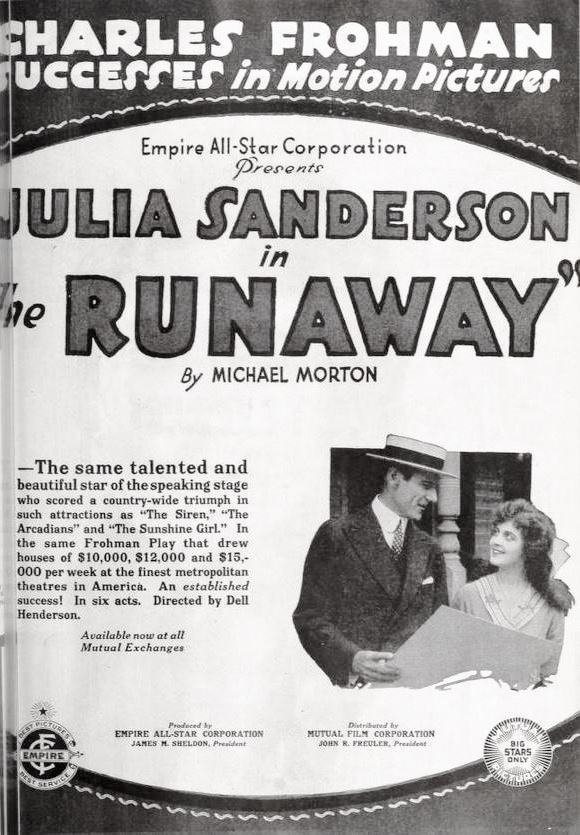
Joseph F. Poland and Michael Morton’s scenario lands like a hand-pressed lithograph: subtle tonal gradations, risky negative space, and a heroine who refuses to stay inside the margins. The Runaway is less a melodrama than a palimpsest—every emotional layer scraped and repainted until the canvas itself seems to breathe.
Alice’s opening chapters unfold in a town the color of dried tobacco. Cinematographer William H. St. James shoots the flatland as if it were a medieval illumination: every stalk of wheat haloed, every shadow edged in umber. Aunt Jane’s parlour—overstuffed with horsehair and prohibition—feels like the inside of a coffin lined with prayer books. When Richard arrives, the mise-en-scène pivots; suddenly windows frame him like votive niches. His first gift to Alice is not a kiss but a discarded charcoal study: the curve of her neck lifted from life and immortalised in soft graphite. It is the first theft of her image, the first promise that she too might escape the pigment of provincialism.
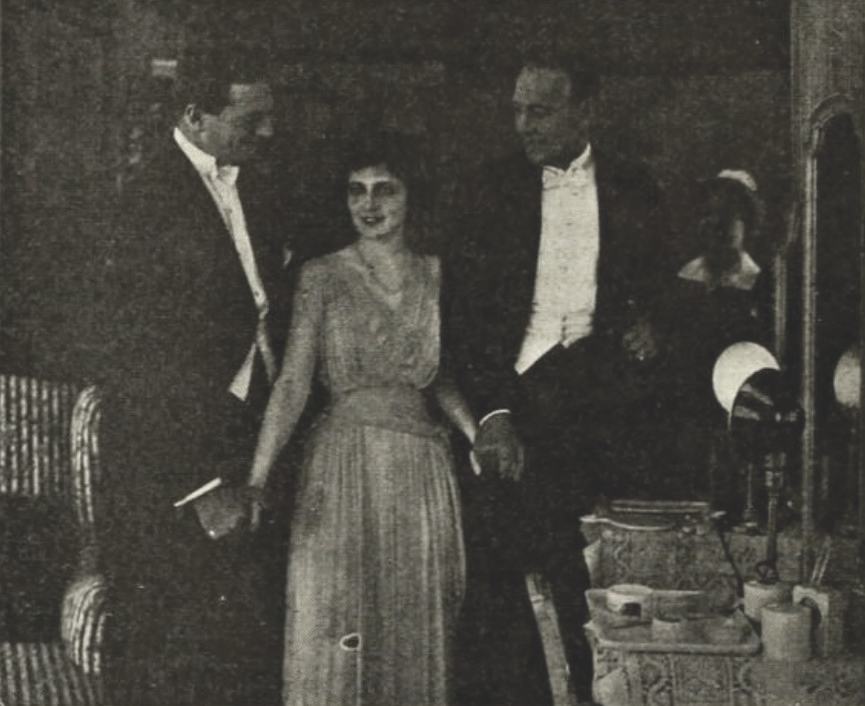
Cut to Manhattan: a skyline stitched together by El trains and electric hoardings. The film stock itself seems to vibrate—James C. Malaidy’s editing rhythm imitates the stutter of a taxi engine. Richard’s garret, crammed with half-finished canvases and the ghost of turpentine, becomes both sanctuary and battleground. Enter Nancy Arnold—Julia Sanderson plays her like a cat who has read both Sappho and the stock market pages: all languid stretch until the claws flash. In one riveting two-shot, Nancy’s silhouette leans over Alice’s shoulder as both women stare at Richard’s newest commission; their profiles overlap, forming a chiaroscuro heart that is about to fracture.
What makes The Runaway fascinating is how it weaponises the very act of looking. Richard paints Nancy to pay the rent, yet every brushstroke on her shoulder is a small betrayal. Conversely, Alice’s eventual stardom reverses the gaze: thousands stare at her image on 24-sheet posters outside the Lyceum. The film quietly asks: who owns the female face—the one who paints it, the one who wears it, or the crowd that consumes it? Compare this tension to The Frame-Up, where male guilt is literally framed, or The Gilded Spider, where a woman’s body becomes a trap rather than a portal. Here, Alice’s body is both luggage and locomotive.
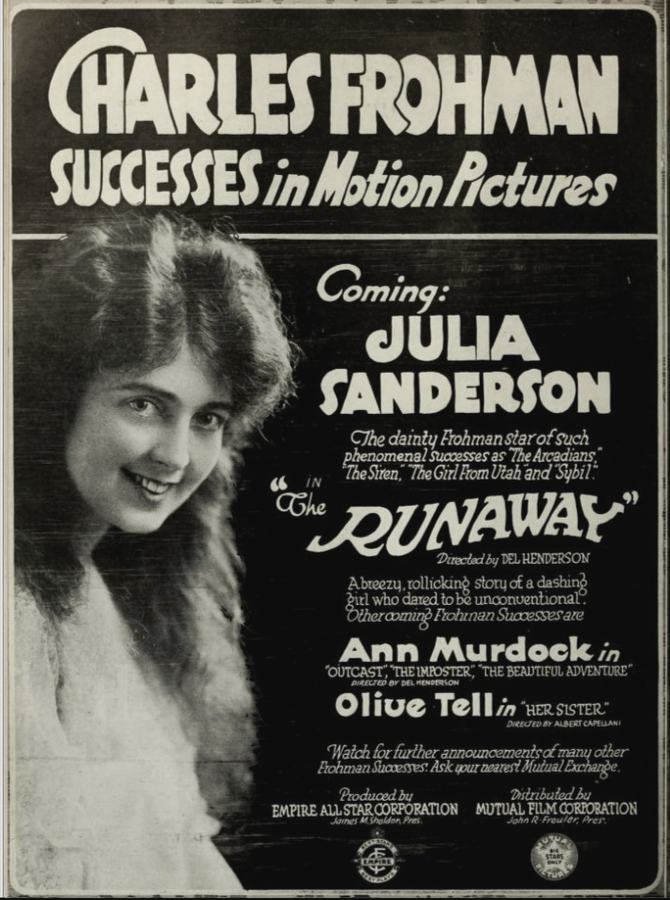
Ada St. Claire does not act; she registers. Watch the moment Alice, rifling through Richard’s stack of studies, discovers a nude of Nancy. The camera lingers in close-up: a swallow travels down St. Claire’s throat, her pupils contract a millimetre, the corner of her mouth twitches as though a puppet string were severed. No intertitle could sharpen the stab. Critics often praise The Manxman’s Anita Stewart for stoic eyes, but St. Claire gives us stoicism’s aftermath—when the mask dissolves yet the shards refuse to fall.
Edward Fielding’s Richard is not your standard bohemian rake. Early on, he sketches Alice while humming a Schubert lied; later he stands in the aisle of a darkened theatre, watching her transform into Magdalena the Fair, and the humming dies. Fielding lets his shoulders sag a fraction, signalling that the artist has at last been rendered—his own composition dwarfed by the living artwork he casually sponsored. The film refuses to punish him with grand tragedy; instead it gifts him the humbler penance of gratitude. In 1926, that restraint feels almost radical.
Alice’s flight into theatre is no mere plot pivot; it is ontological resurrection. She enters the chorus of a revue titled Electric Eve, where sequins mimic constellations and dancers form shifting geometries. Director Stanhope Wheatcroft borrows Soviet-style montage—legs, trumpets, grinning masks—yet overlays it with lace-veiled eroticism. One breathtaking superimposition merges Alice’s audition with a memory of her mother’s touring trunk: the past literally travels through her body as she high-kicks into anonymity that will, paradoxically, secure her identity. Compare to A Night Out, where escapism stays frivolous; here it is holy.
Even after Alice has conquered Broadway, the prairie reasserts itself. Letters from Aunt Jane—read in voice-over that utilises the crackle of a stylus on shellac—warn of “the wages of painted cheeks.” Cinematically, these missives arrive during orchestral crescendos, as though the aunt’s moralism were a counter-melody to saxophones. The editing never lets us forget that every spotlight also casts a shadow, and sometimes the shadow has a Puritan collar.
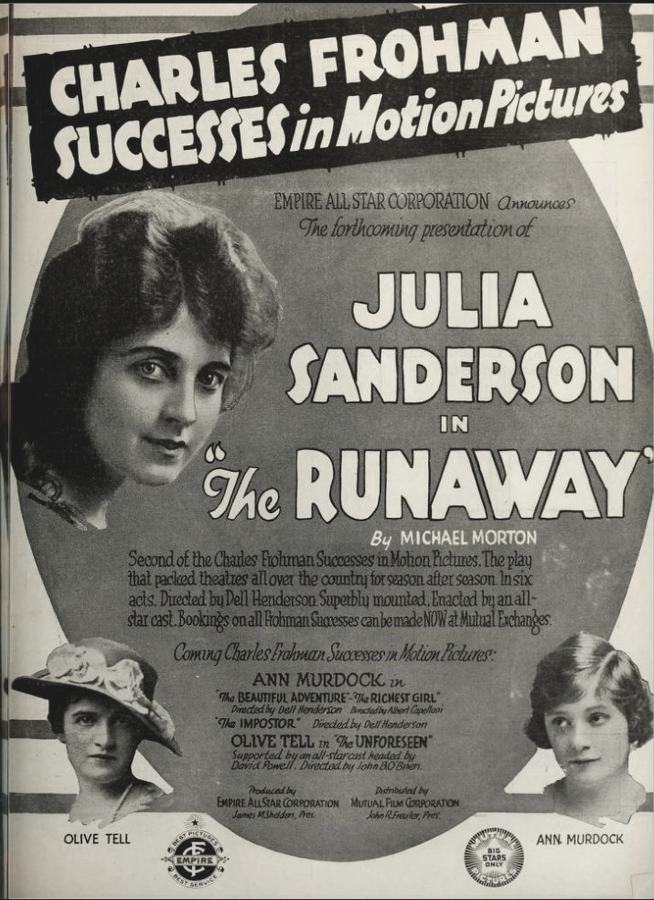
Richard’s eventual pursuit of Alice is shot almost like a noir: rain-slick streets, a theatre alley rank with cigar smoke, a stage door that swings like a guillotine. When he finally corners her—not with demands but with a sketchbook full of empty pages waiting for her return—the scene inverts the myth of Orpheus: the woman is asked to stop looking back. St. Claire’s silent reply—a nod so faint it could be a tremor—carries more weight than pages of dialogue. She chooses marriage, yes, but the film frames it as collaboration, not capitulation. The curtain falls on the couple exiting through a fire escape into a sunrise the colour of wet plaster, suggesting art itself will continue offstage.
Though monochrome, the film communicates chromatic ideas through texture. Alice’s calico dress sports a tiny sprig pattern that reads as beige handcuffs; in New York she dons a robe of lamé scales, turning into a fish that has swapped ocean for limelight. Richard’s neckties migrate from paint-spattered linen to sober silk—evidence of his slow domestication. Even the aunt’s cameo brooch reappears on Sarah’s dress, hinting that guardianship, like guilt, can swap throats.
Where The Outcast treats female ambition as social threat and Sowers and Reapers punishes it with biblical wrath, The Runaway sanctions self-invention yet interrogates its cost. Its nearest spiritual cousin might be Das Tal des Traumes, where dreamscape and duty collide, but that German offering lacks the American belief in reboot. Conversely, Husband and Wife domesticates conflict into drawing-room hush; our film drags the same conflict through greasepaint and gin before letting it exhale.
Julia Sanderson’s Nancy glides through her role like a panther who knows the cage is imaginary; her sneer when Richard rejects her could frost glass. Dore Flowden as Sarah embodies a warmer foil—eyes always glistening as though she’s just finished crying or is just about to start, we can’t tell which. Among the second tier, Jennie Ellison supplies comic relief as a chorine who measures success in free lunches, never overstaying her welcome.
Poland and Morton’s structure obeys sonata form: exposition in the prairie (andante), development in Manhattan (allegro), recapitulation in the theatre (adagio with brass). Intertitles favour the poetic—“Love arrived on a day without postmarks”—yet avoid the purple haze that sinks lesser silents. A single card reading “She learned applause is a currency that buys nothing at daybreak” distills the film’s ethos into a line many talkies would kill for.
Original exhibition reportedly featured a score blending Debussy arabesques with banjo folk, capturing the heroine’s cultural whiplash. Modern restorations substitute a minimalist quartet: cello heartbeat, piano ripple, gong for subways, brushed snare for backstage bustle. The result feels like eavesdropping on memories rather than witnessing events.
Contemporary viewers might bristle at Alice’s final relinquishment of the stage, yet 1926 context matters. Lead roles for women were scarce, pay inequity rampant, and the Hays Office loomed like a guillotine. By letting Alice exit on her own terms—after proving she can fill a theatre—The Runaway slips a quietly feminist note inside a seemingly conservative envelope. It anticipates the compromise still faced by artists who happen to be women: visibility versus viability, autonomy versus affection.
For decades the film slumbered in an archive mislabelled “A Runaway Girl”. A 2018 nitrate restoration by the Library of Congress—funded under the Women in Silent Cinema initiative—returned its missing French-titled inserts and original tinting. Kino Lorber’s Blu-ray offers two scores plus an essay by Shelley Stamp; however, the edition frequently goes out of print, so snatch it when you can. Streamers occasionally rotate a 720p transfer riddled with ghosting; avoid that like Aunt Jane’s prune pie.
Great films seduce you into re-evaluating your own escapes: which train did you miss, which door did you slam, which applause still rings in your skull at 3 a.m.? The Runaway endures because it refuses to mock whichever choice you made. It simply asks that you keep sketching, keep dreaming, and—if the spotlight feels too hot—remember that fire escapes lead to dawns, not defeats.
Verdict: a ravishing, morally knotty triumph—equal parts prairie psalm and neon nocturne. 9.2/10
IMDb —
1919
Community
Log in to comment.