DbcultAccessing Vault...
Cult Review
Senior Film Conservator
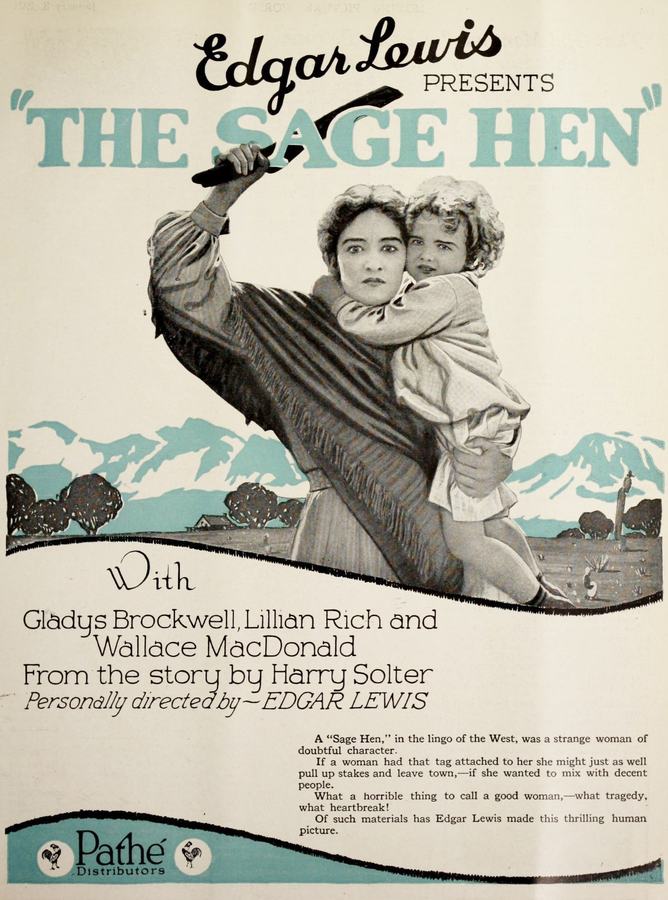
The sagebrush winds of Arizona whisper with the ghosts of judgment and regret in Harry Solter’s The Sage Hen, a 1910 Western that carves its narrative into the bedrock of early cinema’s emotional landscape. This film, though steeped in the conventions of its era, transcends them through the raw vulnerability of its protagonist, Jane Croft, portrayed with luminous pathos by Gladys Brockwell. The flickering celluloid captures not just the grandeur of the frontier but the suffocating weight of societal censure, rendered in stark black-and-white contrasts that mirror the moral binaries of its characters.
Set in Silver Creek, 1880, the film opens with a chilling tableau: Jane, her face shadowed by the sunhat she wears as both protection and penance, is hounded by the Home Purity League—a name that drips with irony. The League’s virulent gossip, which brands her as a fallen woman, is less a reflection of her actions than a projection of their own fears. This setup echoes the themes of The Brass Bullet, where societal norms weaponize morality, but Solter’s direction here is more intimate, focusing on the personal toll of ostracization. Jane’s exile is not merely physical; it’s a spiritual dismemberment, as she is forced to flee with her infant son, John, the child who becomes both her anchor and her curse.
The film’s most harrowing sequence occurs when Jane, in a moment of desperation, sends John galloping into town on a horse, a decision that severs their bond for two decades. This act of maternal sacrifice is rendered with aching simplicity: her fingers linger on the reins, her voice a tremble of love and resolve. John’s adoption by the Rudds—a family as transient as the winds of the prairie—sets the stage for his return as a cavalry lieutenant, a figure of authority who now stands at the crossroads of duty and desire. The narrative’s tension peaks when he re-enters Jane’s life, now entangled with the schemes of Craney, a gambler whose threats exploit the town’s lingering prejudices. The parallel between Craney and the villains of The Wife He Bought is striking, yet here the antagonist’s cruelty feels more insidious, a slow erosion of trust rather than brute force.
What elevates The Sage Hen beyond its melodramatic framework is its nuanced exploration of motherhood. Jane’s role as both housekeeper and "mother" to Stella Sanson—a duality that mirrors the complex dynamics in Sherry—is a masterstroke of emotional layering. Her nurturing of Stella becomes a balm for her own wounds, yet it also binds her to a life of quiet servitude. The film’s climax, where Jane confesses her past to John, is a tour de force of silent cinema: without a single line of dialogue, Brockwell’s eyes betray a lifetime of sorrow, her trembling hands a testament to the weight of secrets. This scene is reminiscent of the climactic revelations in The Girl in the Taxi, but here the emotional stakes are heightened by the generational divide between Jane and her son.
Visually, Solter employs the vast Arizona landscapes not as a backdrop but as a character in its own right. The golden hues of the desert, captured in the film’s surviving reels, evoke both the promise of the frontier and its capacity for desolation. The recurring motif of the sage hen—a symbol of resilience in a harsh environment—seeps into the film’s subconscious, a silent companion to Jane’s journey. The cinematography, though rudimentary by modern standards, is purposeful; long takes emphasize the isolation of the characters, while close-ups dissect their inner turmoil with surgical precision. The use of natural light, particularly in scenes of Jane’s labor on the ranch, underscores her connection to the land and its unforgiving beauty.
The performances are uniformly compelling, with Brockwell anchoring the film with a performance that transcends the era’s often-exaggerated acting styles. Her portrayal of Jane is a masterclass in subtlety: a glance, a pause, the way her fingers clutch a threadbare shawl—all these details build a woman who has learned to hide her pain but whose cracks are visible to those who dare to look. John’s return, embodied by Alfred Allen with a blend of stoic resolve and simmering vulnerability, creates a dynamic that is both tender and charged with unresolved tension. The chemistry between Allen and Lillian Rich, who plays Stella, is understated yet electrifying, their love story unfolding with the quiet inevitability of desert flora blooming after a storm.
Thematically, the film grapples with the paradox of redemption in a society built on judgment. Jane’s ultimate happiness, hard-won after years of sorrow, is not a triumph but a fragile truce. The film’s resolution—where John protects his mother and Stella from Craney’s machinations—feels less like a victory and more like a necessary reckoning. This ambiguity is what makes The Sage Hen resonate beyond its historical context; it is a story about the cost of survival in a world that demands conformity, a theme as relevant today as it was a century ago. The parallels to A Man’s Law, which explores similar frontiers of justice and identity, are evident, but Solter’s film is more inward-looking, its focus on the personal rather than the political.
In the pantheon of early Westerns, The Sage Hen occupies a unique space. It is neither the swashbuckling adventure of Prairie Trails nor the pure romanticism of Wild Primrose. Instead, it is a gritty, introspective tale that uses the Western genre’s archetypes to dissect the human condition. The film’s pacing, though deliberate, allows for a meditation on time and memory, particularly in the extended sequence where Jane and Stella tend to the Sanson household—a domesticity that contrasts sharply with the larger-than-life myths of the frontier.
One cannot discuss The Sage Hen without acknowledging its place in the broader context of women’s roles in early cinema. Jane Croft is a far cry from the damsel in distress; she is a woman who rebuilds herself in the shadows of a society that has declared her unworthy. Her resilience is both a personal triumph and a quiet rebellion, a narrative thread that anticipates the feminist undertones of later films like The Missing Links. While the film’s structure is linear, its emotional depth and character complexity suggest a proto-feminist consciousness, one that challenges the viewer to see beyond the surface of a woman’s so-called "fallen" state.
The film’s final act, where Jane’s confession to John shatters the last barrier between them, is a masterclass in silent storytelling. Solter frames the scene in a dimly lit room, the shadows playing across Brockwell’s face as she recounts her past. The absence of sound here is not a limitation but a strength; the weight of her words is carried by her expressions, the flicker of fear in her eyes, the tremor of her lips. John’s reaction, a mix of anger and understanding, is captured in a single close-up that lingers just long enough to let the audience feel the tension. This moment, though pivotal, is never sentimental—it is grounded in the realism of a mother-son relationship fractured by time and lies.
In conclusion, The Sage Hen is a film that rewards patience and attention. Its strengths lie in its emotional authenticity, its nuanced portrayal of female agency, and its unflinching look at the consequences of societal judgment. While some may find its pacing slow or its moralizing heavy-handed, these very elements contribute to its quiet power. It is a film that lingers in the mind like the taste of dust and determination, a testament to the enduring spirit of its central character. For those seeking a Western that is as much about the interior landscapes of its characters as the external ones, this film is an essential watch. In an age where the frontier myth is often romanticized, The Sage Hen reminds us that the true frontier is within, where the battle for identity and dignity is fought in silence.
IMDb 7.1
1936
Community
Log in to comment.