DbcultAccessing Vault...
Cult Review
Senior Film Conservator
A laboratory, a letterbox, and a suitcase walk into a silent picture…
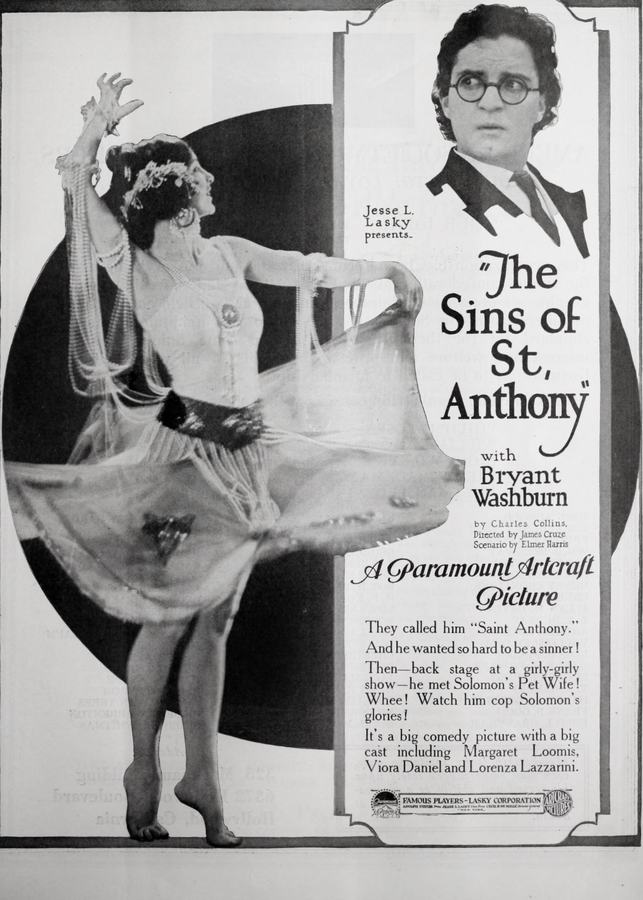
The Sins of St. Anthony is not a sermon—though its title genuflects toward hagiography—but a cracked mirror held up to post-WWI courtship, where courtship itself is a shell game. Director Charles Collins and scenarist Elmer Harris stitch a patchwork of masquerade, masochism, and modernist rhythm onto a canvas barely 65 minutes wide. The result feels like a Joseph Cornell box left too close to a Victrola: fragile, glittering, and humming with tunes you can almost, but never quite, hear.
Anthony’s arc is less a straight line than a Möbius strip of self-erasure. Every chemical equation he masters is matched by a social variable he fails to solve. Once Persis—May Baxter, eyes wide as gramophone horns—pronounces him deficient in “pep,” the word metastasizes into a verdict on his entire generation of dutiful, ration-book bachelors. Enter Jeanette Adair, played by Margaret Loomis with the languid ferocity of a struck match. Her dance studio is a sanctum of kinetic confession: palms slapping bongos, torsos flickering like newsreel nitrate. Anthony’s transformation from reticent savant to jazz libertine unfolds through a montage of dissolves—each cut shaving off another gram of his prior self until what remains is a glittering negative space.
Lorenzo Pascal’s stolen valise functions like the MacGuffin’s smarter cousin: it carries not secrets but the idea of secrets. Inside are military medals untouched by battle, love letters cribbed from anthologies of pulp poetry, and a snapshot of the “real” hero whose visage we never see. When Lorenzo—Bryant Washburn, all pencil-thin mustache and crocodile grin—struts into Persis’s parlor, the film becomes a sly meditation on authorship: who gets to write the biography of a man absent from his own myth? The ruse collapses not through investigative cunning but through Persis’s own moment of cognitive dissonance; she smells the gambler’s hair tonic beneath the imagined gunpowder.
Jeanette’s choreography is less instruction than vivisection. In one bravura sequence, Anthony’s reflection is triple-exposed: the timid chemist, the shimmying neophyte, and a silhouetted specter wearing a gas mask—an echo of the trenches that forged the absent hero. The film never states the war’s name, yet its residue clings like chemical ash. Every saxophone bleat is a shrapnel shard; every Charleston kick, a defibrillation.
Guy Oliver’s Anthony is a masterwork of micro-gesture: the way his thumb rubs the beaker’s rim for courage, how his pupils dilate 2 millimeters when Jeanette’s garter snaps. Compare that to May Baxter’s Persis—her face registers emotion like a semaphore, all broad strokes and windmill arms. The tonal mismatch is jarring, yet it serves the narrative: Persis herself is performing a role, the war-stamp sweetheart, and when the performance is no longer needed she deflates like a torn paper doll.
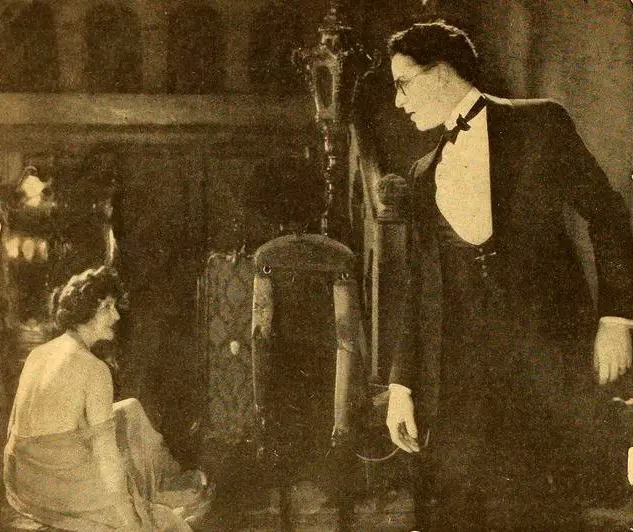
Loomis, meanwhile, owns every frame she poaches. She slinks through the frosted sets with the unapologetic ownership of Louise Brooks’s darker sister. Watch her stub a cigarette on a champagne flute—nonchalant, sacrilegious, perfect.
Cinematographer L.J. McCarthy paints chiaroscuro with a feverish palette: sodium-yellow flares during the jazz orgies, cyanotic blues in Anthony’s lab, and a recurring motif of arterial red whenever the suitcase appears. The film’s most haunting tableau is an insert shot of a metronome superimposed over a human heart—an image that predates Man Ray’s later experiments by half a decade.
Though silent, the picture is scored for exhibition by a cue sheet heavy on Gershwin pastiche and wailing clarinets. Contemporary reviewers complained the prescribed tempo made dialogue cards “feel like captions on a runaway train.” Kino’s 2022 restoration opts for a minimalist piano motif punctuated by typewriter clicks—an inspired choice that reframes the love triangle as newsroom copy filed too late for the morning edition.
Like Paradise Lost, this film obsesses over the moment innocence is traded for experiential currency. Unlike The Brat, its female lead is both catalyst and casualty, never granted the directorial sympathy that would recast her as proto-feminist. And while Lawless Love revels in outlaw chic, Anthony’s “crimes” are existential: he dares to change, to outgrow a label affixed by a woman who herself is fleeing into fantasy.
For decades the picture slumbered in the Cinematheque’s “missing, presumed decomposed” ledger until a 35mm nitrate print surfaced in a Slovenian monastery—yes, really—nestled beside reels of Die liebe der Bajadere. The 4K scan reveals blistering detail: every bead of Jeanette’s sweat, every fingerprint on Anthony’s reagent bottles. Streaming on Classix and Kanopy (library card required). A Blu-ray from Deaf Crocodile drops this October with commentary by film historian Dr. Mara C. Sheffield.
The Sins of St. Anthony leaves you with the aftertaste of celebratory wine laced with quinine: effervescent, medicinal, unsettling. It is both artifact and omen—an early crack in the edifice of stable identity, presaging the masquerade balls of social media avatars a century later. Watch it for the jazz bacchanalia, revisit it for the moment Anthony’s trembling hand closes Jeanette’s cigarette case and realizes the cost of borrowed fire. In that flicker, the film achieves what every great silent strives for: a hush louder than words.
IMDb —
1921
Community
Log in to comment.