DbcultAccessing Vault...
Cult Review
Senior Film Conservator
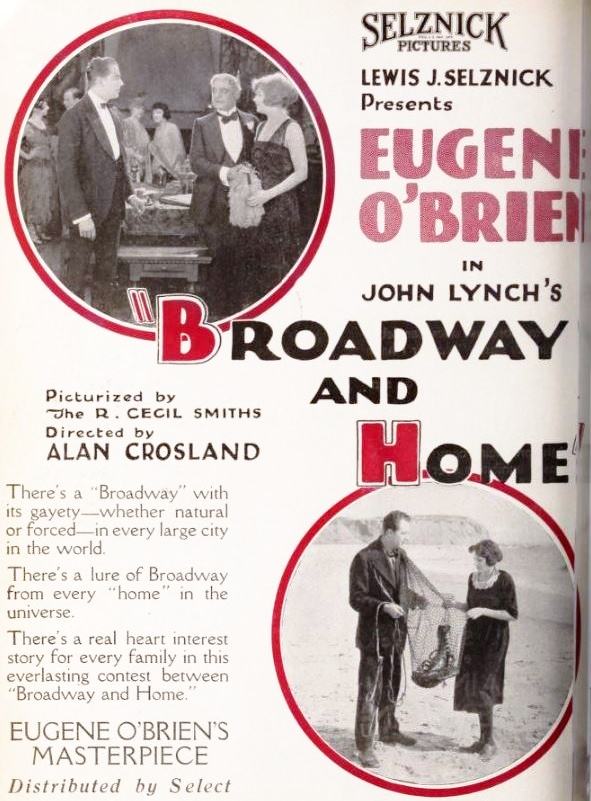
There is a moment—quiet, almost offhand—when Eugene O’Brien’s Michael, shoulders dusted with stage snow that never melts, watches a curtain rise in his mind long before any literal drapery stirs. That flicker of interior theater is the whole film in miniature: Broadway and Home masquerades as a small-town-exile fable, yet its true engine is the footlight glare that burns inside every character, exposing the greasepaint under their skin.
Director William C. deMille (yes, the less-sung Cecil sibling) shoots New York like a cathedral erected to Mammon: façades climb beyond the frame, trolleys slice through pools of sodium light, and the Brooklyn Bridge looms with the sternness of a judge’s gavel. Compare this to the marshy chiaroscuro of The Secret of the Swamp and you’ll appreciate how cinematographer L. Guy Wilky trades Gothic ooze for urban phosphorescence. Every window is a proscenium; every passer-by, a potential curtain-call.
Rest Haven, by contrast, arrives soaked in slate and iodine. The village is rendered through soft-focus filters that blur the horizon until sky and sea merge into one implacable moral witness. Note the dissolve from a Manhattan close-up of Laura’s sequined collar to a fisherman’s calloused thumb gutting cod: the edit is so abrupt it feels like a slap, reminding us that geography is destiny, and destiny rarely washes the salt from its hands.
Eugene O’Brien was the Harrison Ford of the teens—matinee symmetry, a smile that promised propriety while hinting at the rake beneath. Here he weaponizes that duality: when Michael learns Laura’s status as “kept woman,” his face cycles through micro-expressions—brow furrowed in sanctimonious horror, pupils flaring with residual lust—faster than an iris shutter. It’s a silent-era masterclass in how to scream without title cards.
Ellen Burford’s Laura, meanwhile, sidesteps the vapidity that plagued many a vamp of the period. She gifts her character a weary pragmatism, the look of someone who has read the last page of her own tragedy and still turns it anyway. Watch the way she cradles a cigarette holder: not as phallic swagger, but as a conductor’s baton orchestrating her small, defiant symphony. Her final collapse on the wharf—hair unpinning in tendrils that mimic sea-grass—feels like the birth of film noir a full two decades early.
Warren Cook’s Paul Grayson exudes the entitled languor of a man who has never needed to raise his voice to command a room. Yet in a late close-up, when he informs Michael of Laura’s contractual reality, the corner of his mouth twitches—a hairline fracture revealing the terror that money may not, after all, purchase permanence.
R. Cecil Smith and John Lynch lace the intertitles with epigrammatic venom: “A town that forgets your name is kinder than a city that remembers your price.” The line arrives after Michael’s first night in Grayson’s mansion, superimposed over a shot of a marble staircase. It’s a Brechtian jab, alerting us that class, not Cupid, writes this love story. Compare the moral absolutism here with the elastic ethics of Leap to Fame; where that film pirouettes on ambition, Broadway and Home plumbs the sediment of shame.
Some scholars read the narrative as a Protestant cautionary tract: leave your parochial Eden, taste metropolitan forbidden fruit, and blood must rinse the stain. I’d argue it is more fatalistic than religious. The closing tableau—Michael kneeling beside Laura’s corpse as constables emerge from the mist—owes less to scripture than to Greek amphitheater: the chorus of the law arrives too late; catharsis has already bled out.
Surviving prints are accompanied by a 2018 electro-acoustic score that interpolates distant foghorns, typewriter clacks, and the susurrus of surf. During the lovers’ escape by train, the music drops to a single heartbeat-like kick drum, mimicking rail joints while insinuating the fugitive pulse of two lives now off-rhythm with the world. It’s a reminder that silent cinema was never truly mute; it merely spoke frequencies modernity forgot how to hear.
Broadway and Home shares DNA with The Great Shadow in its suggestion that cities devour the innocent. Yet where the latter externalizes corruption through gangland shootouts, this film keeps violence intimate—one pistol crack echoing inside gilded walls. Conversely, An Old Fashioned Boy offers bucolic redemption, a road not taken here; Rest Haven provides no hearth, only tide and testimony.
Modern viewers might bristle at the film’s gender politics: Laura’s fate feels ordained by the Hays Code before the Code itself existed. Yet Burford’s performance complicates the Madonna/whore binary; she plays Laura as a woman keenly aware the world only loans her agency, and at usurious rates. Her decision to fire the gun reads less as melodramatic hysteria than as a ledger balancing—an actuarial strike against the ledger of male possession.
For decades, Broadway and Home languished in the shadow of its jazzier contemporaries like Cowboy Jazz. New 4K restoration reveals textures worthy of museum walls: the glint of Laura’s lamé gown against matte street bricks, the way sea-fog eats into film grain like guilt corroding conscience. It’s a relic, yes, but one that whispers how little the contract between desire and power has been renegotiated since 1923.
Seek it out not for quaint nostalgia, but for a masterclass in how to stage an entire universe inside a single, trembling close-up. Then, when the lights rise and you step back into your own neon night, you may find yourself listening for gulls over taxi horns—and wondering which city, or small town, is busy forgetting your name, or remembering your price.
★★★★☆ (4.5/5)

IMDb —
1931
Community
Log in to comment.