DbcultAccessing Vault...
Cult Review
Senior Film Conservator
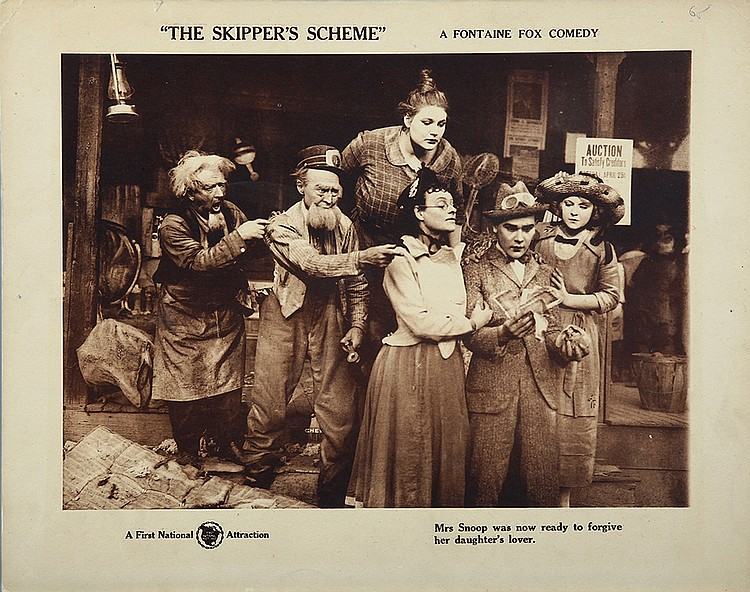
A twelve-minute celluloid fever-dream, The Skipper’s Scheme is less a story than a contagion: the contagion of salesmanship let loose on a captive populace.
Fontaine Fox’s script—really a lit fuse—ignites inside the first twenty seconds: a handbill slapped onto a depot windowpane, wet ink smearing the word “AUCTION” into something half-readable, half-prophetic. From that instant, the film refuses to stand still; it lurches, wheezes, whistles, and spits soot like the ancient paddle-wheeler itself. Dan Mason’s skipper is a molting peacock in a commodore’s cap, voice like a cornet with a split seam. He doesn’t speak lines—he hawks them, each syllable a bid for attention.
Wilna Wilde, all eyes and elbows, slips aboard as if conjured by the captain’s bravado. She is both audience and accomplice, her gaze measuring the distance between promise and payoff. In close-up—rare for 1920—her pupils dilate like ink in water, registering every fresh deceit. The film’s emotional fulcrum rests on those micro-tremors: will she buy in or bolt?
Fox structures the voyage like a descending auctioneered scale: each stop shaves dignity off both hawker and hawked. Passengers who began the trip clutching carpetbags exit clutching only receipts for imaginary lots. The boat’s boiler, a throaty Greek chorus, hisses steam that resembles weary laughter. Cinematographer Frank Zucker frames it all in low-angle tableaux—sooty rafters, dangling lanterns, a cat that wanders across the deck as if auditing the metaphysics of commerce.
Comparisons? Imagine Spotlight Sadie stripped of melodrama and dunked in river sludge, or the sardonic bite of Tony America distilled into a single, merciless gag. Where Robbery Under Arms romanticizes outlaw enterprise, The Skipper’s Scheme demystifies it: crime here wears a grin, smells of cheap cigars, and asks for spare change.
The tinting—amber decks, sea-blue night scenes—doesn’t merely prettify; it weaponizes nostalgia. Amber makes the handbills glow like relics, sea-blue turns the river into a tarot card of uncertain futures. Intertitles arrive staccato, sometimes mid-gesture, as if the film itself can’t wait to outbid silence. One card reads: “Going… going… gone to the gentleman who believes in mermaids!” The next instant, a deckhand actually wheels out a rain-battered mannequin fishtail. The cut lands like a slapstick rim-shot.
Mason’s physical comedy is vaudeville honed to surgical edge: a single eyebrow hoisted auctioneer-style can crater passenger resistance. Watch him sidle along the promenade, palms open like a confession, only to palm a flask into a mark’s pocket—now the mark’s indebted, now he’ll bid. It’s capitalism as three-card monte.
Wilde, often relegated to flapper footnotes here claims center-frame. Her character owns no backstory; she is pure reactive membrane, registering price fluctuations in the moral stock market. When the skipper promises a “genuine Amazonian shrunken head,” her pupils contract—disgust? desire?—a micro-performance that forecasts the coming crash of belief. In the final shot, as the boat docks and passengers disperse clutching worthless receipts, she alone steps backward, refusing to leave, staring at the empty auction block as if waiting for the next lie to hatch. It’s an ending that refuses closure, a proto-neo-realist shrug.
Silent, yes, but the film bangs with sonic ghosts: call-and-response patter imagined between title cards, the thunk of gavel on crate, wheeze of calliope. Contemporary exhibitors often enlisted local auctioneers to provide live counterpoint—meta-theatre squared. Viewed today, the absence of spoken hucksterism amplifies the visual pitch; we become co-auctioneers, filling the aural void with our inner barker.
Released months before the 1920-21 depression, the short plays like an economic fever-chart: speculation, inflation of expectation, spectacular bust. One senses Fox sniffing the wind, predicting the bubble. Compare it to For the Freedom of the World, bloated with wartime idealism—Scheme counters with post-war cynicism, compact as a hand-grenade.
A 4K restoration premiered at Pordenone 2019, scanned from a Dutch print found in an Amsterdam flea market. The tints were recreated using chemical analysis of nitrate edges; sea-blue night scenes glow with cyanotic chill. Streaming? As of this month, it’s tucked inside the “American Slapstick Vol. 8” anthology on specialty platforms; physical media hounds can snag the Blu from Sprocket Vault, complete with a new score by Mont Alto that syncs xylophone chatter to auction patter.
Is The Skipper’s Scheme a masterpiece? Nah—masterpieces posture. This is a shifty sideshow barker of a film, palming off laughter that corrodes in real time. It offers neither moral nor redemption, only the eternal reprise of the sell. And that, fellow suckers, is why you should buy a ticket before the boat shoves off again.
Verdict: 9/10—A pocket-sized tonic against every polished reboot, a reminder that cinema once hustled for pennies and still broke the bank of imagination.
IMDb 6.5
1935
Community
Log in to comment.