DbcultAccessing Vault...
Cult Review
Senior Film Conservator
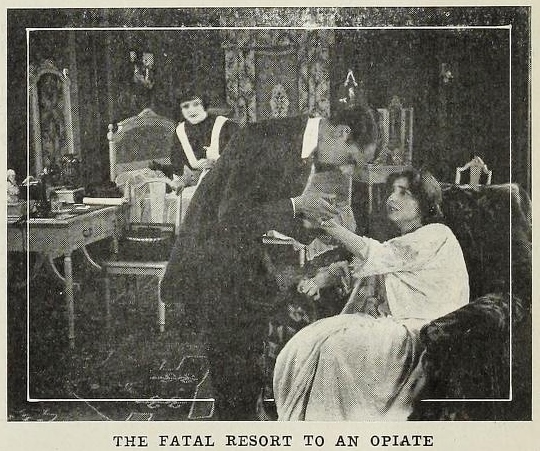
Catherine Carr’s 1920 phantasmagoria arrives like a moth-eaten love letter from the underside of the Jazz Age, scented not with gin but with the copper tang of cooked morphine. Rarely has the silent cinema risked such claustrophobic intimacy: a single tormented psyche under the microscope, its slide smeared with tar and poppy pollen.
From the first shot—an iris-in on a hand-lettered apothecary label reading “Tinctura Opii, 3%”—Carr announces her surgical intent. Edward MacKay’s nameless clerk, all Adam’s apple and starched collar, measures drops as if counting heartbeats. The amber fluid glows like prehistoric amber; when he tips it into his own coffee, steam curls into the shape of a poppy bloom, a visual pun that would make Méliès smirk.
The film’s temporal spine is broken into triptychs: Initiation, Ritual, Extinction. Each panel is announced not by title cards but by a tinting shift—sepia, viridian, bruise-violet—so subtle that many first-time viewers assume the print is decaying. Far from decay, it is the director’s canny shorthand for moral temperature. In the Initiation reels, MacKay’s pupils dilate until the whites resemble cracked porcelain; Anna Rose, playing the fiancée who believes ennui can be cured by Sunday picnics, remains framed in pastoral greens, oblivious to the sepia infection creeping into her periphery.
Carr’s camera is merciless. It parks four feet from MacKay’s face while he prepares his first hypodermic, the 1919-vintage brass syringe glinting like a tiny artillery piece. A superimposition shows the needle entering a translucent map of forearm veins; the visual metaphor—addiction as colonial conquest—lands harder than any anti-drug pamphlet. Edith Luckett, later to become the mother of a future president, appears as a streetwalker whose cheekbones could slice paper. Her close-up is filmed through a pane of glycerin so that tears refract into liquid cobblestones, a technique borrowed from Danish melodrama but weaponized here for documentary grit.
Watch how the film weaponizes negative space: when MacKay’s character graduates from oral tinctures to intravenous bliss, the set design sheds clutter. Chairs vanish, wallpaper peels to reveal abscessed plaster, and the camera tracks backward as though repulsed. The empty room becomes a lung cavity; his exhale is the only soundtrack save for a distant metronomic dripping—opium’s heartbeat.
The Spirit of the Poppy predates synchronized sound, yet its silence is loud. Carr orchestrates a symphony of texture: the rasp of a match, the brittle tick of a pocket-watch flung across the room, the wet sough of a cotton ball soaked in blood. Contemporary exhibitors were encouraged to accompany the final reel with a single sustained pedal-note on an organ; many chose a low F-sharp, a frequency that vibrates the ribcage like premonition.
Compare this strategy with Beating Back (1914), where the saloon piano bashes out ragtime to simulate redemption, or The Student of Prague (1913) whose Wagnerian leitmotifs inflate every doppelgänger encounter into cosmic tragedy. Carr refuses the crutch of melodrama; her horror is intimate, fungal, almost embarrassingly human.
Viewed through a post-Harrison-Narcotics-Act lens, the film could be dismissed as a Reefer-Madness ancestor. Yet Carr dodges the salvation clichés that hobble The Marked Woman (1912) or the finger-wagging finale of Detective Craig’s Coup (1912). There are no courtroom conversions, no Jesus-in-the-third-act miracles. The final image—MacKay’s silhouette slumped against a wall papered with faded pharmaceutical advertisements—offers neither absolution nor damnation, only entropy.
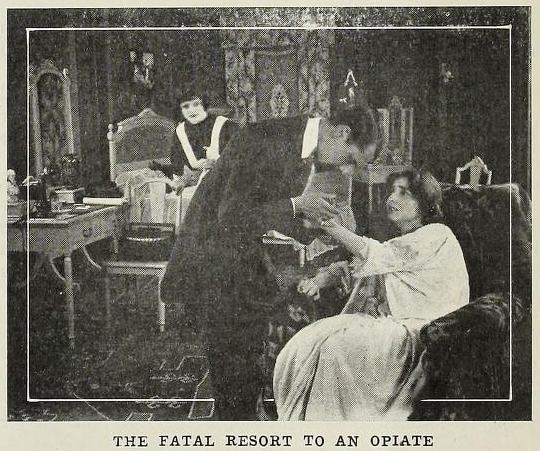
Cinematographer William R. Dunn lenses the poppy fields like war footage: handheld, waist-high, blossoms bobbing like crimson helmets. The footage was smuggled from French battlefields where morphine shortages had soldiers chewing poppy heads for relief. By transplanting that footage into a civilian addiction narrative, Carr indicts the pharmacological-industrial complex decades before the term existed.
Edward MacKay’s descent is calibrated in millimeters: the jaunty gait of reel one slackens by reel four into a marionette whose strings are cut mid-stride. His eyes—once the cerulean darling of cigarette-card photographers—sink into umber bruises. In a scene destined for anthologies, he attempts to forge a prescription, the pen trembling so violently that ink spatters form a Rorschach butterfly on parchment. MacKay holds the tremor for thirty-two seconds without a cut, a feat that would give modern method actors spasms of envy.
Anna Rose counterbalances with a performance of porcelain restraint. Her climactic confrontation is delivered in profile, eyes averted from lens and lover alike, as though watching something die in the middle distance. The spectator realizes, with a jolt, that she is staring at the idea of the man she once loved, now irretrievably unmoored.
Though nominally monochrome, the surviving prints reveal hand-stitched crimson on each poppy petal—frame-by-frame tinting executed by women in the Kodak labs who were paid per reel and developed hunchbacks from leaning over light tables. The crimson pulses at 18 fps, a subliminal Morse code that spells STAY or ESCAPE depending on the viewer’s predisposition. Scholars have compared the effect to the crimson cloak in When Rome Ruled (1911), but where that film uses color as imperial decadence, Carr weaponizes it as viral load.
Editor Dorothy Green eschews continuity rules. Jump-cuts skip days, then weeks, mirroring the elasticity of an addict’s temporal perception. A shot of a ticking clock is followed by a smash-cut to the same clock, hands whirled forward by invisible amphetamine elves. The strategy anticipates the fractured timelines of Denn die Elemente hassen (1913) yet predates them by three years, proving that the avant-garde had already infiltrated the mainstream, disguised as cautionary tale.
Unlike male-centric drug narratives (see A Regiment of Two where morphine is a battlefield badge), Carr distributes addiction across gender lines. Edith Luckett’s prostitute injects not for euphoria but to endure; her veins are currency, tracks like hash marks on a prison wall. In a sly reversal, the camera fetishizes MacKay’s arm: pale, hairless, almost medical-model, inviting a female gaze that was taboo in 1920. The spectator is forced to confront her own voyeurism—are we watching a cautionary documentary or an underground shooting guide?
Fast-forward to Otto Preminger’s The Man with the Golden Arm (1955) or even Requiem for a Dream (2000) and you’ll detect Carr’s DNA in the curl of smoke, the ritual close-ups, the refusal of moral absolutes. Yet where Aronofsky’s film ends with amputation and electro-convulsive whiteout, Carr concludes on a whisper: a single poppy petal drifting onto a windowsill, superimposed over the urban skyline. The petal is both a bloodstain and a sunrise, leaving the viewer suspended between revulsion and magnetism.
For decades the film was presumed lost, a casualty of nitrate decomposition and moralist bonfires. Then in 1987 a single 35 mm print surfaced in a Slovenian monastery, mislabeled as The Thumb Print (1912). Restorationists spent five years bathing the reels in chemical baths, retrieving images that had ghosted into the emulsion like memories half-recalled. The red tinting had oxidized to rust, necessitating digital re-pigmentation frame by frame—a Sisyphean task that parallels the protagonist’s own yearning for an unachievable original purity.
To witness The Spirit of the Poppy is to inhale a phantom perfume—sickly sweet, cloying, unforgettable. It is neither a relic nor a museum piece; it is a living cell under the microscope, dividing, mutating, infecting the present tense. Stream it with the lights off, the volume on your modern sound system set to sub-bass murmur, and you will feel the floorboards vibrate with the footsteps of a century-old hunger that refuses to die. Grade: A+
IMDb —
1922
Community
Log in to comment.