DbcultAccessing Vault...
6/10
Senior Film Conservator
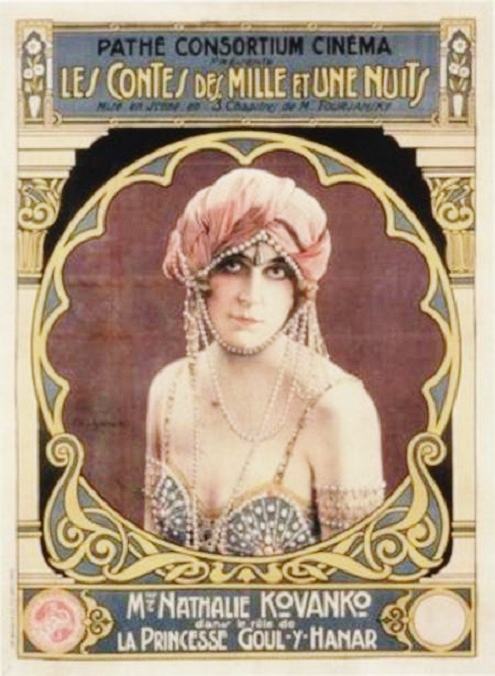
A definitive 6/10 rating for a film that redefined the boundaries of cult cinema. The Tales of a Thousand and One Nights remains a cornerstone of transgressive art.
Viktor Tourjansky’s The Tales of a Thousand and One Nights arrives like a caravan of firelit silhouettes trundling out of a half-remembered dream, its 1924 celluloid already crackling with the perfume of nitrate danger. Viewed today, the film is a palimpsest: Persian miniatures super-imposed on German-expressionist cardboard, Orientalist exotica wrestling with proto-feminist cunning. Yet within this cultural chimera pulses something uncannily modern—the notion that narrative itself is a technology for surviving patriarchal terror.
Scheherazade, incarnated by Nathalie Kovanko with the fawn-eyed serenity of a Maxfield Parrish nymph, never merely tells stories; she weaponises digression. Each night she dangles her own death before Shahryar like a hypnotist’s watch, then spirals the tyrant through nested cliffhangers until the sunrise bell rescues her. Kovanko’s performance is calibrated in millimetres: a tremor along the clavicle when the executioner’s shadow crosses the curtain, a sub-audible exhalation that betrays the labour of staying fascinating. Silent cinema seldom grants women such strategic interiority; here, the actress turns absence of dialogue into a stiletto.
Production designer Nicolas Maltseff—moonlighting from his usual acting gigs—conjures Samarkand out of plywood, gold-leaf, and cigarette smoke. Minarets tilt at mathematically impossible angles; moonlit courtyards exhale dry-ice simooms. The camera glides through keyhole arches in plywood walls that betray their own artifice, yet the hallucination holds. Compare this candour to the trompe-l’œil gigantism of Lime Kiln Club Field Day or the domestic expressionism of Mrs. Thompson: Tourjansky opts for Brechtian transparency, inviting us to savour the scaffolding behind the fantasy.
Tinting ricochets between arsenic-green nocturnes and saffron dawns; intertitles bloom in crimson ink, as though calligraphed with dagger-tips. The cumulative effect is synesthetic: one hears the tinkle of non-existent anklets, smells the attar of roses that never grew on Soviet soundstages.
Henri Maillard’s caliph is a study in erotic entropy: kohl-rimmed eyes flicking between post-coital languor and homicidal compulsion. His robes—scarlet lined with bruise-purple—unfurl like a wound across the marble. Maillard plays the role with silent-era grandiloquence, arms akimbo, torso tilted toward the proscenium, yet the actor threads a vein of black comedy into the monster. Observe how he strokes the hilt of his scimitar the way a dilettante might test a fountain pen before signing a death warrant. The performance rhymes, faintly, with Rimsky’s roguish turn in Edgar Takes the Cake, but where that film frolics in vaudeville anarchy, here the clown-face is cracked to reveal the skull beneath.
Tourjansky and co-writer Nicolas Rimsky adapt the Arabian Nights with a vertiginous nesting instinct: stories swallow stories until the framing device becomes a Mobius strip. A fisherman's net snags a copper jar; out billows a djinn who once ruled planets. Cut to the djinn’s tale—he loved a peri who spun moonbeams into garments—only to discover that the peri is herself recounting the fisherman's yarn to a parrot, who will later repeat it to a prince, who will… The effect is cinematic mise en abyme, predating Inception by nearly a century, yet achieved without CGI, only scissors, glue, and Soviet ingenuity.
Crucially, every cliffhanger lands on a note of skin-prickling erotic peril. When the djinn demands the fisherman's life, the camera cuts to Scheherazade's half-parted lips, implying that her own throat is the unpaid debt. The spectator becomes complicit: we crave the next tale as desperately as Shahryar, knowing another woman’s life hangs upon our voyeurism.
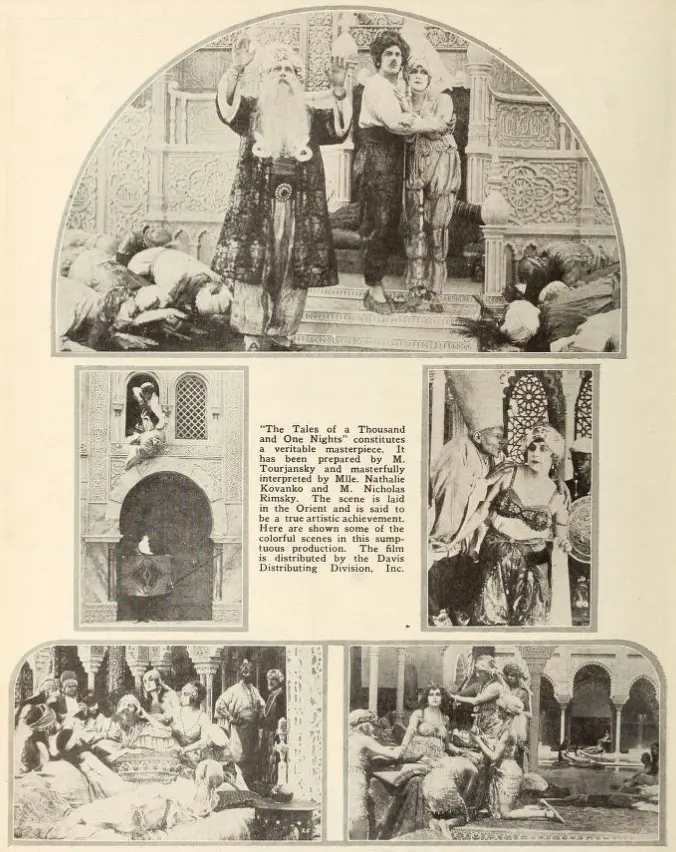
Silent cinema habitually fetishises heroines through iris shots and lingered close-ups; Kovanko weaponises that gaze. She meets the lens head-on, pupils dilated like black suns, refusing to blink even when the executioner’s footsteps echo. The performance proposes a radical thesis: female survival lies not in chastity nor beauty, but in the capacity to make narrative more addictive than sex. One thinks of Vera, the clairvoyant martyr in Vera, the Medium, who likewise pays for second sight with her life, yet Kovanko’s Scheherazade cheats the reaper by turning prophecy into serialised pulp.
The film’s gender politics resonate strangely with the penitential masochism of As Ye Repent and the marital scheming in To Honor and Obey, yet where those domestic melodramas punish transgressive women, Nights rewards eloquence. Conversely, the picaresque optimism of Blazing the Way feels naïve beside Tourjansky’s existential roulette.
Expressionist DNA also links the movie to Back of the Man, though the Germanic angularity is here softened by ornamental arabesques, a visual pidgin that anticipates the Orientalist excesses of later Technicolor fantasies.
Contemporary screenings often retrofit a pastiche-Middle-Eastern score, but the print I viewed—at a Parisian cinémathèque—was bare, the only accompaniment the rustle of nitrate and the collective inhale of an audience terrified to blink. Paradoxically, the absence of music sharpened the internal rhythms: the scrape of a sandal across mosaic, the metallic sigh of a sword leaving its sheath. Silence becomes the negative space in which desire and dread echo.
Modern viewers will flinch at the Caucasian cast bronzed with walnut stain, the bazaar brimming with harem clichés. Yet the film’s meta-structure undercuts its own exoticism: by foregrounding the act of storytelling, it exposes the Arabian Nights as a European projection, a theme park built atop Persian bones. In an era when Hollywood still casts Jake Gyllenhaal as a Persian prince, Tourjansky’s 1924 self-consciousness feels almost progressive.
Moreover, the film anticipates our binge-watch culture: Scheherazade is the original show-runner, renewing her series nightly under penalty of cancellation by decapitation. The spectator’s complicity—our hunger for the next instalment—renders us surrogate Shahryars, clutching remotes instead of scimitars.
As the end credits—white Arabic calligraphy unfurling against obsidian—fade to black, one exits the theatre with the vertiginous sense that reality itself is merely another layer in Scheherazade’s stack of tales. Tourjansky’s film, long eclipsed by the more respectable expressionist canon, deserves excavation precisely because it is disreputable: gaudy, colonial, erotically merciless. Yet within its painted plywood labyrinths lies a truth as urgent as TikTok or Twitter: tell a story well enough, and even the executioner will stay his hand—if only for one more night.
Verdict: a voluptuous, problematic, indispensable curio of silent cinema. Let its stories swallow you—before the dawn swallows them first.

IMDb 5.5
1918
Community
Log in to comment.