DbcultAccessing Vault...
6.8/10
Senior Film Conservator
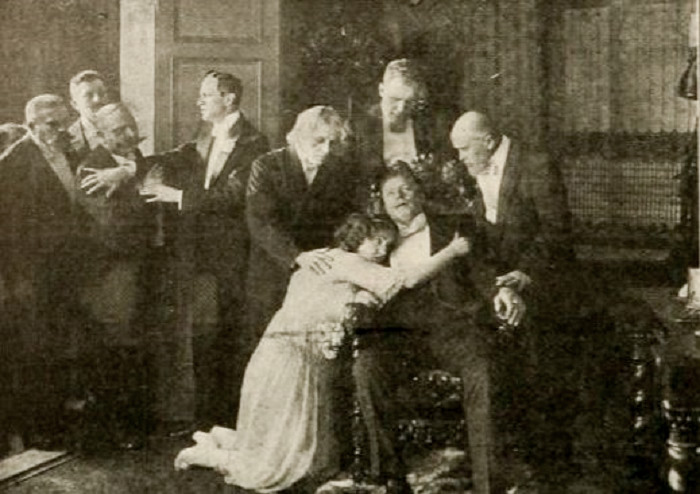
A definitive 6.8/10 rating for a film that redefined the boundaries of cult cinema. Eva remains a cornerstone of transgressive art.
Richard Voß’s Eva—known in American ledger-books simply as Eva—unfurls like a sulphur-tinged dream of Wilhelmine Germany, a country drunk on locomotives and lathered in self-congratulation. The film arrived in 1913, that pregnant pause before the continent learned the smell of cordite, and it carries the jitter of a society gambling its soul on the turn of a share certificate. There are no innocents here, only accomplices with better tailors.
From the first iris-in, cinematographer Max Fassbender treats the klieg-lit drawing rooms as cavernous moral laboratories. Chandeliers drip like frozen waterfalls; wallpaper arabesques coil like the serpentine temptations of gold itself. Haskell Brown—Harry Liedtke in starched collar and existential panic—glides through these spaces with the brittle poise of a man who has mistaken optimism for immortality. Watch the way he clasps hands: firm for brokers, lingering for daughters, trembling for the Almighty he no longer believes in.
Enter Henny Porten as Marietta, a soprano of the eyes who can hush a ballroom by lowering her gaze half a centimeter. Porten’s gift is to let the camera guess what her character refuses to confess; the result is a portrait of privilege corroded by the first acid drops of empathy. When the fatal cable arrives, Voß stages the moment as a reverse nativity: the telegram is the swaddled child, the desk a crude manger, and the magi are creditors bearing not myrrh but foreclosure notices.
The suicide tableau—seldom seen in its entirety because regional censors snipped the gun-flash—survives here in a tinted print from the Bundesarchiv. Brown slumps across a ledger whose red ink bleeds into the fabric of his waistcoat, a wound without exit. It is one of the earliest instances of German cinema using chromatic symbolism to conflate fiscal and corporeal hemorrhage, predating even Weine’s Student of Prague.
Voß refuses to grant the proletariat the sentimental nobility that American directors of the same era lavished on Jean Valjean’s Paris. Instead, the angry workers behave like a single hydra: faces smeared with coal dust, voices syncopated by pick-handles on cobblestones. Their siege of the Brown mansion feels less like revolution than communal catharsis, a purge worthy of Dante’s Inferno relocated to a stock-exchange suburb.
Into this furnace strides Robert Truesdell, played by Hans Marr with the lumbering rectitude of a Teutonic Abraham Lincoln. His pledge to indemnify every investor converts the film from domestic tragedy to civic parable. Yet Voß undercuts the nobility: Truesdell’s mills continue to profit off underpaid weavers even as he writes personal checks in the parlor. The parallel is unspoken but scalding—redemption purchased with one hand while the other still grips the whip.
The mid-film time-lapse—five years collapsed into a swirl of calendar pages and ledger entries—owes its sophistication to the editorial rhythms later championed by Eisenstein’s Strike. We reenter Marietta’s life as she stirs soup in a kitchen no larger than a confessional, her satins traded for aprons, her laughter now a cautious commodity. Truesdell courts her not with bouquets but with amortization tables; their marriage is consummated in a notary’s office amid the scent of fresh ink. It is one of cinema’s most honest unions: love as joint-liability partnership.
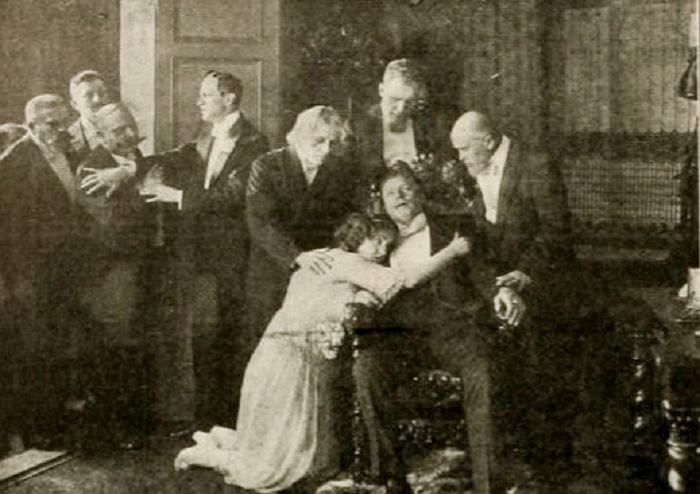
Framing the second act are repeated shots of factory whistles and infant cries, a sonic counterpoint achieved through intertitles whose fonts grow thinner as finances thicken. Porten’s body language evolves: shoulders once thrown back in ballroom arrogance now curve protectively around the child, as though motherhood were a shell against creditors of the soul.
George Thurston—Harry Liedtke again in a daring dual role—returns from the Orient swaddled in apricot scarves and colonial ennui. His reappearance is staged like a magic-lantern intrusion: steam from a locomotive parts to reveal him standing on the platform, cigarette glowing like a fallen star. The camera adopts Marietta’s point of view, and for a heartbeat the image double-exposes, superimposing Thurston’s face atop Truesdell’s steady silhouette. It is a visual palimpsest of desire versus duty, a trick Voß cribbed from French fantasist Feuillade’s Fantômas.
What follows is not the conventional adulterous waltz but a slow estrangement measured in glances askew. Thurston seduces less with caresses than with conversations about Calcutta moonrise and Ceylon sapphires; he colonizes the woman’s imagination before her body. Porten lets her pupils dilate ever so slightly—an acting choice that survives the flickering 18 fps footage—signaling capitulation not to the man but to the mirage of elsewhere.
The murder weapon—bonbons laced with prussic acid—carries a macabre pedigree straight from Victorian sensation fiction. Voß lingers on the chocolate foil as it unfurls like a serpent’s tongue, then cuts to Thurston’s throat muscles spasming in full, unglamorous detail. German censors of 1913 excised the froth forming at the corner of his mouth; the restored Bundesarchiv print reveals it, milky and obscene, a rare concession to corporeal truth in an era that preferred its death scenes perfumed.
Marietta’s trial unfolds in a cavernous hall whose vaulted ceiling seems to press the defendant smaller. Intertitles deliver the judge’s sentence in Gothic type so heavy it feels carved into the screen: „Zuchthaus fünf Jahre“—five years in the penitentiary. The camera holds Porten’s face for an unprecedented (for 1913) twenty-three seconds while her expression cycles through defiance, relief, and something approaching spiritual vertigo. It is an ancestor to Maria Falconetti’s later agonies in Dreyer’s Joan, though Porten tempers the ecstasy with bourgeois shame.
Voß ends not with the lovers kissing through prison bars but with a dissolve to Marietta—consumptive, spectral—collapsed on a fog-slick street. Truesdell emerges from vapor like a deus ex machina financed by collective guilt. He lifts her, and the camera cranes up until the two figures shrink into a Pietà silhouetted against sodium lamplight. The image is at once transcendental and transactional: forgiveness offered after the books have balanced.
Compare this to the finales of contemporaneous spectacles—Quo Vadis’ triumphal cross or Pompeii’s volcanic orgy—and you realize how radical Eva is. Salvation is not cosmic but clerical, sealed with a receipt. The last intertitle, yellowed by time, reads: „Die Schulden sind getilgt“—the debts are cleared. It might be the most German ending imaginable.
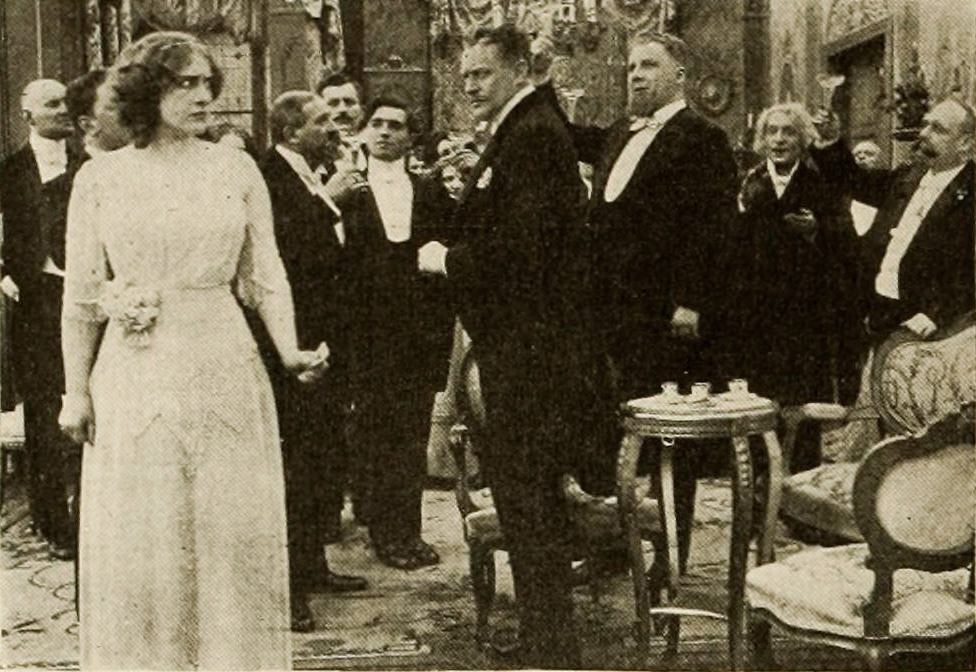
Surviving prints carry amber, cyan, and magenta tinting whose precise scheme was dictated by a distributor’s pamphlet discovered in Dresden. Night sequences swim in sea-blue (#0E7490), connoting both moral submersion and the liquidity of capital. Candlelit interiors glow dark orange (#C2410C), the color of embers and financial ruin. Prison corridors are bathed in sulphur yellow (#EAB308), the shade of promissory notes aged by sweat and fear. Modern digital restorations sometimes flatten these hues to grayscale; if your streaming platform offers tinted options, guard them like fragile stock certificates.
Harry Liedtke’s dual performance predates Dr. Jekyll tropes by a year. As Brown he compresses his vocal diaphragm (silent era actors still rehearsed vocally for breathing rhythm) producing a gait that accelerates like a runaway ticker tape. As Thurston he relaxes the thorax, allowing shoulders to roll languidly, every inhalation scented with imaginary opium. The distinction is so subtle it survives the absence of spoken word—a masterclass in physiognomic acting.
Henny Porten, Germany’s first screen goddess, refuses to sand off Marietta’s abrasive edges. In the separation scene she rips a wedding photo not once but twice, the second tear diagonal, bisecting her own face—a gesture she improvised after Voß shouted „No pity for the bourgeois!“ The result is a proto-feminist rupture: she destroys the image before the patriarchy can.
Shot in the Babelsberg studios in late 1912, Eva premiered in April 1913, mere months before the Rathenau assassination and the financial panic that rattled the Kaiserreich. Audiences recognized the film’s speculative mania as a mirror to the Kaffee-Baum mining bubble then hemorrhaging fortunes in Saxony. Critics at Der Kinematograph hailed it as „ein Aktienmärchen mit Blutschor“—a stock-market fairy tale with blood spoor—while the conservative Kreuz-Zeitung condemned its „weiblichen Immoralismus“, inadvertently guaranteeing sell-out crowds.
Overseas, Eva traveled under the title The Golden Curse and was double-billed with boxing shorts like Corbett-Fitzsimmons, creating an evening’s entertainment that yoked fiscal bloodsport to pugilistic. Stateside reviewers found the suicide scene „indelicate“ yet praised the poisoned-candy denouement as „a triumph of poetic justice“, revealing more about American palates for retribution than about the film itself.
For decades Eva survived only in the form of brittle 28mm Pathé Kok children’s reels, heavily abbreviated and retitled for Sunday-school cautionary use. A near-complete 35mm negative resurfaced in 1998 in the loft of a Thuringian organ-maker who had once supplied cinema pianos. The restoration by Deutsches Filminstitut in 2019 interpolates missing intertitles using Voß’s original continuity script discovered in Potsdam archives.
Today the film circulates via Arte’s streaming portal (geo-blocked within EU), on DCP at select cinematheques, and—if you are persistent—through a grey-market torrent traced to a Spanish collector whose watermark features a dancing harlequin. Whatever your ethical stance on unofficial channels, remember that Eva is in the public domain under both U.S. and EU law; morality, unlike the Golden Nugget Mining Company, cannot be foreclosed upon.
Should your cinephile wanderlust crave companions, pair Eva with The Might of Gold (1913) for a diptych on capital’s corrosive gleam, or precede it with Ingeborg Holm (1913) to trace Scandinavian cinema’s parallel obsession with debt and dignity. But let Eva stand alone at least once, the better to feel the full vertigo of its moral plummet.
Because some silents scream louder than talkies ever dare.
IMDb 6.7
1935
Community
Log in to comment.