DbcultAccessing Vault...
Cult Review
Senior Film Conservator

Charles Reade’s literary contraption, first stitched in the gas-lit theatres of 1863, arrives on flickering celluloid in 1914 with the volcanic urgency of a morality play that refuses to die. The film—The Ticket-of-Leave Man—is less a relic than a palimpsest: each frame overwritten by our collective anxiety about guilt, reparation, and the paper-thin membrane separating respectability from infamy.
The plot pivots on a single flourish of ink: two thousand pounds conjured from a paternal signature. That flourish detonates a family, a friendship, and—because this is the age of empire—an entire continent’s worth of exile. Once Chester Livingstone is shackled for another man’s forgery, the film becomes a travelogue of penitence, dragging us from London’s fog-slick alleys to the sun-scorched quarries of New South Wales. Cinematographer George W. Middleton shoots the penal colony like a fever dream: flaring whites, abyssal shadows, the camera perched on precipices as if afraid to touch the ground.
Notice the symmetry: a forged note buys a man’s freedom in London; a ticket of leave buys another man’s freedom in Australia. Both documents are lies on parchment—one criminal, one carceral. Reade’s irony is merciless.
As Allan Bancroft, Sam J. Ryan carries the film’s original sin in the tremor of his pupils. Watch the scene where he overhears his father’s plan to cede the family business: Ryan’s shoulders stiffen like a marionette whose strings have been yanked skyward. Guilt, not ambition, animates him; the audience can almost smell the brimstone of panic.
Opposite him, Sheldon Lewis sculpts Chester Livingstone into a monument of stoic resentment. His eyes—cavernous, unblinking—seem to measure every horizon for an exit that never appears. When he rescues Helen Gerard from a bolting carriage, Lewis performs the deed with the mechanical dispatch of a man who knows heroism will not commute his sentence.

Eleanor Woodruff’s Helen is no swooning figurine. She traverses the arc from colonial ornament to self-possessed agent, her pupils dilating not at danger but at the prospect of danger. The chemistry between Woodruff and Lewis smolders rather than sparks; their love is negotiated in glances that last half a second too long, violating the Hays-compliant prudery that would soon throttle American screens.
Because the film is silent, every visual choice is cranked to operatic volume. Note the ochre deserts that swallow human figures whole—an inversion of the claustrophobic debtor’s prison London will later become. The director juxtaposes these vistas with tableau shots of paperwork: the forged promissory note fills the frame, its ink still glistening like a fresh wound. The moment when elder Bancroft brandishes the document is filmed from a low angle, making the paper a towering obelisk that eclipses filial loyalty.
Equally striking is the shipwreck sequence, achieved with miniature hulls and double-exposure. Waves—actually agitated vats of mercury—lap against a toy vessel, yet the illusion persuades because the filmmakers intercut documentary footage of listing freighters. The result is a hallucination of maritime disaster that anticipates the expressionist nightmares of The Revolutionist (1916).
Reade’s source play trafficked in sensational melodrama; the 1914 adaptation channels that energy into a bifurcated tone poem. The London segments unfold like proto-noir: shuttered counting houses, gas lamps smearing light into cobblestones, the money-lender Bateman skulking in doorways like a gargoyle. Once the action relocates to Australia, the register shifts to colonial gothic—parched plains, convicts in irons singing hymns that fracture under the whip, the governor’s mansion perched like a white scab on the landscape.
This tonal split weaponizes geography itself. England equals repression, paperwork, the invisible shackles of debt. Australia equals corporal punishment, the visible shackles of iron, but also the possibility of absolution because the slate of civilization has been momentarily wiped clean. When Helen and Chester are marooned on their Edenic island, the film pauses for a luxuriant mid-section that feels like a different movie—closer to Burning Daylight (1914) than to Reade’s typical urban morality fare.
Original exhibition prints shipped with a cue sheet recommending Wagner’s “Pilgrim’s Chorus” for the penitential quarry scenes and Suppé’s “Light Cavalry” for the runaway carriage. Contemporary restorations often substitute a chilling minimalist score—piano, timpani, and a single cello that groans like a ship’s hull. Either approach works because the narrative’s emotional valence is so stark that music merely colors what the images have already drawn.
Listen for the moment the ticket of leave is handed to Chester: the suggested chord progression shifts from minor to major, but the modulation is abrupt, almost sarcastic. The film knows that conditional freedom is still a cage, merely with gilded bars.
Helen Gerard’s body operates as both bargaining chip and narrative ignition. Each male character seeks to possess or rescue her, yet the film grants her pivotal agency in the final act: she it is who confronts Allan aboard the doomed vessel, who slaps him with the same gloved hand that will later cling to driftwood. Woodruff plays the moment with a tremor of self-disgust—as if Helen realizes she has been complicit in her own commodification.
Colonial politics seep in at the margins. Governor Gerard is portrayed as benevolent but aloof, his paternalism indistinguishable from governance. When he rewards Chester with a ticket of leave for foiling a burglary, the film stages a miniature parliament: white authority dispenses clemency to a convict for protecting white property. Indigenous presence is entirely erased, a silence more deafening than any intertitle.
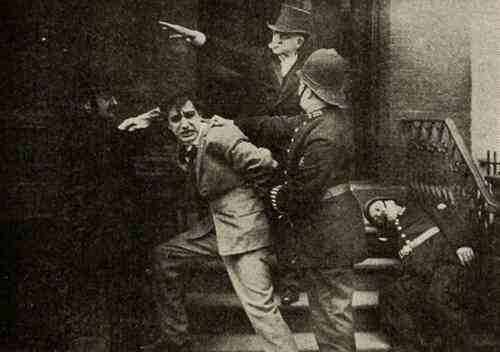
Modern viewers will balk at the arithmetic: five years of hard labor for a forged signature; social ostracism for the actual forger that lasts scarcely two reels. Yet the film’s true punishment is psychological. Allan’s fever dreams—rendered via double exposure where Chester’s face materializes inside his own reflection—suggest that guilt is a penal colony without shore leave. By the time restitution arrives, both men have been transfigured: the innocent tempered like steel, the guilty corroded like iron.

Viewed alongside Beverly of Graustark’s courtly whimsy or A Mexican Mine Fraud’s southwestern caper, The Ticket-of-Leave Man feels like molasses poured over lace—slower, darker, viscous with moral quandary. It shares DNA with It Is Never Too Late to Mend (also sourced from Reade) in its disgust at carceral cruelty, yet surpasses that film’s didacticism by wedding reformist zeal to pulp thrills.
Meanwhile, Dan Morgan offers a bushranger anti-hero; our film flips the vantage, making the convict the moral axis. Together they form a diptych of Australian penality: outlaw as folk legend vs. convict as Christ figure.
The sole surviving 35 mm nitrate print was salvaged from a Tasmanian farmhouse in 1978. MoMA’s 4K restoration re-premiered at Pordenone in 2019, accompanied by a commissioned score that interpolates folk didgeridoo motifs—a controversial choice, given the film’s settler gaze. Kino Lorber’s Blu-ray pairs the film with an audio essay by critic Luke McKernan who contextualizes its convict iconography within Australia’s century-long cultural cringe.
Streaming options remain scant; occasional appearances on Criterion Channel’s “Silent Shadows” carousel offer the best access. Beware murky YouTube bootlegs where the shipwreck looks like shredded lint.
Because the questions it raises—who deserves mercy, how debt shackles bodies, whether redemption is a destination or a horizon—remain the marrow of modern headlines. Because its visual grammar, though primitive, teaches us that cinematic tension can be conjured with nothing more than a piece of paper fluttering into the gutter. And because, in an era when algorithmic credit scores exile the poor to digital penal colonies, we are all, in some spectral sense, ticket-of-leave people—walking the perimeter of an invisible island, praying the next ship that crests the horizon bears not our old sins, but a pardon written in light.
“Watch it not as antique curio but as prologue to every contemporary tale where systemic injustice masquerades as procedural formality.”
Seek it out, dim the lamps, let the celluloid flicker reflect in your eyes like the first blush of conscience. The bars may be invisible now, yet you will still feel their chill across a century of silence.

IMDb —
1923
Community
Log in to comment.