DbcultAccessing Vault...
Cult Review
Senior Film Conservator
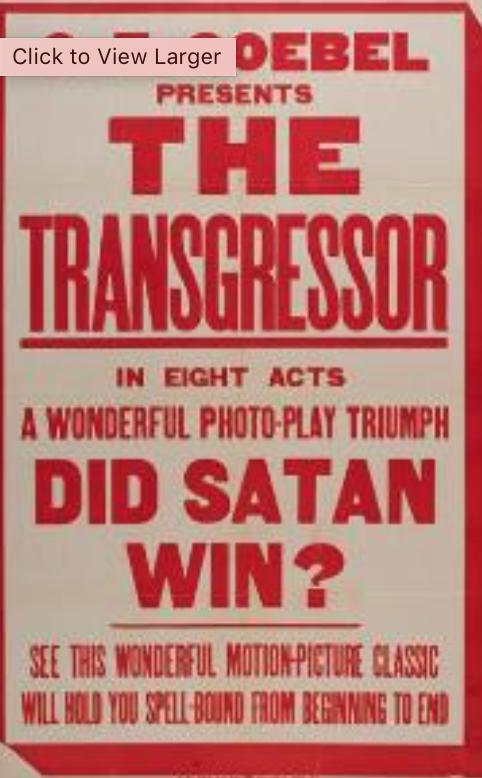
Smoke does not simply billow in The Transgressor; it testifies. Every chimney is a reluctant prophet coughing sooty scripture over mill towns where the night shift moon looks suspiciously like a coin pressed into the sky’s grimy palm. Father Conway—played by matinee-idol turned moral lightning rod Ben Lyon—navigates this fog with the gait of a man who’s read the Gospels back-to-front and decided the meek might inherit the earth but only after the bulldozers finish with it. His first appearance is a silhouette framed by a foundry’s orange maw, cassock whipping like a rebel flag. The image is so stark it feels carved, an expressionist woodcut smuggled into what trade papers of 1920 brusquely labeled a “preachment story.” Yet sermonizing is the last thing on this picture’s agenda. It would rather detonate dogma than dispense it.
Directors O.E. Goebel and polemicist-cleric Condé B. Pallen splice melodrama with agit-prop the way bootleggers lace sacramental wine with gin. The plot—or perhaps the fever dream—unfurls in episodes stitched by title cards that burn like manifestos. One reads: “Between the anvil of conscience and the hammer of capital, a soul is forged.” Cue close-ups of molten iron cascading, sparks haloing Conway’s troubled mug. Such visual punning could sink into kitsch, yet the film’s sincerity is so white-hot it cauterizes irony. You believe, because the filmmaking believes.
Inez Ranous embodies Sister Lillian, a woman who traded rosary beads for megaphones without ever quite losing the beads’ circular imprint in her palm. Ranous, better known for sprightly flapper roles, here sports a bobbed halo of defiance. Watch her eyes when she confronts Conway inside the candle-lit cellar where workers forge strike placards: they shimmer with the accusation of someone who’s seen the Sermon on the Mount footnoted by strikebreakers. Their chemistry is less romantic than eschatological; every glance asks “which of us has truly fallen?”
Theodore Friebus’s steel tycoon Amos Radlow arrives in a Pierce-Arrow gleaming like a secular reliquary. His performance is all jawline and cufflinks until a startling private scene where he unwraps his deceased mother’s lace handkerchief, sniffing it like an addict for gentility. In that moment the villainy refracts: he’s less Snidely Whiplash than a man terrified the century will leave him clutching obsolete currency. The screenplay refuses him a comeuppance; instead the strike cripples his mills and he simply—exquisitely—adjusts his cravat, pivoting to war profiteering. Capitalism’s elasticity becomes the true horror.
Marian Swayne’s photographer Ivy Darnell drifts through carnage with a Graflex camera the way war angels once carried trumpets. She preserves faces that history will steamroll: a Syrian mill girl, a Black miner clutching a pamphlet on Marx, a Polish mother shielding her coughing infant from the frame. Swayne’s silent close-ups—lips parted, flash-bulb flaring—double as the audience’s aperture. We witness through her aperture, and the realization that celluloid itself is a fragile shield against oblivion lands like a bruise.
Cinematographer J. Roy Hunt (uncredited in most surviving prints but identified by diligent archivists) renders industrial grime with cathedral grandeur. Note the sequence where Conway strides past a row of coke ovens at dusk: each oven mouth glows like a nave window depicting some soot-smeared saint. The camera tilts upward to reveal a cruciform gantry looming against a livid sky. Religion and industry don’t merely coexist; they co-pollinate into a new, terrifying iconography.
Compare this to Passion (1919), where Lubitsch erects fantasy cathedrals of eroticism, or The Cheat (1915), where Demille turns orientalism into a feverish pulpit. The Transgressor inverts both: the sacred infiltrates the profane, but not to redeem—merely to expose how profoundly irredeemable things have become. Another touchstone might be Sjöström’s Fången på Karlstens fästning, yet whereas that film’s prisoner breaks out of stone walls, Conway’s incarceration is ideological: he cannot absolve a system that eats its own sacraments.
The intertitles, penned chiefly by Pallen, a lay theologian who once debated H.L. Mencken in print, throb with biblical cadence and anarchist bile. “Woe to you who grind the widow’s bones into dividends.” The phrasing anticipates the Social Gospel yet sidesteps pat answers. When Conway ultimately blesses the strike—an action that costs him his diocesan standing—the film refuses to sanctify violence, but it won’t demonize it either. In one bravura montage we see:
The cumulative effect is the cinematic equivalent of Walter Rauschenbusch meets Diego Rivera, with a dash of Emma Goldman’s firebrand oratory.
No original score survives, but contemporary exhibitors reported using variations: some paired the picture with Dvořák’s Stabat Mater, others with the radical anthologies of the Industrial Workers Band. Modern restorations commissioned by the Pordenone Silent Cinema Archive employ a haunting prepared-piano motif—strings threaded with paper to mimic the hiss of steam looms. Watch the climactic scene where Conway lifts the Host during a makeshift street mass while workers kneel on cobblestones slick with mill-scum. The piano hammers strike discordant minor sevenths; the sacred wafer quivers like a truce flag in a hurricane. Your pulse syncs to shuttle-rap of machinery bleeding through the soundtrack.
“Between the anvil of conscience and the hammer of capital, a soul is forged.”—Title card
Trade journals of 1921 called it “a sermon for the Reds masquerading as entertainment,” while the Kansas City Catholic Register urged parishioners to picket theatres. Box office returns were modest; prints vanished like smoke. Yet the film haunted cine-clubs, resurfacing in 1968 during a Paris Cinémathèque retrospective where Situationists hailed it as a proto-symphony of détournement. Today, after a 4K restoration culled from a nitrate print discovered beneath a defunct Vermont church’s floorboards, The Transgressor feels less historical artifact than prophecy fulfilled. Gig-economy serfdom, climate collapse, algorithmic Taylorism—Conway’s questions scorch louder than ever.
Place The Transgressor beside A Broadway Scandal and you’ll see how easily Jazz-Age frivolity can act as an ideological opiate. Pair it with In Defense of a Nation, that jingoistic call-to-arms also released in 1920, and you witness American cinema arguing with itself in real time—one film waving flags, the other burning them. Even closer spiritual kin: Sjöström’s The Patriot (1928) and Powder (1995), each diagnosing power’s pathology, though neither dares implicate the very institution—organized religion—tasked with soothing that pathology.
Is it perfect? Nitrate burns scar two reels; continuity wobbles like a drunkard during reel four’s subplot involving a factory spy. Yet flaws feed the film’s feral energy. Imperfection becomes an aesthetic, a metaphor for a nation itself unsure whether to march toward Calvary or Toward Revolution. The Transgressor ends not on Conway’s face but on ivy creeping over mill bricks, nature quietly reclaming what capital—and perhaps Christ—could not. The image lingers, an open-ended parable for viewers who, like the workers onscreen, still await their eight-hour day, their living wage, their dignity.
In an era where streaming algorithms flatten history into consumable thumbnails, encountering this molten chunk of 1920 is like grabbing a live rail: it shocks, it illuminates, it leaves scars you secretly cherish. Seek it out, preferably in a dark theatre with a restless audience likely to debate past midnight. Let the incense of its contradictions—hope and despair, faith and fury—settle into your lungs until you, too, breathe smoke like scripture.
IMDb —
1917
Community
Log in to comment.