DbcultAccessing Vault...
Cult Review
Senior Film Conservator
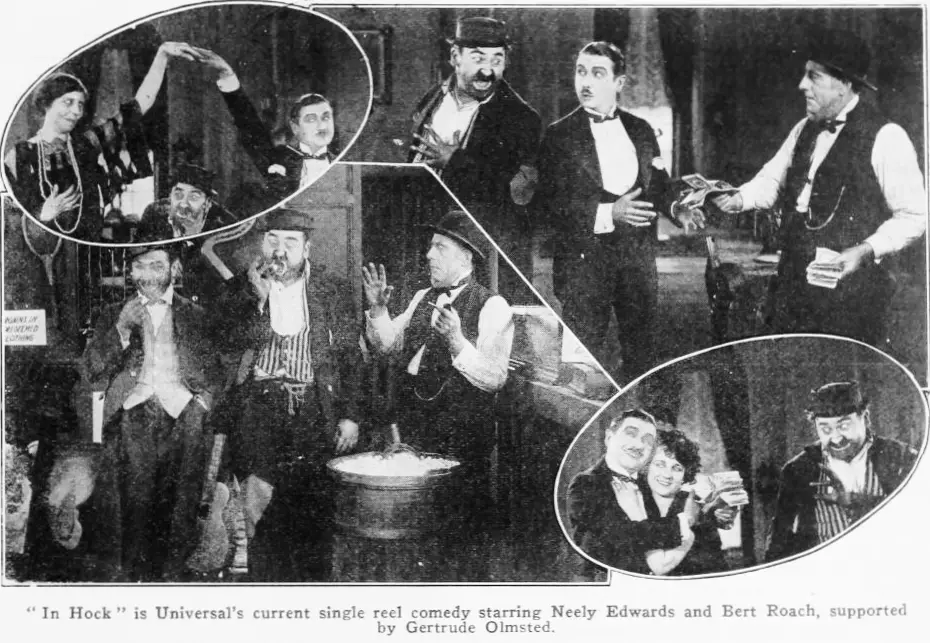
There is a specific, feverish rhythm to the silent comedies of the mid-1920s that modern cinema often struggles to replicate. It is a cadence of escalating anxiety, where the most mundane objects—a hat, a cane, or in the case of In Hock, a dress suit—become the epicenter of a localized apocalypse. Directed by the seasoned William Watson, this 1926 gem serves as a fascinating specimen of vestiary obsession and the precarious nature of social performance. Starring the perpetually flustered Bert Roach and the sharp-witted Neely Edwards, the film navigates the murky waters of debt, deception, and the sheer terror of being caught out of uniform.
The premise of In Hock is deceptively simple, yet it taps into a profound urban anxiety of the era. Ned, played with a delightful mix of entitlement and panic by Bert Roach, is a man whose identity is inextricably linked to his appearance. When his secretary, in a move of baffling audacity, pawns Ned’s dress suit, the stakes are not merely financial. Tucked within the lining of a pocket is a photograph of a girl—a piece of evidence that could potentially dismantle Ned’s carefully curated domestic or social life. This photograph acts as the ultimate MacGuffin, driving the narrative forward with a relentless, clockwork precision.
Unlike the more somber explorations of poverty seen in films like The Crisis, Watson’s film treats the pawn shop not as a place of tragic finality, but as a liminal space of high-stakes negotiation. The pawnbroker is the gatekeeper of Ned’s dignity. The sequence where Ned 'borrows' the suit back by offering his valet as human collateral is a stroke of dark comedic genius. It subverts the master-servant dynamic, turning a human being into a literal pawn in a game of fashion-forward survival. This transactional absurdity is reminiscent of the social critiques found in The Great Mistake, where the veneer of wealth is shown to be paper-thin.
The second half of the film shifts gears from a domestic farce into a full-throttle chase. Once the original owner of the suit—a man apparently as desperate for his threads as Ned is—offers a five-hundred-dollar reward for its return, the world of In Hock transforms into a predatory landscape. Every character becomes a hunter, and the suit becomes the prey. William Watson’s direction shines here, utilizing the urban geography to create a sense of mounting claustrophobia. The chase isn't just about speed; it's about the frantic, peripatetic movement of bodies through space, a hallmark of the era's physical comedy.
"In Hock is a testament to the idea that in the silent era, a man's worth was often measured by the cut of his jib and the speed of his retreat."
Comparing the frantic energy of this film to Oh, Girls!, one can see how Watson balances the gender dynamics of the era. Gertrude Olmstead provides a grounding presence amidst the male hysteria. While Roach and Edwards are busy tripping over their own feet and ethics, Olmstead’s character often serves as the silent observer of their folly. Her performance is subtle, contrasting sharply with the histrionic desperation of the male leads, a technique also employed effectively in The Girl from Bohemia.
From a technical standpoint, the cinematography in In Hock is remarkably fluid for 1926. The use of depth of field during the pawn shop scenes creates a cluttered, oppressive atmosphere that mirrors Ned’s internal state. The suit itself is lit with a curious reverence, often appearing brighter than the characters who fight over it. This visual hierarchy reinforces the theme that the object has surpassed the human in importance. It is a precursor to the object-fetishism we see in later works like Shell Shocked Sammy, where material goods dictate the moral compass of the protagonists.
The screenplay by William Watson is a masterclass in economy. In an age before dialogue could bail out a weak plot, the narrative relies entirely on visual cues and the expressive faces of its cast. The moment Neely Edwards realizes the suit is worth five hundred dollars, his entire physiognomy shifts from a loyal valet to a calculating opportunist. It is a transition that happens in a heartbeat, yet it tells us everything we need to know about the corrupting influence of sudden wealth. This theme of moral erosion is a recurring motif in silent cinema, often explored in more dramatic contexts like Faith, but here it is played for laughs that carry a sharp, cynical edge.
What sets In Hock apart from the standard slapstick fare of the time is its willingness to lean into the absurdity of its premise. The idea of leaving a human being as a deposit for a coat is inherently surreal, bordering on the Kafkaesque. It highlights the dehumanizing nature of the urban struggle, where people are as interchangeable as currency. While films like Civilization deal with the macro-horrors of society, In Hock finds the horror—and the hilarity—in the micro-transactions of everyday life.
The resolution of the film, without giving too much away, is a whirlwind of comedic timing. The convergence of the various parties—the pawnbroker, the valet, the secretary, and the rightful (and wrongful) owners of the suit—creates a chaotic tableau that is as satisfying as it is exhausting. It is the kind of cinematic payoff that requires immense rehearsal and a deep understanding of physical space. In this regard, Watson proves himself a peer to the greats of the genre, rivaling the structural integrity found in Smiling Jim or even the more complex The Stolen Play.
Ultimately, In Hock is more than just a relic of a bygone era. It is a vibrant, breathing piece of entertainment that speaks to the universal fear of losing face—and the literal clothes off one's back. Bert Roach delivers a performance of sweaty, wide-eyed brilliance, while Neely Edwards provides the perfect foil as the valet-turned-mercenary. The film’s pacing is relentless, its logic is delightfully skewed, and its heart is found in the frantic scramble for a piece of fabric.
For those who appreciate the artistry of the silent era, this film is an essential watch. It lacks the saccharine sentimentality that sometimes plagues films like Welcome Little Stranger, opting instead for a gritty, fast-paced cynicism that feels surprisingly modern. Whether you are a fan of the slapstick tradition or a student of cinematic history, In Hock offers a rich, rewarding experience that proves some things—like a good suit and a desperate man—never go out of style. It stands tall alongside other character-driven comedies of the period, such as Felix O'Day, reminding us that the best stories are often found in the most unlikely of places: the back of a pawn shop.
Review by the Cinephile's Journal Editorial Team. All rights reserved.
IMDb 6.1
1935
Community
Log in to comment.