DbcultAccessing Vault...
Cult Review
Senior Film Conservator
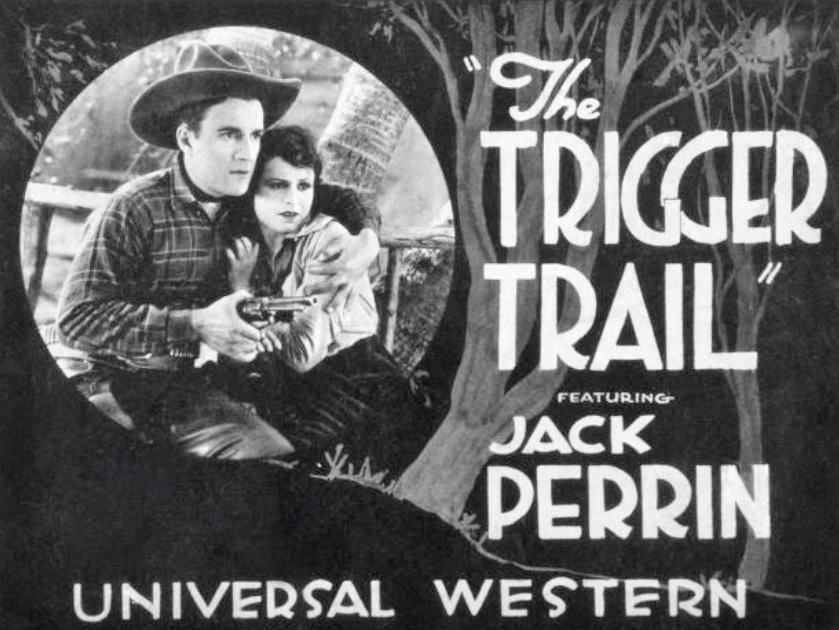
In the annals of early Western cinema, few films distill the essence of moral conflict and personal redemption as starkly as The Trigger Trail (1916). This film, a masterclass in visual storytelling, positions its lead sheriff not as a paragon of virtue but as a flawed, misunderstood figure whose silent resolve becomes the narrative's beating heart. Directed with a deft hand by George H. Plympton and J. Edward Hungerford, the film transcends its era's conventions by weaving a tale where the line between hero and pariah blurs, only to be redefined through action.
The film’s opening sequences establish a harsh, sunbaked terrain that serves not merely as a backdrop but as a character in its own right. The arid plains and jagged mesas mirror the protagonist's internal struggle, their desolation amplifying the tension between societal judgment and personal integrity. The use of natural light—harsh midday glare and the warm, melancholic hues of dusk—creates a chiaroscuro effect that underscores the sheriff's emotional journey. This visual motif echoes the techniques seen in The Blue Bird, where nature itself becomes a narrative device, though here the message is far grittier.
Jack Perrin’s portrayal of the sheriff is a masterstroke of understatement. His performance avoids the bombast typical of early action heroes, instead relying on micro-expressions and measured gestures to convey a man grappling with public scorn. When the posse dismisses him as a coward, Perrin’s eyes harden—not with anger, but with a steely determination that suggests a soul in quiet rebellion. This restraint contrasts sharply with the over-the-top villainy of Charles Herzinger’s bandit, whose histrionic menace feels almost comically out of step, a deliberate choice that highlights the sheriff’s moral gravity.
The script, penned by Plympton and Hungerford, unfolds with the precision of a coiled spring. The sheriff’s decision to aid a neighboring lawman is not framed as altruism but as a calculated risk—a bridge between self-preservation and duty. This duality is what elevates the film beyond mere genre fare. The sheriff’s eventual capture of the bandit is not a triumph of force but of strategy, a revelation that the audience pieces together alongside him. This narrative layering recalls the psychological depth of The Testing of Mildred Vane, though here the stakes are physical rather than social.
While the sheriff dominates the screen, the supporting cast adds texture. Louise Lorraine’s enigmatic presence introduces a thread of romantic tension that remains unresolved—a narrative choice that prioritizes thematic cohesion over genre expectation. Jim Corey’s grizzled deputy, though a stock character, is given moments of quiet wisdom, his gravelly drawl a counterpoint to the sheriff’s stoicism. These performances, though often confined to archetypes, are elevated by the actors' commitment to the material’s earnestness.
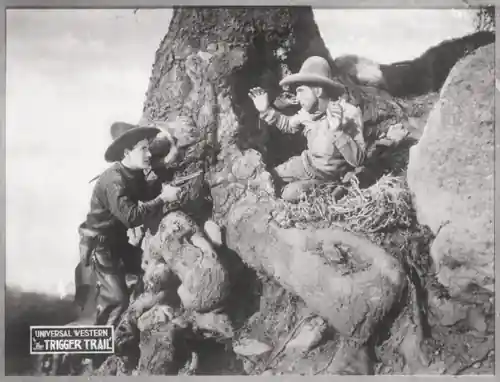
For its time, The Trigger Trail exhibits a remarkable command of cinematic language. The use of wide shots to emphasize the sheriff’s isolation is reminiscent of The Golden West, yet here the technique serves a more introspective purpose. The editing, though rudimentary by modern standards, maintains a brisk pace that mirrors the sheriff’s relentless pursuit. Perhaps most striking is the film’s use of silence—dialogue is sparse, with the score (or lack thereof) allowing the weight of each action to speak volumes.
Over a century later, The Trigger Trail remains a compelling artifact of the Western genre’s formative years. Its exploration of honor in the face of misunderstanding resonates in an era where public perception often eclipses truth. The film’s refusal to sanitize its protagonist—his moments of doubt, his silent battles with self-worth—offers a proto-existentialist take on heroism. In this light, it anticipates the anti-hero narratives of later decades, from The Prison Without Walls to modern revisionist Westerns.
The film’s aesthetic choices are both bold and deliberate. The stark, almost monochromatic palette is enlivened by the occasional burst of color—a red scarf, a golden sunset—that serves as a visual metaphor for hope. Starlight the Horse, though an animal actor, becomes a symbol of fidelity and partnership, their interactions with the sheriff a wordless testament to trust. This bond, though conventional, is rendered with such sincerity that it transcends cliché.
While The Trigger Trail stands on its own merits, its thematic kinship with The Sport of the Gods is undeniable; both films grapple with the tension between individual agency and societal expectation. Yet where the latter leans into melodrama, this film’s strength lies in its restraint. Similarly, its use of landscape as a narrative force evokes Melting Millions, though with a far more grounded emotional core.
In dissecting The Trigger Trail, one cannot overlook its role as a cultural document. It reflects the early 20th-century fascination with frontier justice and the mythologizing of the self-made hero. Yet it also subverts this myth by presenting a protagonist who is neither noble nor flawless, but human. This duality—between the myth of the West and the reality of its inhabitants—is what renders the film enduringly compelling. For those seeking a Western that marries action with introspection, this film offers a rare and rewarding journey.
IMDb —
1915
Community
Log in to comment.