DbcultAccessing Vault...
Cult Review
Senior Film Conservator
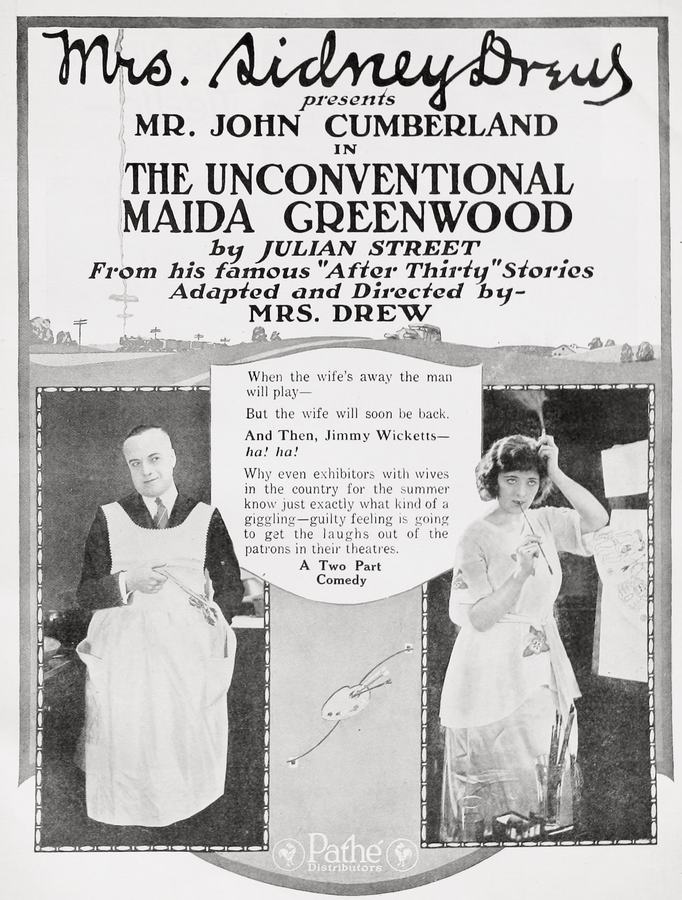
To witness The Unconventional Maida Greenwood is to step into a meticulously crafted parlor of social anxieties and gendered performances. Directed and written with the sharp, satirical edge that became synonymous with the Sidney Drew brand of comedy, this film transcends the simple 'naughty husband' trope to offer something far more ephemeral and biting. Unlike the broad, slapstick chaos found in Convict 13, the humor here is rooted in the psychological friction between public respectability and private yearning. The film presents us with Jimmy, played with a delightful, jittery energy by John Cumberland, whose every gesture screams of a man trying to convince himself of his own spontaneity. His 'fussing' with Maida Greenwood is not the act of a libertine, but the act of a man desperate to feel 'unconventional' by proxy.
The setting is almost claustrophobic, a domestic stage where every piece of furniture seems to stand in judgment of Jimmy’s minor transgressions. Maida herself, portrayed by Eleanor Custis, acts as the catalyst for this bourgeois breakdown. She is the 'unconventional' element—a term that, in the context of the era, suggested a terrifying lack of adherence to the domestic status quo. Yet, as the narrative progresses, we realize that Maida is less a person and more a projection of Jimmy’s mid-life malaise. His interactions with her are clumsy, lacking the suave grace of a true romantic hero, which only adds to the film’s poignant realism. It reminds one of the thematic explorations of identity and masquerade found in The Make-Believe Wife, where the boundaries of social roles are blurred for the sake of a temporary escape.
John Cumberland’s performance is a masterclass in the 'nervous comedy' that would eventually influence generations of comedic actors. He inhabits Jimmy with a physicality that is both frantic and restrained. When he is with Maida, his movements are expansive, almost performative in their attempt to mimic a bohemian freedom. However, the moment the threat of the domestic sphere—embodied by his wife—reappears, his posture collapses into a rigid, servile obedience. This transition is not merely funny; it is a scathing indictment of the performative nature of the 'good husband.' It echoes the frantic attempts at maintaining a facade seen in Dull Care, though with a much more sophisticated narrative backbone.
The writing, credited to the formidable trio of Mrs. Sidney Drew, Julian Street, and Tom Bret, avoids the pitfalls of moralizing. Instead, it leans into the absurdity of the situation. There is a specific cadence to the storytelling that feels remarkably modern. The film doesn't ask us to condemn Jimmy, nor does it ask us to pity him. It simply asks us to observe the futility of his 'digressions.' These small deviations from the 'straight and narrow path' are presented as essential safety valves for a society that demanded absolute conformity. In this sense, the film shares a certain DNA with The Misleading Lady, where the chase for excitement is ultimately a circular journey back to the familiar.
The true protagonist of The Unconventional Maida Greenwood is not Jimmy, but his wife, played by Mrs. Sidney Drew herself. Her presence is the gravitational center of the film. While Jimmy and Maida occupy the foreground with their 'fussing,' the wife exists in the periphery, a silent observer whose power lies in her perception. When she returns home, the film shifts gears. The 'unconventional' world of Maida Greenwood vanishes like a fever dream, replaced by the crushing weight of domestic normalcy. But rather than playing the role of the betrayed spouse, Mrs. Drew offers a performance of profound, quiet complexity.
Her smile—that final, enigmatic, knowing smile—is the film’s greatest achievement. It is a smile that suggests she has seen this play many times before. She understands that Jimmy’s infidelity is not a threat to their marriage, but a pathetic, necessary ritual that reinforces his dependence on her. This 'knowingness' elevates the film from a simple domestic comedy to a proto-feminist critique of the male ego. It is a far more nuanced take on gender dynamics than what is often found in contemporary works like The Sex Lure, which dealt with similar themes through a much more melodramatic and moralistic lens. Here, the power is not in the confrontation, but in the silent acknowledgment of the husband's inadequacy.
Visually, the film utilizes the limited technology of its era to create a sense of lived-in reality. The cinematography doesn't strive for the epic scale of Mr. Logan, U.S.A. or the fantastical drama of Edelsteine. Instead, it focuses on the intimate details: the way a hat is adjusted, the nervous glance toward a door, the subtle shift in a woman’s expression. The blocking of the scenes reinforces the theme of domestic entrapment. Jimmy is often framed by doorways or windows, suggesting a man who is perpetually on the threshold of something else, yet never quite able to cross over.
The collaboration between Julian Street and Tom Bret ensures that the intertitles are more than just plot descriptors; they are witty, observational asides that mimic the tone of a high-society gossip column. This literary quality distinguishes the film from more purely visual comedies like The Village Smithy. There is a sophistication to the irony here that requires a literate, attentive audience. The film assumes its viewers are familiar with the 'straight and narrow path' and the various ways one might try to stray from it without ever truly leaving the sidewalk.
In the broader landscape of silent cinema, The Unconventional Maida Greenwood stands as a precursor to the modern 'comedy of manners.' It eschews the grand historical sweeps of Nell Gwynne or the overt moralizing of The Craving in favor of something much more difficult to capture: the quiet desperation of the middle class. The film recognizes that for many, the 'conquest' is not of nations, as in The Spirit of the Conqueror, but of one’s own boredom.
Jimmy’s 'fussing' is a universal human experience—the desire to be someone else, to be 'unconventional,' if only for an afternoon. But the film’s genius is its insistence that we are always being watched, and that the people who know us best are often the ones who find our attempts at rebellion the most amusing. It is a sentiment echoed in He Comes Up Smiling, though that film takes a more optimistic approach to the idea of personal transformation. In Maida Greenwood, there is no transformation, only the restoration of a comfortable, if slightly fraudulent, order.
Ultimately, the film is a triumph of subtlety. It doesn't need the overt drama of The City of Illusion or the rugged masculinity of Sudden Jim. It finds its strength in the micro-expressions of its cast and the cleverness of its script. It is a film about the 'tail of a cat'—a small, seemingly insignificant thing that nonetheless reveals the direction of the whole animal. (And speaking of felines, one might find a curious thematic rhyme in the lightheartedness of The Tail of a Cat, though the stakes here feel significantly more grounded in the social reality of the time.)
As we look back at this gem, we see a bridge between the early vaudevillian influences of silent film and the sophisticated domestic satires that would follow. It is a testament to the Drews' ability to find the extraordinary within the ordinary, and to remind us that the most 'unconventional' thing of all might just be the truth of a long-term marriage. For those seeking a cinematic experience that is as intellectually stimulating as it is charming, The Unconventional Maida Greenwood remains an essential piece of the silent era puzzle. It is a film that smiles at us, just as the wife smiles at Jimmy, inviting us to share in the secret knowledge of the human heart’s small, predictable wanderings.
IMDb —
1916
Community
Log in to comment.