DbcultAccessing Vault...
Cult Review
Senior Film Conservator
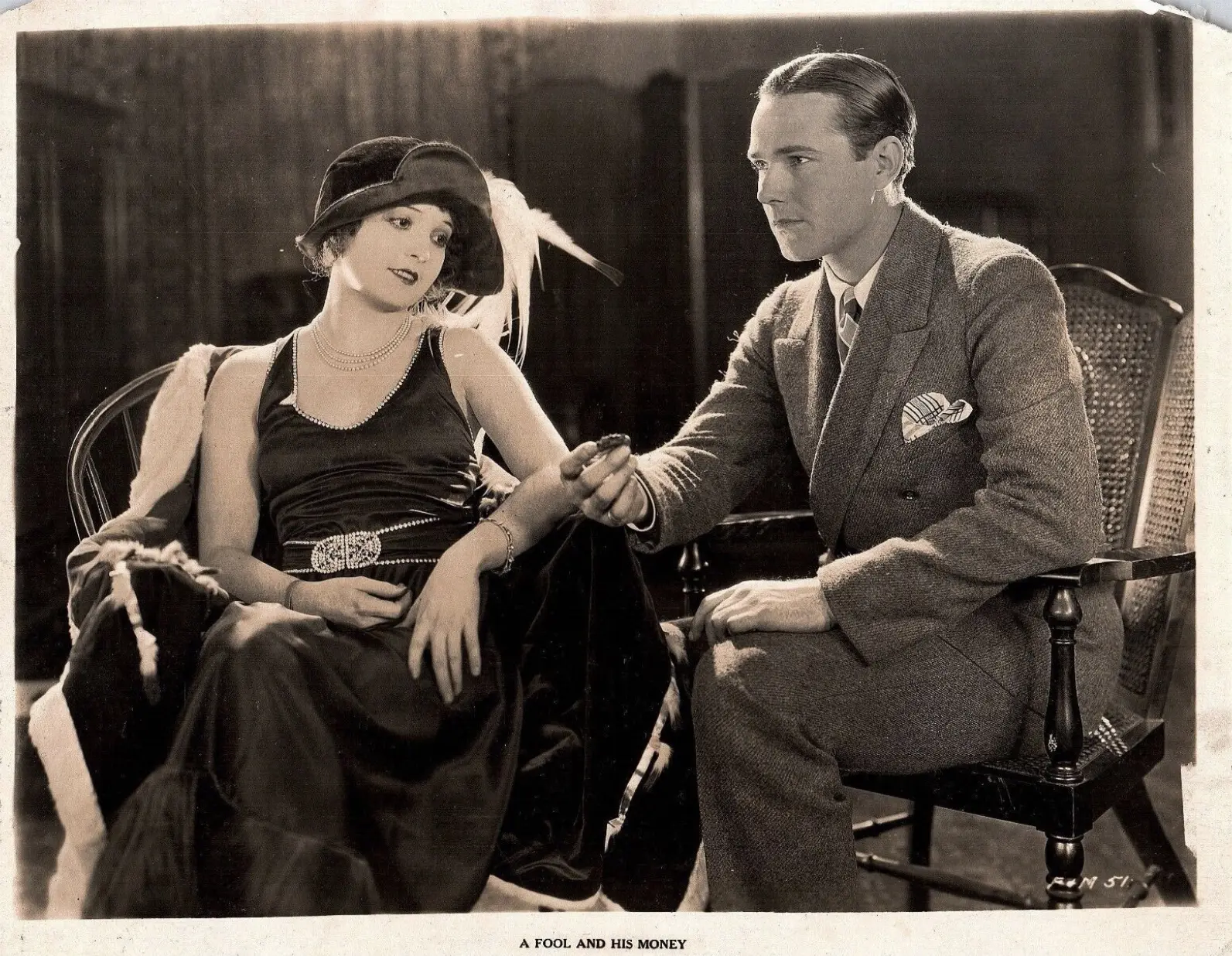
Ah, the silent era! A time of grand gestures, exaggerated expressions, and storytelling through the sheer force of visual artistry. In this vibrant tapestry of early cinema, a film like A Fool and His Money, released in 1925, stands as a fascinating artifact, offering a window into the romantic sensibilities and dramatic conventions of its time. It's a delightful blend of whimsical fantasy, burgeoning romance, and a touch of legal intrigue, all wrapped up in the charming, if somewhat naive, packaging of a bygone cinematic age.
Our story introduces us to John Smart, portrayed with an endearing blend of earnestness and youthful exuberance by the era's 'flaming youth' icon, William Haines. Smart is, by all accounts, a hack writer, a wordsmith toiling in relative obscurity, perhaps dreaming of grander narratives than he himself pens. His life, however, takes an abrupt and rather spectacular turn with the unexpected inheritance of a substantial fortune from a distant relative. This sudden affluence propels him from the mundane into a world of possibilities, the most immediate of which is the acquisition of a venerable, albeit slightly foreboding, castle in the German town of Laupheim. The very notion of a commoner inheriting such a windfall and then purchasing a European castle speaks volumes about the escapist fantasies prevalent in the 1920s, a trope that continues to resonate in narratives where destiny intervenes, much like the unexpected turns in The Great Gamble, though with a decidedly more romantic bent here.
The castle, far from being a mere backdrop, becomes a character in itself. It's replete with the usual trappings of such ancient abodes: long corridors, echoing chambers, and, naturally, a resident spectral presence. Smart, with a burgeoning curiosity that borders on the audacious, embarks on a quest to unravel the mystery of this apparent ghost, a beautiful woman who flits through the castle's shadows. What he discovers, however, is not a supernatural entity, but a flesh-and-blood enigma: the Countess von Pless, exquisitely played by Madge Bellamy. Bellamy, with her delicate features and expressive eyes, perfectly embodies the ethereal quality initially attributed to her character, making the reveal all the more poignant.
The Countess, it transpires, is the estranged wife of the castle's previous occupant, the notoriously cruel Count von Pless, brought to life with chilling effectiveness by Stuart Holmes. Holmes masterfully crafts a villain who is not merely an antagonist but a palpable threat, his sneering countenance and domineering presence casting a long shadow over the nascent romance. The dynamic between Smart and the Countess is a study in contrasts: his American optimism and her European melancholy, his newfound wealth and her inherited sorrow. Their connection, forged in the clandestine corners of the castle, blossoms with a tender fragility, a testament to the human need for companionship and understanding, particularly when faced with adversity. It's a romance that feels both fated and forbidden, reminiscent of other silent era tales where societal constraints and personal demons often stand in the way of true love, perhaps even more complex than the straightforward pursuit seen in In Quest of a Kiss.
The chemistry between Haines and Bellamy is palpable, a crucial element for any silent film romance. Their exchanges, conveyed through glances, gestures, and the occasional intertitle, speak volumes. Haines's boyish charm and earnest pursuit are perfectly complemented by Bellamy's elegant vulnerability. She embodies the classic damsel in distress, yet imbues the role with a quiet strength, suggesting a woman who has endured much and still hopes for solace. The film cleverly uses the 'ghost' premise as a catalyst, transforming a Gothic mystery into a heartfelt love story, a narrative pivot that demonstrates the writers' (Dorothy Howell, Walter Anthony, George Barr McCutcheon, Douglas Z. Doty) ability to infuse familiar tropes with fresh emotional resonance.
However, no good silent film romance is without its formidable obstacles, and the cruel Count von Pless provides them in spades. His malevolent presence looms large over the narrative, a constant reminder of the external forces threatening to tear our lovers apart. The Count's machinations are not merely born of jealousy, but of a possessive cruelty, a desire to control what he perceives as his property. He orchestrates a nefarious plot to ensnare Smart, attempting to convict him of obstructing justice. This legal entanglement adds a thrilling layer of suspense to the romantic drama, elevating the stakes beyond mere emotional turmoil. The threat of imprisonment or public disgrace for Smart, a newcomer to this aristocratic world, feels genuinely perilous, highlighting the rigid social structures and the power wielded by figures like the Count.
The film excels in building this tension, allowing the audience to feel the palpable pressure on Smart and the Countess. The writers skillfully weave the legal drama into the fabric of the romance, ensuring that the two plotlines are inextricably linked. It's not just about two people falling in love; it's about two people fighting for their love against a formidable, vengeful adversary. This aspect of the narrative, where external forces conspire against the protagonist, bears thematic resemblances to films like Miscarried Plans, where characters find themselves caught in webs of circumstance beyond their immediate control, though A Fool and His Money maintains a more overtly romantic core.
Beyond the compelling narrative, A Fool and His Money showcases the sophisticated cinematic techniques available in 1925. The set design for the German castle is particularly noteworthy, creating an atmosphere that is at once grand and slightly eerie, perfectly complementing the initial 'ghost' premise and the subsequent romantic intrigue. The use of shadows and light is masterful, a common but expertly deployed technique in silent films to convey mood and heighten drama. Close-ups are utilized effectively to capture the nuanced emotions of Haines and Bellamy, allowing their expressive faces to tell much of the story without the need for extensive intertitles.
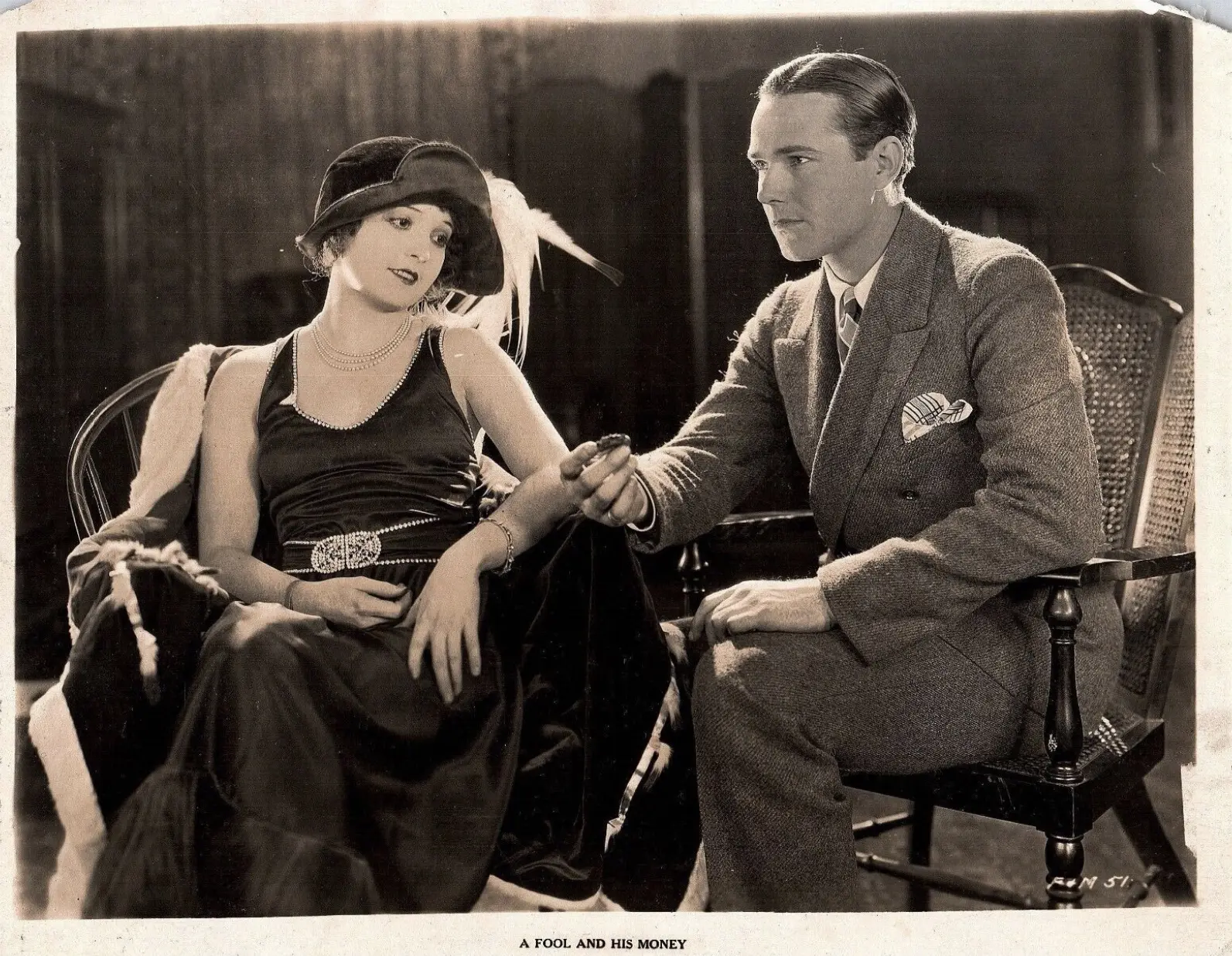
The direction, while not groundbreaking by today's standards, is efficient and clear, guiding the audience through the intricate plot with ease. The pacing is deliberate, allowing moments of emotional weight to breathe, yet it never drags, maintaining a steady momentum towards the climax. The editing, too, plays a crucial role in building suspense during the Count's machinations and in highlighting the tender moments between the lovers. One can observe the careful construction of scenes, designed to maximize visual impact and emotional resonance, a hallmark of skilled silent film production.
William Haines, a major star of the era, truly shines as John Smart. His persona as the 'flaming youth' — rebellious, charismatic, and slightly mischievous — is perfectly suited to the role of a young man who finds himself unexpectedly thrust into a world of old money and ancient grudges. Haines conveys Smart's initial naiveté and burgeoning confidence with equal conviction. His physicality and facial expressions are wonderfully calibrated, making Smart a relatable and engaging protagonist. He embodies the American ideal of rugged individualism meeting European refinement, a cultural clash that often provided fertile ground for silent-era narratives.
Madge Bellamy, as Countess von Pless, delivers a performance of remarkable grace and depth. Her portrayal avoids the pitfalls of mere victimhood, instead presenting a woman of quiet dignity and inner strength. Her eyes, in particular, convey a world of unspoken sorrow and longing, making her eventual blossoming under Smart's affection all the more believable and moving. The contrast between her initial spectral appearance and her eventual human warmth is beautifully rendered, demonstrating Bellamy's command of her craft. Her role here is a poignant example of the 'fallen woman' or 'woman in distress' archetype, yet she manages to imbue it with agency, even if subtle.
Stuart Holmes, as the villainous Count von Pless, is a masterclass in silent film villainy. His performance is appropriately theatrical, yet never descends into caricature. He exudes an aura of menace and entitlement, making him a truly formidable foe. The Count represents the entrenched power and corruption of the old world, a stark contrast to Smart's fresh, democratic spirit. Holmes's ability to convey such palpable malice without uttering a single word is a testament to his skill and the power of non-verbal communication in cinema.
The screenplay, credited to Dorothy Howell, Walter Anthony, George Barr McCutcheon, and Douglas Z. Doty, is an admirable adaptation. Taking a narrative that could easily devolve into melodrama, they instead craft a story that maintains a delicate balance between romance, mystery, and legal tension. The evolution of the plot, from the quirky premise of a ghost hunt to the more serious battle against injustice, feels organic and earned. They manage to infuse the story with both lighthearted charm and genuine peril, ensuring that the audience remains invested in the fate of the protagonists. The collaborative nature of silent film writing, as evidenced by the multiple credits, often led to robust story structures, ensuring all angles of the plot were explored and refined for visual storytelling.
The writers understood the power of visual metaphor – the castle as a prison, the 'ghost' as a symbol of the Countess's trapped existence. They also grasped the importance of character motivation, ensuring that even the Count's villainy stems from a twisted sense of possessiveness rather than arbitrary evil. This attention to detail elevates the film beyond a simple potboiler, giving it a certain depth and resonance. In an era where many films were quickly churned out, the thoughtful construction of A Fool and His Money stands out, showcasing a commitment to engaging narrative, much like the careful plotting evident in A Soul for Sale, which also delved into complex human motivations.
While perhaps not as widely celebrated as some of its contemporaries, A Fool and His Money remains a charming and engaging silent film that offers much to appreciate. It's a testament to the enduring power of classic storytelling: a compelling plot, sympathetic characters, and a clear conflict. For modern audiences, it serves as an excellent introduction to the silent era, showcasing its unique strengths and the captivating performances that defined it.
The film's exploration of themes such as social mobility, the clash between old-world aristocracy and new-world ambition, and the timeless struggle between good and evil, ensures its relevance even today. It reminds us that while cinematic technologies evolve, the fundamental human stories – of love, betrayal, and the pursuit of happiness – remain constant. It’s a delightful journey back to a time when expression was paramount, and the power of a glance could convey more than a thousand words. Ultimately, A Fool and His Money is more than just a historical curiosity; it's a vibrant piece of cinematic art that continues to charm and entertain, proving that true love, even against formidable odds, can indeed find a way, even in the silent, flickering frames of a forgotten castle. It captures a particular zeitgeist of the 1920s, a blend of post-war exuberance and enduring romanticism, making it a valuable cultural artifact in addition to a compelling watch.
IMDb 5.6
1933
Community
Log in to comment.