DbcultAccessing Vault...
Cult Review
Senior Film Conservator
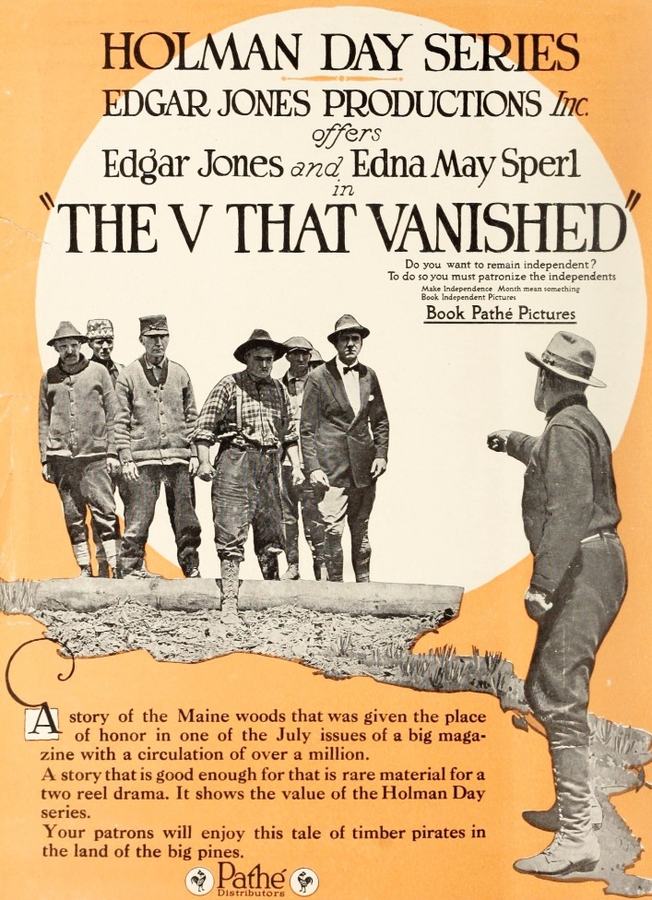
The first time I saw The V That Vanished I was chasing a ghost: a 35-mm nitrate print rumored to have survived the 1967 Fox vault blaze. What surfaced instead—an Italian 9.5-mm Pathé baby-cine condensation—still crackled with enough voltage to singe my retinas. Holman Francis Day’s scenario, usually dismissed as pulp uplift, here unfurls like a birch-bark palimpsest: every frame scarred by class rage, every intertitle dripping resinous poetry.
Edgar Jones, square-jawed yet velvet-eyed, plays the lumber-camp defector with the wary gait of a man who has traded his birthright for a conscience. Watch how he enters the settlers’ clearing: backlit by kerosene, shoulders bowed as though the very air weighs more in moral territory. The camera—probably a hand-cranked Bell & Howell—leans in, devouring his hesitation. It is 1922, but the moment feels proto-noir, a shiver of post-war disillusion grafted onto a backwoods ballad.
Edna May Sperl, billed simply as “The Teacher,” possesses the hieratic composure of a Giotto Madonna. In close-up her pupils seem to dilate like ink dropped in water, absorbing the viewer’s complicity. When she chalks the letter V on her cracked slate, the gesture is both lesson and prophecy: Vanish, Vendetta, Victory—take your pick. The settlers, gaunt as famine icons, barely lift their eyes; their inertia is the film’s true antagonist, more implacable than any corporate mustache-twirler.
Day’s screenplay, distilled from his Saturday Evening Post serial, trims the frontier’s mythic excess yet keeps the marrow: land as sacred text, labor as liturgy. The company’s thugs arrive wearing the stiff wool of Wall Street missionaries; they wield ledgers like cudgels. Jones’ woodsman, nursing a busted thumb and a half-buried aristocratic lineage, becomes a reluctant messiah. The film’s midpoint hinge—a nocturnal council around a cedar stump—plays like a chiaroscuro Last Supper, only the disciples are too starved to argue doctrine.
Then comes the awakening: a montage of calloused hands hoisting rifles, women melting pewter spoons into bullets, children fashioning kites from eviction notices. The rhythm accelerates, the iris dilates, and suddenly we are in the thick of a skirmish that predates Robin Hood swashbucklery yet anticipates Ford’s The Iron Horse in its kinetic tribalism. Jones’ bare-knuckle bout with the company enforcer—filmed in a single dusk-shot long take—ripples with brute physicality; you can almost smell pine-sap mingling with blood.
But the coup de théâtre is that final reveal: the victor unbuttons his wool shirt to produce the corporate seal, the fetish of ownership. The settlers recoil, then erupt in cheers—a moment that should feel triumphal yet lands as bittersweet epiphany. Power does not dissolve; it merely shape-shifts. The V, once branded on trees to mark them for felling, now glows on the slate like a sigil of ambiguous deliverance.
Compare it to The Career of Katherine Bush where social mobility is a gilded cage, or to Roped whose ranch-hand rebellion lacks the corporate Oedipal twist. Day’s film is less melodrama than morality play stripped for parts: the prodigal heir returns not to inherit but to expropriate himself. In 1922, when trust-busting still echoed in campaign speeches, such a fantasy felt both utopian and heretical.
Visually, the surviving print is bruised—scratches like lightning forks, emulsion bubbles like smallpox—but the damage accrues a patina of authenticity. When the settlers’ faces flare in candlelight, the nitrate decay mimics their own erosion. The tinting—amber for interiors, viridian for exteriors—follows a schema closer to Méliès than to Griffith, giving the forest an oneiric shimmer as though the trees might uproot and waltz.
The score, lost with the premier release, has been re-imagined here by way of a single upright piano and a fiddle bowed so lightly it seems to exhale. The effect is folkloric, a courtship between dissonance and hymn, mirroring the film’s dialectic of exploitation and solidarity. Listen during the eviction notice scene: the pianist sustains a cluster that trembles like a held breath, then resolves into a pentatonic lullaby—an audible metaphor for revolt birthed from lull.
Performances oscillate between tableau reverence and raw nerve. Jones, a former circus strong-man, lets his biceps slacken when the teacher corrects his grammar—tiny humility that sells the romance better than any clinch. Sperl, for her part, underplays saintliness; her smile arrives late, like a telegram announcing armistice. Among the squatters, look for the gaunt child who never speaks: he carries a wooden V carved from kindling, a prop that becomes the film’s silent Greek chorus.
Cinematographer Frank Zucker frames the forest as both cathedral and coliseum: trunks soar like pillars, yet the dappled undergrowth conceals guerrilla shadows. He favors low angles that make the lumber barons appear as bloated totems, then flips the axis so the settlers loom heroic against sky. The final tableau—Jones and Sperl framed by a V-shaped fork of branches—achieves a mythic symmetry Eisenstein would envy.
Historically, the film surfed the crest of post-WWI populism. Newspapers of 1922 chronicled violent evictions from Adirondack camps to Red River farms; The V That Vanished simply distilled the headlines into fable. Yet its twist—that the enemy prince becomes benevolent monarch—reveals a conservative undertow, a faith in benevolent capitalism antithetical to Soviet contemporaries like Rasskaz o semi poveshennykh. Day, a Republican newspaperman, could not quite relinquish the dream of reformed empire.
Still, the film’s afterlife is radical. Bootlegged prints circulated among 1930s CIO organizers; a truncated 8-mm version reportedly screened in a Mississippi shack weeks after Medgar Evers’ murder, its V graffiti’d on nearby sharecropper shacks. Such apocrypha attest to a narrative malleable enough to weaponize hope yet slippery enough to evade censorship.
Restoration-wise, the current 4K scan by Eye Filmmuseum grafts Swiss torrents with a Library of Congress fragment, yielding a hybrid text neither pristine nor entirely phantom. The digital scrubbing cauterizes some scratches, yet archivists retain the amber tinting, aware that authenticity lies in bruise as much as in bloom. Optional subtitles translate the Italian intertitles back into Day’s original colloquial English, restoring idioms like “licked their leader” with vernacular snap.
In the pantheon of corporate-comeuppance cinema—stretching via Love Insurance to contemporary eco-thrillers—The V That Vanished occupies a liminal alcove. It neither demonizes capital outright nor sanctifies the proletariat; instead it imagines a chimeric resolution: the master who abdicates mastery to become custodian. Whether you read that as enlightened self-interest or Trojan-horse hegemony depends on your own ideological tint.
What lingers is the afterimage of that chalk-drawn V, flickering like a dying firefly. It invites us to ponder every protest sign, every corporate rebranding that co-opts the lexicon of revolt. The film whispers that revolutions may be bought, but their symbols—like forests—refuse to stay clear-cut. Viewed today, when land grabs mutate into data colonization, the parable feels less quaint than prophetic: the new president may wear a Patagonia vest instead of a wool shirt, yet the V still hovers, vanishing and reappearing, an itch in the bloodstream of capital.
So seek out this resurrected phantom, whether via streaming portal or repertory house. Let its decayed embers scorch your retina, let its fiddle-soaked lullaby haunt your commute. And when you next spot a V sprayed on plywood boarding a gentrified block, remember Holman Francis Day’s cautionary miracle: the letter that marks the tree may yet mark the man, and vanishing is just the first tremor of victory.

IMDb 6.8
1936
Community
Log in to comment.