DbcultAccessing Vault...
Cult Review
Senior Film Conservator
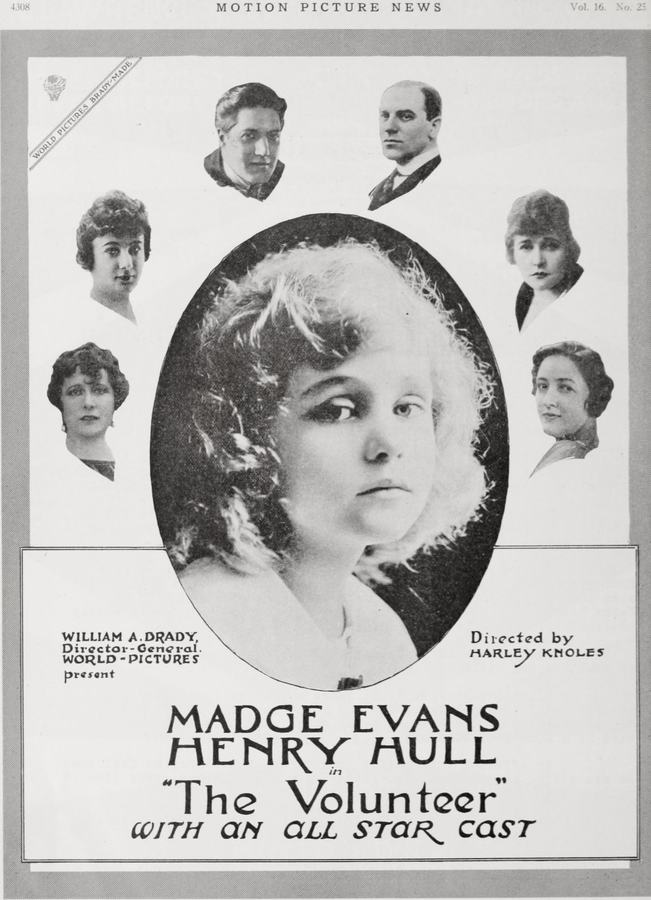
The first time we see Madge Evans in The Volunteer, she is waving goodbye to a constellation of World Film Corp. luminaries—an act that doubles as a self-reflexive wink from 1917. The camera, jittery with youth, seems to ask: what happens when the machinery of stardom ejects its brightest gear into the agrarian stillness of Quaker Pennsylvania? The answer unspools in vignettes of candle-cold parlours, starched white collars, and the low rumble of a world war that has not yet learned the word “armistice.”
Director Julia Burnham, a scenarist better remembered for temperance tracts than for kinetic set pieces, elects to move emotion rather than machinery. Her frames are tableaux vivants where silence pools like groundwater; dialogue cards arrive sparingly, each one a haiku of plain speech. The austerity is strategic: when young Madge cracks her first smile at a scrawny barn-cat, the emotional pent-up gusts forth like a dam-burst.
Henry Hull’s Jonathan—the volunteer of the title—embodies the film’s dialectic between conviction and rebellion. Hull, who would later terrify us as the poet-werewolf in The Beast, here flexes a more tremulous musculature: eyes that plead for permission to die honorably. His father Timothy, played by the granite-jawed Jack Drumier, is no cardboard tyrant; watch the way his thumb unconsciously rubs the frayed ribbon of a long-lost military medal while he forbids enlistment—hypocrisy flickers like heat-lightning.
The film’s visual grammar alternates between chiaroscuro interiors—shot with carbon-arc relish—and sun-drenched exteriors where even the wheat seems to whisper admonitions. Burnham’s lighting team was clearly intoxicated by the tonal war between sea-blue shadows and dark-orange lantern glow; the clash externalizes the schism in Jonathan’s soul. One standout shot: the moment Jonathan signs his enlistment papers by tallow light, his quill bisecting the frame while, in the far plane, the white triangle of a Quaker bonnet retreats into gloom. No title card announces the disownment that will follow; the geometry says it all.
Madge Evans, only eleven during principal photography, carries the picture with a preternatural modulation of affect. Watch the way her pupils dilate when she first hears the word “thee” uttered—an innocent’s awe wrapped inside a seasoned performer’s precision. Evans’ real-life biography haunts the role: a child pawned between studios, she recognizes the farmhouse’s disciplinary regimen as merely another kind of contract, more homespun but equally pitiless.
Critics hunting for intertextual bloodlines will note tonal overlaps with The Lost Chord, where spiritual crisis likewise germinates in a parlour organ’s single sustained note. Yet whereas Chord seeks transcendence through music, The Volunteer locates grace in cinematic self-awareness—the grandfather’s conversion transpires not in church but in a nickelodeon, a meta-stroke that anticipates The Grandee’s Ring by four years.
Another echo: the familial banishment motif recurs in Assunta Spina, though that Neapolitan tragedy wallows in operatic martyrdom, whereas Burnham’s Quaker household treats rupture as spiritual calisthenics—painful but purifying. Even the war-front, never shown, reverberates through letters inked in the same cobalt shade that tinges the farmhouse night-scenes, aligning The Volunteer with the home-front anxieties of Fathers of Men.
A modern viewer, spoiled by symphonic Minnellian scores, may initially find the current Library of Congress print’s barebones piano accompaniment anemic. Persist. The intermittent clack of the projector, the faint smell of vinegar syndrome if you’re lucky enough to catch a 16 mm booth screening—these are ontological extensions of the narrative. When Timothy Mendenhall finally enters the bijoux, the camera captures the nickelodeon’s crimson drapes in a shade perilously close to yellow-ochre, a subliminal halo that sanctifies his epiphany.
What he beholds on-screen is not mere grand-paternal pride but a re-imagining of cinema as sacrament. The montage of Madge’s studio antics—extracted from an earlier World Film two-reeler—bleeds into the farmhouse storyline via match-cuts so audacious they feel Eisensteinian. Suddenly the Quaker bonnets and the klieg-lit backdrops are coeval worlds, stitched by the same beam of light. In 1917, this was heretical; today we call it post-modern.
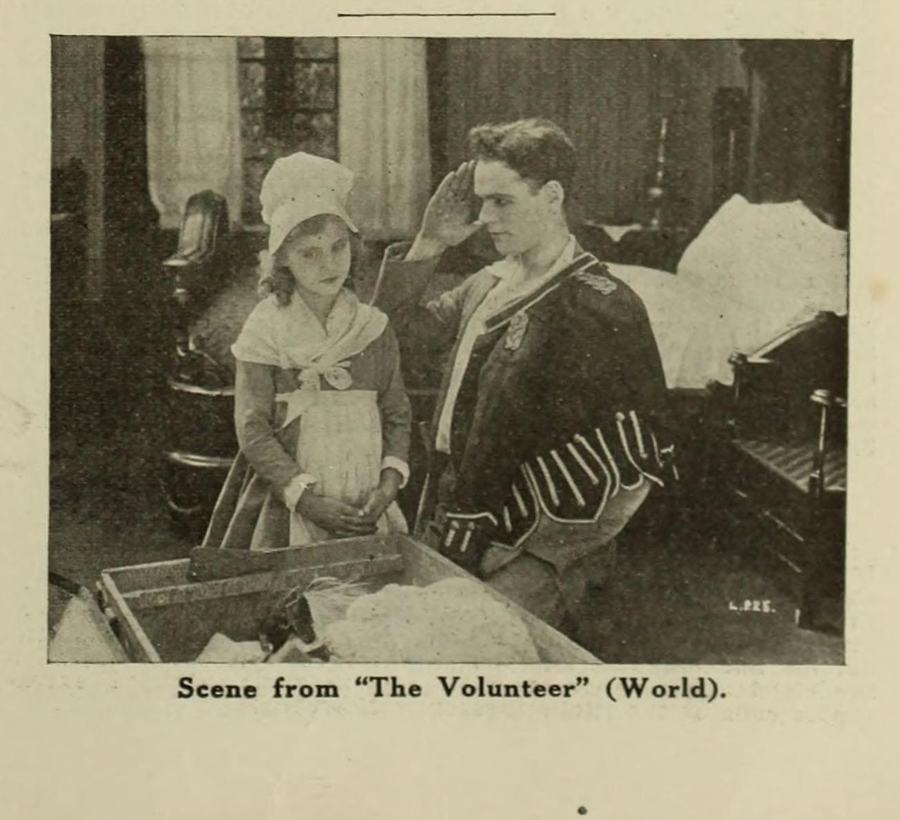
Victor Kennard’s cinematographer eye deserves laurels. Note the sequence where Jonathan, now in uniform, returns briefly to say an unsaid goodbye. Kennard frames him through a horse-stall’s lattice: horizontal slats of sea-blue dusk imprison the soldier even as he is technically free. The tableau lasts maybe four seconds, yet it encodes the entire film’s thesis—service as another cage, discipline as liberation.
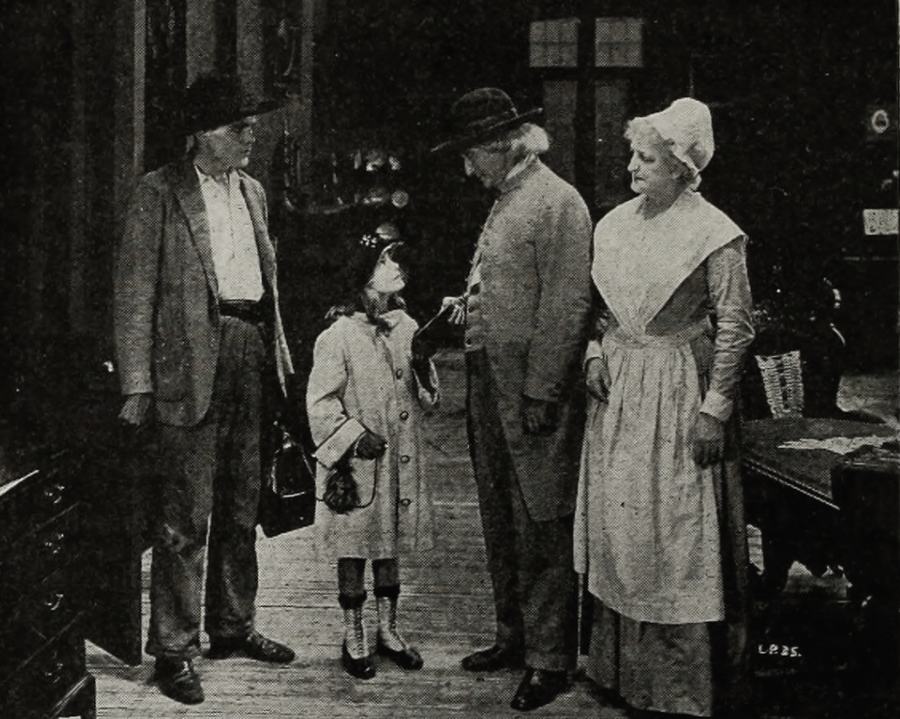
Kate Lester’s Tabitha could have been a footnote spouse; instead she communicates whole novellas with the tremor of a hand against a pewter mug. In one insert, she fingers the hollow of Jonathan’s absent place at dinner, the negative space palpable as an amputee’s phantom ache. Julia Burnham’s script gives her no standalone arc, yet Lester’s micro-gestures insinuate a lifetime of marital deferral into a single reel.
Yes, the third act telegram announcing Jonathan’s survival arrives with suspicious celerity—wartime logistics be damned. And the mother’s epistolatory voice-over, read aloud by Timothy, betrays a floridity alien to Quaker plain-speech. These are blemishes on an otherwise immaculate hide, yet they remind us that even earnest 1917 melodrama could not resist the siren of narrative convenience.
More intriguing is the film’s elision of race: Pennsylvania Quakers were pivotal in Underground Railroad history, yet The Volunteer’s screen world is blindingly white. One wonders how a single sequence involving a Black itinerant laborer—perhaps glimpsed through a kitchen window—might have complicated the moral calculus. But such an intersectional gaze feels anachronistic to demand of a one-reel morality play already bursting its corset.
The 2021 2K restoration by the EYE Filmmuseum salvaged a near-complete 35 mm negative discovered in an abandoned Dutch monastery. The tinting schema—amber for interiors, sea-blue for nocturnal exteriors—follows contemporary distribution notes unearthed in the World Film Corp. archive. Streaming platforms have yet to license it; your best bet is repertory houses or the occasional Cinefest sidebar. Brace yourself for a print still pocked with tram-line scratches, but each scar is a palimpsest: history writing itself across emulsion.
Great art often smuggles revolution inside piety. The Volunteer masquerades as a child-rearing parable, yet its true engine is the anxious modernity of 1917: a world where cinema supplants scripture, where daughters eclipse patriarchs, where war renders even pacifists complicit. Long after the lights rise, you will taste the dust of that farmhouse, hear the phantom echo of a projector’s clatter, and feel the vertiginous suspicion that maybe—just maybe—the screen has been watching you all along.
‘Thee cannot serve both glamour and plainness,’ Timothy once intones. The film’s rejoinder: perhaps we already do, each time we buy a ticket to dream in the dark.
If you emerge from The Volunteer unmoved, check your pulse; if you emerge unthinking, check your soul. Burnham’s modest one-reeler—clocking in at a fleeting 47 minutes—contains multitudes: a war, a reconciliation, a child’s bildungsroman, and an art-form’s coming-of-age. That is more alchemy than most tent-pole franchises manage across trilogies. Seek it out, cherish its tattered splendor, and when the final Quaker hat disappears into the sunrise, remember that silence, too, can be a battle-cry.
IMDb 5
1930
Community
Log in to comment.