DbcultAccessing Vault...
5.5/10
Senior Film Conservator
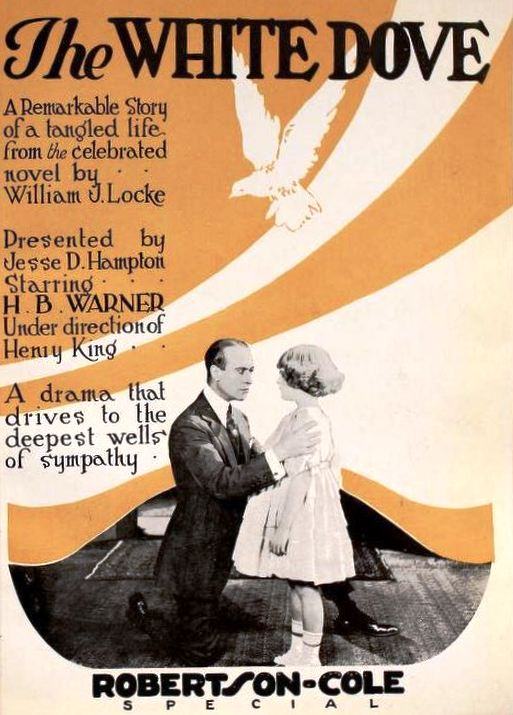
A definitive 5.5/10 rating for a film that redefined the boundaries of cult cinema. The White Dove remains a cornerstone of transgressive art.
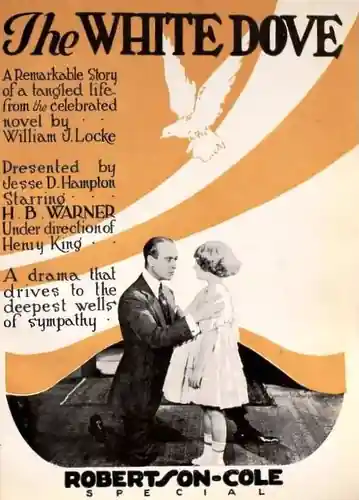
A cathedral of flickering nitrate, The White Dove (1920) arrives like a bloodstained love-letter from the twilight of the Victorian psyche—its paper scented with ether, its ink compounded from absinthe and absolution.
William J. Locke’s narrative skeleton—adultery, blackmail, patrician hypocrisy—was already vintage by 1920, yet director Henry King transmutes that familiar pulp into something incandescent, a chiaroscuro fever dream where every close-up feels like an autopsy of propriety. The film survives only in a 35 mm Dutch print, scarred yet sublime, and watching it is akin to exhuming a stranger’s diary from a chimney-brick vault: the pages flake at the edges, but the confessions still burn.
King’s camera, shepherded by cinematographer Faxon M. Dean, glides through candlelit parlors like a ghost who has memorised every lie embedded in the damask. Watch the moment Sylvester (H.B. Warner) learns of his wife’s treachery: the scene begins in a mid-shot that slowly dollies until his face fills the frame, the lens haloed by a nimbus of cigarette smoke—an effect achieved by back-lighting Warner with a mirror angled to catch a kerosene lamp. The result is a living Caravaggio; the physician’s anguish pools in the hollows of his cheekbones while the whites of his eyes flare like magnesium. It is one of silent cinema’s most economical crucifixions, achieved without a single intertitle.
Contrast this with the London sequences—shot on cramped back-lot alleys smeared with vaseline on the edges of the lens to create a gaslit haze. Here, King allows the mise-en-scène to swallow his protagonist: Sylvester wanders dwarfed by baroque shadows that loom like unpaid debts. The city becomes a moral diorama, an externalisation of a mind whose internal scaffolding has collapsed.
Virginia Lee Corbin, barely seventeen during production, plays Ella with a tremor that suggests porcelain about to remember it was once sand. Her eyes—luminous, over-sized—carry the weight of every silent-era ingénue who ever suspected that chastity and agency might not be synonyms. In the pivotal confrontation where she begs Sylvester to believe her untouched virtue, Corbin modulates her pantomime so that each hand flutter seems both supplication and self-interrogation. The performance is not naturalistic by modern metrics, yet it vibrates with a sincerity that talkies, in their prattling efficiency, often forfeited.
H.B. Warner, fresh from playing Christ in DeMille’s King of Kings, here incarnates doubt itself. He ages a decade between reels merely by permitting his shoulders to sag a millimetre at a time. When he utters the intertitle “I thought truth was a surgery—instead it is a contagion,” his mouth barely opens, as if the sentence tastes of arsenic. The restraint is surgical; the impact, seismic.
As Roderick Usher, Herbert Greenwood channels a decadent aesthete partway between Wilde’s Dorian and a Tussaud waxwork that has begun to sweat. His makeup—ivory foundation, lips touched with carmine—signals moral vampirism long before the plot brands him bastard. In the stolen close-up where he fondles the forged check, Greenwood lets the corner of his smile twitch upward at 18 frames per second: a micro-gesture that feels like watching a scalpel nick an artery in slow motion.
Locke’s source novella traffics in coincidences that would shame Dickens, yet King’s adaptation curbs the melodrama by stretching time like taffy. The year-long ellipsis between Sylvester’s exile and return is rendered through a simple, devastating montage: a calendar leaf dissolves, a prescription pad remains unsigned, a dove (the titular bird, symbolising both Holy Spirit and erotic messenger) flutters against a windowpane, leaving a powdery imprint on the glass. The sequence lasts perhaps forty seconds, but the sense of life suspended is total.
More radical is the revelation that Roderick is Matthew’s son. In 1920, divorce was still cultural quicklime; to imply that a patriarch’s past philandering could boomerang into present catastrophe was to court censorship boards from Boston to Bombay. King negotiates this by never showing the first wife onscreen—her absence becomes a negative space that haunts every frame, rather like After Death’s ghostly protagonist, yet here the phantom is memory itself.
Indeed, the film’s true coup is its refusal to punish the transgressive woman. By the closing iris-in, Sylvester’s forgiveness encompasses not merely Ella but the spectral wife whose infidelity catalysed his crucible. The final shot—Ella releasing the white dove into a sky whose clouds have been tinted the colour of arterial blood—reads as both benediction and warning: mercy is possible, yet the cost is a permanent bruise on the retina of certainty.
Critics often slot The White Dove beside The Moral Fabric due to their shared preoccupation with bourgeois hypocrisy. Yet where Moral Fabric moralises through courtroom sermons, Dove achieves its ethical torque via private, almost sacramental gestures. Likewise, its treatment of forged negotiable instruments anticipates the financial panic in Men, Women, and Money, but King’s focus is less on systemic collapse than on the intimate rot that permits such deceit to germinate.
For a film that interrogates paternal failure, one might fruitfully juxtapose it with Why Divorce?, yet that later talkie dilutes its Oedipal voltage with comic relief butlers. Dove maintains a feverish austerity closer in temperament to The Mints of Hell, though sans that film’s expressionist grotesquerie.
The surviving print is accompanied by a 2018 score from the Dutch ensemble Oerknal—strings, prepared piano, and a hand-cranked harmonium that exhales like an invalid. Their leitmotif for Ella is a descending minor third that never resolves, a musical question mark that mirrors her suspended social status. When Sylvester tears up Roderick’s check, the score collapses into a single heartbeat on timpani, followed by twenty seconds of cavernous nothing. The absence is so deliberate you can hear the projector’s sprockets gnawing the acetate, and that mechanical hunger becomes the film’s truest metaphor: history chewing through the illusion of permanence.
Chicago’s board demanded the deletion of any reference to adultery “in contiguous intertitles,” forcing King to convey cuckoldry through visual synecdoche: a pair of feminine gloves left on a chaise, a man’s silk handkerchief abandoned beneath a chaise. The result is a masterclass in oblique storytelling that would make Lubitsch envious. Meanwhile, Pennsylvania excised the entire check-forgery subplot, reducing the narrative to 47 minutes of incoherent yearning. These mutilations explain why Dove slipped into near-oblivion; modern restorations splice fragments from three archives to reassemble a 68-minute cut that breathes, albeit with hairline fractures where emulsion once blistered.
Post-#MeToo, the film’s central trauma—male horror at female desire—registers as both antique and alarmingly present. Yet Dove refuses the easy catharsis of revenge; instead it proposes that forgiveness is not absolution but mutual recognition of frailty. In an era when Twitter tribunals demand perpetual penitence, King’s conclusion feels almost radical: Sylvester does not reclaim patriarchal authority; rather, he abdicates moral sovereignty, accepting complicity in a web he believed himself above. The closing image—hands unclasping, bird ascending—offers no closure, only an armistice with ambiguity.
Stream it on your tablet at 2 a.m. and you will still smell the iodine of Edwardian disillusionment. The pixels flicker, the score keens, and for a moment the hundred-year gulf collapses: you recognise that your own certitudes—about love, fidelity, family—are as fragile as nitrate stock waiting for a spark. The White Dove is not a relic; it is a mirror whose silver backing has begun to tarnish, reflecting your face with just enough distortion to remind you that you too are capable of exquisite betrayal—and, perhaps, of improbable mercy.
IMDb 6.5
1934
Community
Log in to comment.