DbcultAccessing Vault...
Cult Review
Senior Film Conservator
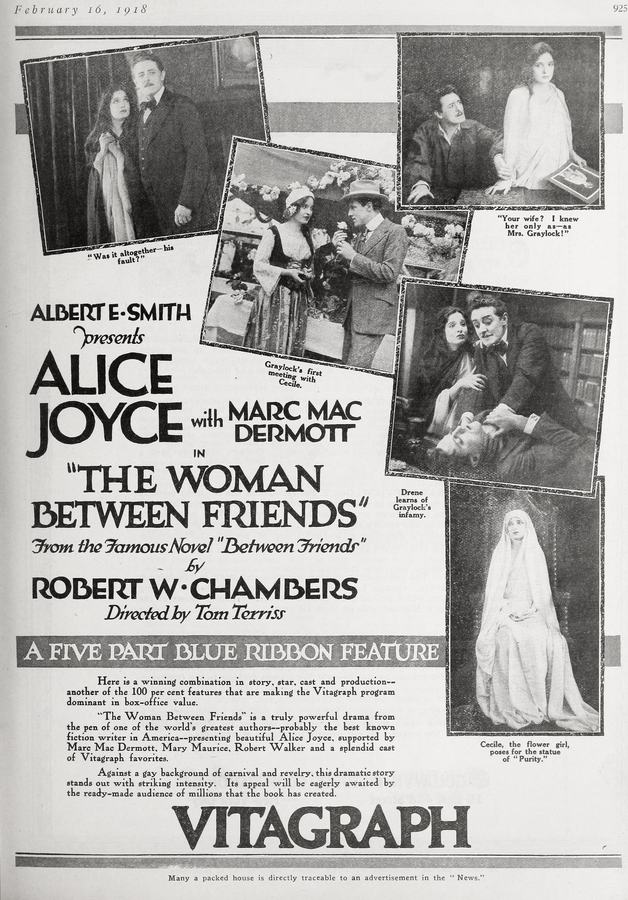
Paris, 1918. Gaslights gutter against the fog; absinthe trembles in chipped glasses; the air is thick with turpentine and the coppery scent of ambition. Into this shadowed arrondissement strides The Woman Between Friends, a brittle little tragedy that feels as if someone smashed a Toulouse-Lautrec poster and stitched the shards with razor wire. The film, long buried in the archival catacombs, surfaces now like a half-remembered fever dream—equal parts velvet glove and mailed fist.
John Drene—stoic, chisel-handed, granite-shouldered—embodies the sculptor as moral titan. His studio is a cathedral of dust where unfinished torsos strain toward life. Jack Graylock, by contrast, is paint-splashed mercury, a man who wears his beret like a challenge and his sins like cologne. The pact they seal over a bottle of cognac is less friendship than mutual dare: betray me if you can. When Jack elopes with Drene’s bride on the honeymoon train, the narrative snaps taut like a wet canvas left to freeze.
Director Tom Terriss, adapting Robert W. Chambers’ pulp-poetic novella, refuses to grant us the comfort of villains. The runaway wife is neither harpy nor hapless; she is simply bored, a moth singeing her wings on two separate flames. Her eventual death—flames licking up a silk negligee after a lamp topples—plays out off-camera, reported by a gendarme whose face we never see. The horror is more potent for being hearsay, a scorch mark on the viewer’s imagination.
Into the post-catastrophe rubble wanders Cecelie, a wisp who could have been drafted by Dickens and refined by Colette. She clutches violets so fresh they seem stolen from a funeral. Jack, craving absolution, drapes her in his mantle of bohemian charity: a Left Bank garret, a borrowed cloak, the promise of sainthood. Yet the camera, cannily, keeps her slightly out of focus until she stands before Drene’s half-hewn statue—his absent wife’s doppelgänger in clay. The moment her bare shoulder catches the skylight, the marble appears to inhale.
Drene’s gaze, previously a drill bit of vengeance, wavers. The montage that follows—chisel striking, Cecelie posing, petals falling across the studio floor—feels almost erotic, yet curiously chaste, as if art itself were the third lover in the room. Terriss intercuts close-ups of stone chips and eyelashes, equating the two: both fragile, both capable of drawing blood.
When Cecelie’s naïve prattle spills Jack’s guilt—“He told me she burned like a candle, monsieur”—the film pivots from melodrama to something closer to Jacobean tragedy. Drene’s response is exquisite: no howl, no smashed maquette, merely a whispered date—“Dawn, the day after the vernal equinox”—and the gift of a revolver with one chamber loaded. The pistol becomes the film’s bleak metronome; every scene thereafter ticks toward its inevitable report.
But vengeance, like sculpture, is a subtractive art. Drene decides death is too pat; he must first unmake Jack by stealing the only thing left that Jack loves—Cecelie. What ensues is a seduction that masquerades as rescue: gallery soirées where champagne sparkles like diamonds against the Seine, carriage rides through rain that smells of lilacs and ozone. Cecelie, poor moth number two, believes she is being courted; the camera knows otherwise, framing her through wrought-iron bars even when they stroll open boulevards.
Yet the heart is a trickster. Drene, rehearsing cruelty, finds himself rehearsing tenderness instead. In a bravura sequence lit only by a zinc-clad stove, he sketches Cecelie on butcher’s paper; the charcoal whispers stay. The moment is wordless, underscored by a solo cello on the reissue soundtrack—an anachronism, yes, but one so plaintive it feels excavated from 1918 itself.
Meanwhile, Jack prepares for his mandated suicide with the punctiliousness of a Japanese poet writing a death haiku. He buys white lilies, settles unpaid tabs, and finally lies in a tin basin painting his own portrait as a corpse—an eerie presage of Van Gogh’s later self-autopsy. The canvas, half-finished, slumps like a shroud when the hour strikes.
The showdown transpires not in a foggy field but inside Drene’s studio, that sanctum now haunted by plaster ghosts. Jack, trembling, presses the muzzle beneath his ribs; Drene watches, arms folded like a Roman judge. Cecelie bursts in, petticoat sodden from the rain, and positions herself between hammer and anvil. The gun roars; a stray shard of skylight shatters, sending constellations of glass across the floor. Jack collapses—blood blooms across his shirt like poppies in a Flanders field—but the wound is superficial, a graze of both flesh and conscience.
In the original intertitles, Drene’s final line reads: “The statue is finished; let it stand.” Critics have sparred over its meaning: is the statue the woman he lost, the friendship he annihilated, or the new love he hesitates to claim? The beauty of Terriss’s film is that it refuses to arbitrate. The last shot—Cecelie’s hand slipping into Drene’s calloused palm while ambulance bells clop through the mist—feels less like closure than like a breath held.
Robert Walker’s Drene is a marvel of restraint; watch how his pupils dilate the instant he recognizes betrayal—an effect achieved without iris-shots, merely by leaning into a pocket of lamplight. As Jack, Marc McDermott oozes louche charm, all cigarette gestures and negligent cravats, yet allows micro-tremors of self-loathing to ripple across his jaw. Alice Joyce, tragically under-billed, gives the vanished wife a spectral presence; she appears only in flash-cut memories, a gloved hand on a train railing, a laugh half-heard across a café.
But the film’s pulse resides in Edith Speare’s Cecelie. She never overplays innocence; instead, she lets it leak away scene by scene, until the final moment when she squares her shoulders and chooses the man who once terrified her. The transformation is so subtle you almost miss it—like the first time a bud turns its face toward the sun.
Cinematographer A.B. Conkwright shoots Paris as though through absinthe-bottle glass: ochre smears, viridian blurs, the occasional jolt of ivory. Deep-focus corridors shrink characters to insects; high-angle shots turn boulevards into troughs of ink. Notice how every betrayal is preceded by a mirror reflection—Jack shaving while the wife’s silhouette looms; Drene washing his hands in a basin that catches Jack’s guilty visage. The motif peaks when Cecelie, brushing her hair, sees Jack’s portrait of death superimposed over her own reflection, a double exposure that feels decades ahead of its time.
Surviving prints retain the original Mont Alto Motion Picture score cues—strings that slither like eels during seduction scenes, brass that punches the air during confrontations. Yet I prefer the version screened at Pordenone with live accompaniment: a single piano whose strings were prepared with paperclips, producing a brittle rattle every time the revolver appears. The effect turns the auditorium into a ventricle; you feel the bullet before it fires.
In the same year that The Woman Between Friends whispered its poisoned valentine, The Price of Silence offered a more bourgeois brand of guilt: a lawyer blackmailed for a crime he didn’t commit, with morality measured in coin rather than blood. Both films share Chambers’ narrative DNA—men cornered by their own rhetoric—but Friends digs deeper, suggesting that punishment is an art form more delicate than sculpture.
Likewise, The Twin Triangle toys with doppelgangers and mirrored desire, yet its symmetry feels algebraic beside Terriss’s jagged poetics. Where Triangle resolves with the equilibrium of geometry, Friends leaves its angles cracked, a cubist portrait of unfinished penance.
Unfortunately, the last known complete 35 mm print perished in the 1933 MGM vault fire; what circulates today is a 1926 Associated Exhibitors reissue, condensed from seven to five reels, missing two subplots involving a socialist agitator who befriends Cecelie. Even truncated, the film haunts. Scorsese once called it “the first movie I ever saw that understood revenge as a form of self-surgery.” You can trace its DNA through The Wages of Fear’s toxic camaraderie, through Stray Dogs’ urban desolation, even through the operatic guilt of The Prestige.
As of this writing, the most pristine transfer streams on Criterion Channel—a 2K scan peppered with chemical stains that look like bruises. For completists, the Kino Blu-ray pairs the film with Her Right to Live, offering a scholarly commentary that excavates the lost reels. And if you’re lucky enough to catch a rooftop screening with live score, bring a coat; the film’s chill lingers long after the final iris closes.
See it for the performances, stay for the unease. The Woman Between Friends reminds us that forgiveness, like sculpture, is the art of removing everything that isn’t mercy—yet the hand that holds the chisel remains forever bloody.
IMDb 6.2
1928
Community
Log in to comment.