DbcultAccessing Vault...
Cult Review
Senior Film Conservator
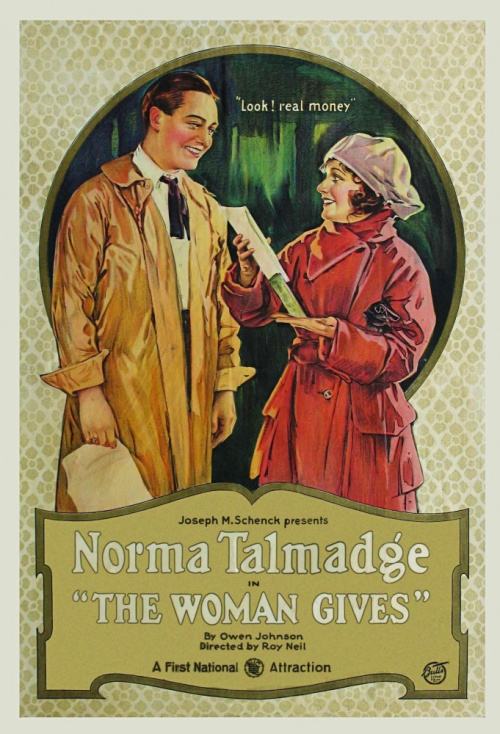
Picture, if you can, a studio suffused with the smell of turpentine and unvoiced longing—an atelier where marble dust waltzes with cigarette smoke along shafts of amber light. Into this crucible steps Inga Sonderson (Norma Talmadge), her silhouette both canvas and question mark. She earns her bread by holding still while men transmute her skin into pigment or plaster, yet the film’s title already inverts the power dynamic: she is not the passive model but the active donor, the one who gives until the giver herself becomes gift.
Director Wesley Ruggles—still in his apprentice years—approaches this tangled triad with a proto-expressionist fervor. Note the diagonal compositions whenever Daniel Garford (John Halliday) is on screen: tilted lampshades, off-kilter picture frames, an entire world sliding off its axis after marital betrayal. The moment Garford stumbles upon his wife’s infidelity, the camera virtually liquefies; shadows ripple like ink in water, prefiguring his imminent plunge into the smoky underbelly of opium.
Where contemporaries such as Der große Unbekannte sensationalized narcotic degradation, The Woman Gives opts for a narcotized aesthetic in itself. Cuts elongate, dissolves linger, and superimposed trails of incense ghost across the frame—an early attempt to render altered perception without sound. One hallucinatory shot superimposes Garford’s dead-eyed face over a spinning potter’s wheel, the clay flinging outward like thoughts he can no longer corral. It’s a visual whisper of “I have forgotten how to shape, therefore I am shapeless.”
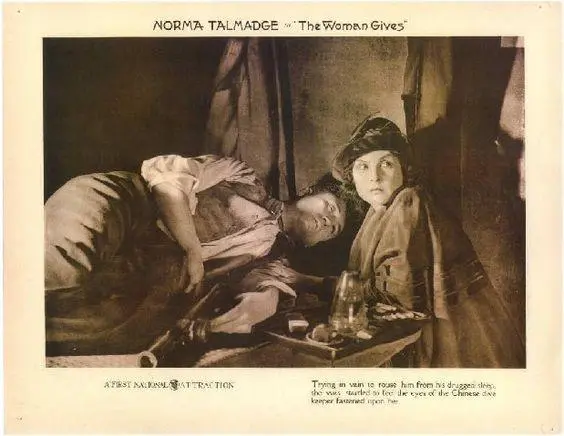
But every chiaroscuro descent needs its Beatrice. Inga, draped in shawls the color of dusk, stalks through Chinatown’s labyrinth pursued only by the flicker of paper lanterns. Cinematographer L. William O’Connell lights her figure from below with a handheld oil lamp, turning her eyes into twin candle flames—an avenging angel in a world of soot. When she drags the emaciated maestro back to his brownstone, the film stages a reversal of the Pygmalion myth: the model now sculpts the artist, coaxing life into the man who once animated marble.
Robert Milton (Edmund Lowe) embodies the quintessential early-cinema sculptor—torso forever swathed in a leather apron, mallet dangling like a prosthetic limb. His misunderstanding arrives not through dialogue (the intertitle is almost bashfully concise) but via spatial geometry: Inga supporting Garford’s weight, their bodies forming a sculptural group reminiscent of “The Descent from the Cross.” Milton, positioned at the far end of a corridor, sees only silhouettes and assumption. The ensuing breakup feels oddly modernist—a narrative rupture communicated by a smash-cut from clasped hands to a shattered clay maquette on the floor. Love, like art, is undone by perspective.
Garford’s convalescence unfolds in montage: a physician’s nod, a dealer’s jubilant telegram, the clamor of reporters on the stoop. Note the film’s sly commentary on cultural commodification. The moment Garford’s brush regains its vigor, the marketplace swarms like vultures, ready to sell redemption in gilt frames. One intertitle reads: “The world loves a resurrection almost as much as it loves a crucifixion.” A century later, the line remains scalpel-sharp, indicting our own obsession with comeback narratives and tortured-artist clichés.
Against this backdrop Inga’s agency intensifies. She withholds her final “yes” until she can ascertain whether marriage to Garford equals gratitude or genuine companionship. Talmadge, often pigeonholed as the queen of noble suffering, here injects a proto-feminist steel. Watch her micro-gestures: a slight recoil when Garford frames her face as if mapping future brushstrokes, the way her fingers curl inward as though guarding the boundary between subject and self.
All melodrama demands a liminal space for catharsis; here it is the grand Beaux-Arts railway terminal where steam and heartbreak intermingle. Milton, suitcase in hand, is poised to vanish into America’s amnesiac expanse. Enter Inga, veil fluttering like a white flag, proclaiming that the man she “loves” is the one who first sculpted her soul, not merely her likeness. The resolution is both fairy-tale and pragmatic: she refuses to be currency in a transaction of gratitude, opting instead for the messy reciprocity of equals.
Ruggles stages this denouement in a single, unbroken take—rare for 1915 small-studio fare. The camera tracks backward as Inga and Milton converge, the departing locomotive billowing curtains of steam that veil then unveil their embrace. It’s a visual assertion that love, like art, is process not product, a perpetual becoming rather than a gilt-framed conclusion.
Norma Talmidge’s reputation rests on her ability to oscillate between porcelain composure and volcanic despair without signaling the switch. In the opium-den sequence she conveys panic not through broad gestures but via the tremor of a single shoulder blade, visible only because her cloak slips askew. When she drags Garford up a stairwell, the muscles along her forearm flicker like piano wires—an eloquent testament to silent cinema’s corporeal vocabulary.
John Halliday, essaying the fallen genius, carries the languor of dissipation with almost too much elegance; one wonders if the actor himself sampled the film’s prop laudanum. His detox scenes avoid the histrionic writhing fashionable in Victorian theater; instead he sits motionless, eyes agape, as though staring at an internal eclipse. The restraint magnifies horror—we intuit the battle inside because we cannot witness it.
Edmund Lowe provides the perfect foil: robust, ego-bruised, all blunt edges to Talmadge’s sinuous ambiguity. His jealousy is never mustache-twirling; it emanates from a fragile artist’s terror that reality will never match the ideal forms he chisels. In the final station scene, watch how his fingers drum against his thigh—an arrhythmic Morse code of doubt—until Inga’s declaration dissolves the tension and the hand falls limp, spent.
Though Technicolor is still two decades away, the film’s tinting strategy enriches its moral spectrum. Interiors awash in sepia suggest the amber haze of nostalgia; opium scenes are daubed with cyan to connote refrigerated despair; the final exterior bursts into apricot sunrise, hinting at chromatic rebirth. These photochemical choices anticipate the expressive palette of Ivanhoe (1913) yet feel subtler, less pageant-like.
Set design deserves laurels as well. Garford’s studio is a cathedral of clutter—easel limbs akimbo, shrouded statuary, Oriental rugs haphazardly layered like geologic strata. The chaos externalizes creative blockage; as his health returns, objects reassemble into orderly perspective. Production crews rarely receive silent-era credit, but whomever curated this mise-en-scene merits archival commendation.
Waldo Walker and Grant Carpenter supply intertitles that flirt with haiku brevity: “Desire sketched in charcoal; love chisels in stone.” The epigrammatic terseness counterbalances the visual opulence, ensuring that language neither competes with nor capitulates to imagery. Only once does the film succumb to moralistic bromide—when an intertitle sermonizes about “woman’s infinite mercy.” Even here, Talmadge’s skeptical half-smile undercuts the platitude, as though she—and the film—recognize the ideological quicksand.
One can read The Woman Gives as a meta-commentary on the muse-industrial complex. Inga begins as object—her flesh mediated by brush and chisel—yet ends as author of the narrative’s moral trajectory. The film interrogates the Victorian maxim that woman must be “given away” in marriage by having its heroine, quite literally, give herself where she wills. Compare this with the marital transactions in Marriage for Convenience or the commodity fetish of Die Herrin der Welt 6. Teil, and The Woman Gives feels quietly revolutionary.
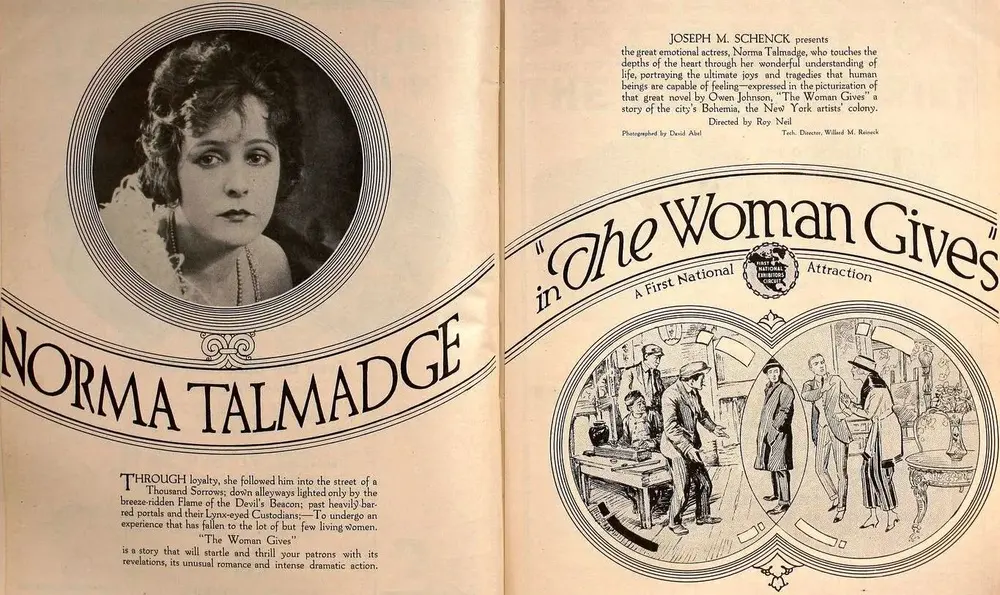
Yet the title’s ambiguity persists. Does “gives” denote sacrifice, donation, or agency? The answer flickers depending on which reel you freeze. Such semantic slipperiness enriches rewatch value, inviting feminist and psychoanalytic reappraisals without bulldozing the yarn’s surface pleasures.
Cinephiles will detect premonitions of Der Golem in the potter’s-wheel hallucination, or of Der Graf von Cagliostro’s occult decadence in the opium-den sequence. Less expected is the structural kinship with Homunculus, 6. Teil: both films stage a fallen creator resurrected by an empathetic Other, only to question whether salvation justifies the savior’s erasure.
Meanwhile, canine devotees of The Bulldogs of the Trail might sniff at the lack of four-legged heroics here, yet the same moral polarities—loyalty misread, devotion tested—animate the human kennel of The Woman Gives.
For decades the film slumbered in the archival limbo reserved for second-feature melodramas. A 2018 4K restoration by the EYE Filmmuseum salvaged a Dutch distribution print from nitrate perdition. Though a few scenes remain truncated (scholars still hunt for the alleged opium-orgy footage excised by Ohio censors), the restoration’s tinting conjectures hew closely to contemporary trade-paper descriptions. The result: images that glow like stained glass viewed by candlelight, accompanied by a newly commissioned score—piano, viola, and brushed cymbals—evoking Satie’s Gymnopédies drifting through cigar smoke.
Modern directors enamored of tortured-artist tropes—think Aronofsky’s Black Swan or Bierman’s Shadow of the Vampire—owe a debt to this obscure gem. The notion that creation and self-obliteration share a bed was not born with Method angst or heroin chic; The Woman Gives already traced that Möbius strip in 1915. Even the closing train-station flourish resurfaces in countless rom-coms, albeit shorn of its existential throb.
Is the film flawless? Hardly. Its portrayal of Asian opium den proprietors lapses into yellow-peril caricature, and the script treats working-class characters as mere furniture. Yet these blind spots, jarring today, open portals for historical inquiry rather than reasons for burial.
What endures is the emotional algebra: how swiftly gratitude can slide into possession, how jealousy masquerades as moral rectitude, how giving can annex the giver if boundaries blur. In an age when patronage networks again determine artistic visibility—Patreon replacing private salons—The Woman Gives feels less antique than prophetic.
Watch it for Talmadge’s incandescent nuance, for the proto-noir cinematography, for the bittersweet realization that every gift demands a response, lest it calcify into chain. Above all, watch it to witness cinema’s youthful audacity: the conviction that shadows, properly orchestrated, can reveal more truth than daylight ever dared.
Silent cinema is often dismissed as gestural mime, sepia curio, or campy accompaniment to ragtime. The Woman Gives argues otherwise—whispering that between the flickers of light and the intervals of dark lies a dialectic of mercy and autonomy, a negotiation as contemporary as your next swipe, your next scroll, your next unspoken wish to be both muse and maker.
Seek the restoration. Project it large, if only to watch those amber shadows lap at the edges of your living-room wall like laudanum waves, reminding you that every image we consume is a gift—one we must learn, at times, to return.
IMDb 5.3
1931
Community
Log in to comment.