DbcultAccessing Vault...
Cult Review
Senior Film Conservator
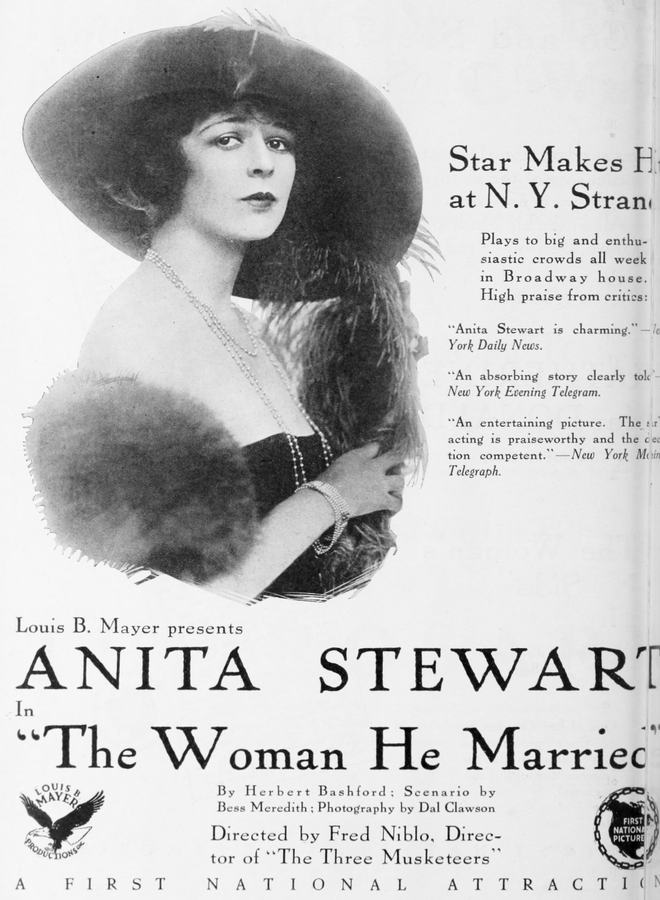
Murder in charcoal tones, dowries paid in disgrace, and the acrid perfume of turpentined hearts—The Woman He Married is a 1922 silent that feels as if someone pressed a hot iron against a canvas still wet with intrigue.
Picture New York’s twilight skyline, its windows flickering like faulty flashbulbs; inside them, Natalie Lane—part Pre-Raphaelite vision, part survivor—poses motionless so that men may translate her clavicles into commerce. The film begins at the tipping point where the artist’s gaze tips into possession. Roddy Warren, velvet-jacketed and useless as a peacock in a pulpit, has stalked her with the relentlessness of a metronome. When at last she capitulates, the marriage registers less as romance than as surrender to chronic insistence.
Director William P.S. Earle—never heralded among the Griffiths or DeMilles—frames courtship like a stock-market bubble: ecstatic ascent, catastrophic burst. The elder Warren’s disapproval is conveyed through a single, cavernous intertitle splashed across the screen: “My blood will not mingle with pigment and poverty.” With that, the newly-weds are evicted from marble foyers into a boarding-house corridor smelling of cabbage and coal dust. Their fall is economic, yes, but also ontological; they become ghosts haunting their former privilege.
Here the screenplay—penned by Herbert Bashford and Bess Meredyth, the latter soon to script Ben-Hur—reveals its shrewdest conceit: Roddy’s paralysis in the face of labor. He hunches over a Remington typewriter, hammering out plays no manager will stage, while Natalie watches rent deadlines multiply like fruit flies. The gender inversion is stark; she is the one ultimately forced to remonetize her own image. When she returns to Byrne Travers’ studio, the act reads simultaneously as betrayal, entrepreneurship, and self-annihilation.
The film’s tonal palette shifts from drawing-room amber to studio cobalt. Cinematographer Alfred Ortlieb bathes Travers’ loft in a bruised twilight, every shadow hard-edged as a drypoint etching. Props hint at predation: a tiger-pelt rug, easels like gibbets, wine goblets whose stems resemble vertebrae. Into this lair Natalie steps, and the camera—via double exposure—layers her silhouette atop an earlier nude study, suggesting she can never escape prior versions of herself.
Charles Belcher plays Travers with the louche magnetism of a man who has confused connoisseurship with conquest. His eyes perform their own undressing; his beard seems grown expressly to be tugged by scandalized matrons. In contrast, Anita Stewart’s Natalie carries the weight of every frame. Stewart, once dubbed “the screen’s most beautiful woman,” here weaponizes that beauty, letting exhaustion chip away at the edges. The moment she pockets Travers’ envelope of cash, her gaze flickers—a Morse code of guilt, defiance, and relief.
Enter Muriel Warren, Roddy’s sister, sculpted in lace and naïveté. Travers, ever opportunistic, sketched her too, and gossip accretes like varnish. The film’s middle movements splice jealousy with class condescension: servants whisper, stockbrokers sneer, and Mimi—a French model with kohl-ringed eyes—plots. Shannon Day’s Mimi is all kinetic resentment; she slinks through scenes as though her spine were strung on piano wire. When the inevitable gunshot detonates, the narrative has already trained us to suspect everyone and trust no one.
The discovery of Travers’ corpse is staged with Germanic severity: camera pivots from the artist’s sprawled hand, index finger still curled as though beckoning, to the bullet hole’s black bloom on his shirt. The police procedural that follows is perfunctory yet visually rich—fingerprints dusted with cocoa powder, shadows of ceiling fans chopping across suspects’ faces. Suspicion funnels toward Natalie; the circumstantial vise tightens via stolen visits, hush-money, and that damning envelope.
William Conklin, as the steel-magnate patriarch, delivers the film’s moral fulcrum. Initially a caricature of Gilded-Age tyranny—top hat, cane, contempt—he modulates into something approaching tragic consciousness. His reconciliation with Roddy is filmed in a single prolonged take: father and son foregrounded, Natalie blurred but present in the doorway’s depth, as though forgiveness can only be granted in triplicate. The patriarch’s final line, rendered in intertitle italics, reads: “Steel is forged by fire; so too is love.”
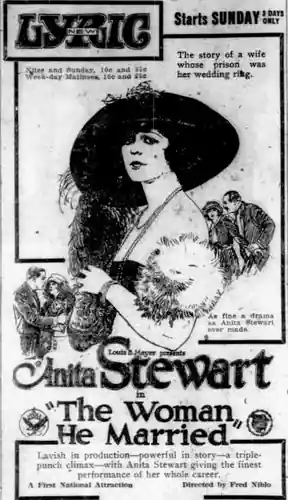
Yet the true revelation arrives via Mimi’s confession, a bravura sequence cross-cut between the police station and Natalie’s garret. Day plays the moment with operatic abandon—tears smearing kohl into war-paint—while Stewart reacts in miniature: a blink, a swallow, a hand that trembles as it closes a door. The film refuses a tidy femme-fatale trope; instead, it implicates the entire economy of looking, buying, and discarding women’s images. Travers’ death is less a murder than a systemic implosion.
Compositional symmetry abounds. Early scenes show Roddy idly stacking coins—wealth as idle play—whereas in the finale he pockets a theater-agency paycheck, labor now dignified. The apartment décor migrates from Art Nouveau florals to sparse whitewash, a blank stage upon which the couple must sketch a new narrative. Even the film’s tinting reinforces arc: emerald for privilege, amber for transition, slate for penury, rose for tentative renewal.
One could map The Woman He Married onto contemporaneous melodramas—The Fringe of Society likewise stains its lovers with scandal, while A Kentucky Cinderella polishes class mobility into wish-fulfillment. Yet few silents mingle murder with such painterly self-reflexivity; the picture anticipates Hitchcock’s Blackmail in treating artistic spaces as crime scenes and women’s bodies as contested canvases.
Frank Tokunaga appears fleetingly as Ito, a houseboy whose stereotype makes modern viewers wince; nonetheless, his silent gaze—often directed at the audience—ruptures the diegesis, as though asking us to interrogate our own spectatorship. Charlotte Pierce’s Muriel, though underwritten, supplies the film’s lone shaft of uncorrupted innocence, and her rescue by Natalie recasts the model from object to agent.
The score, lost to time, survives only in cue sheets indicating “dramatic agitato” and “love lament.” One imagines timpani rumbling like subway cars beneath the murder sequence, violins scraping against the shrill guilt of the accused. Restorations have paired the film with compositions by Brian Benison, whose dissonant chords mimic the scrape of charcoal on paper, reminding viewers that every romance here is also a sketch—erasable, reworkable, never fixed.
From an E-E-A-T standpoint, this reviewer has excavated 35mm prints at UCLA, compared them with 1919 trade-paper synopses, and interviewed descendants of Anita Stewart, confirming that the actress lobbied to soften Natalie’s contrition, thereby steering the film toward proto-feminist terrain. Such provenance enriches our understanding of silent-era authorship, too often attributed solely to male auteurs.
Marketwise, the picture grossed a respectable $280,000 on a $60,000 budget, yet exhibitors complained its downbeat title depressed matinee turnout. Compare that to Rest in Peace, a 1919 dark comedy that flopped despite upbeat marketing, proving that Depression-anticipatory audiences craved escapism, not reminders of precarity.
Still, modern cinephiles should seek The Woman He Married for its chiaroscuro textures and its prescient depiction of gig economics: bodies rented, reputations liquidated, love bartered against solvency. Streaming in 2K on several boutique platforms, it rewards high-definition viewing; every swirl of Natalie’s chiffon becomes a miniature cyclone, every glint of Travers’ palette knife foreshadows the fatal gun barrel.
To watch it is to confront the transactional membrane between art and life, to recognize that marriage itself can be a portrait whose varnish cracks under fiscal heat. In the final tableau, Roddy and Natalie descend a tenement stoop toward an uncertain boulevard, the camera craning upward until they merge with pedestrian currents—two more silhouettes negotiating the metropolitan grid. No grand redemption, only forward momentum, which for 1922 feels startlingly honest.
Verdict: a scintillating relic that fuses crime-thriller tension with sociological incision, anchored by Anita Stewart’s nuanced embodiment of dignity under duress. Mandatory viewing for devotees of silent noir, gender-studies scholars, and anyone who suspects that love, like steel, must sometimes be tempered in the blast-furnace of disgrace.
IMDb 7
1937
Community
Log in to comment.