DbcultAccessing Vault...
7.4/10
Senior Film Conservator
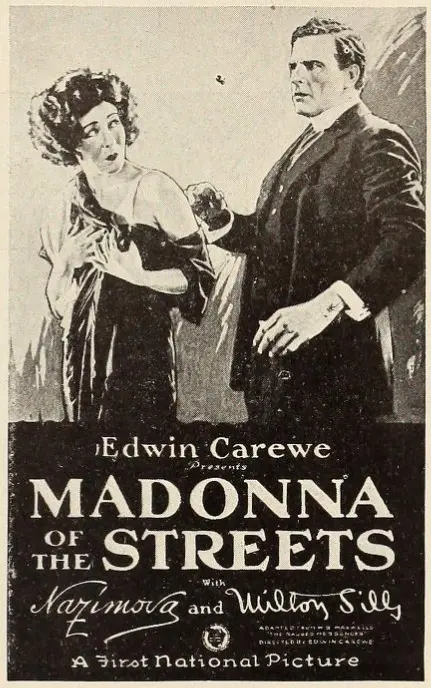
A definitive 7.4/10 rating for a film that redefined the boundaries of cult cinema. Madonna of the Streets remains a cornerstone of transgressive art.
The year 1924 stood as a precipice in the evolution of silent cinema, a moment where the crude gesticulations of the early nickelodeon era had fully transmuted into a sophisticated visual language. Within this milieu, Madonna of the Streets emerges not merely as a melodrama, but as a visceral exploration of the dichotomy between the sacred and the profane. Directed with a keen eye for atmospheric tension by Edwin Carewe, the film serves as a luminous vehicle for the enigmatic Alla Nazimova, whose presence on screen remains a haunting testament to the power of the 'Star of the East.'
The narrative architecture of the film is built upon the sturdy shoulders of Milton Sills, who portrays John Morton with a rugged, almost desperate sincerity. Unlike the more whimsical protagonists found in contemporary works like A Flirt There Was, Morton is a man possessed by a singular, perhaps naive, vision of Christian socialism. His transition from the manicured lawns of St. Andrews to the fog-choked alleyways of Limehouse is depicted with a stark realism that challenges the viewer’s perceptions of class mobility. Morton isn't just seeking to help the poor; he is seeking to purge himself of the guilt of his own inheritance—a theme that resonates deeply in the post-war disillusionment of the 1920s.
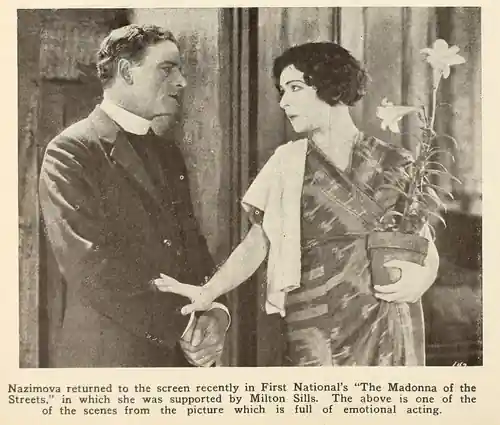
Sills brings a 'muscular Christianity' to the role, a physicality that contrasts sharply with the ethereal, almost feline movements of Nazimova. His Morton is a man of action who finds himself paralyzed by the very morality he preaches. When he discovers that his mission is failing because his 'hearers' demand bread instead of bibles, the film touches on a sociopolitical nerve that feels remarkably modern. The mob’s attempt to hurl him into the river is a sequence of terrifying kinetic energy, reminding one of the gritty survivalism seen in The Brute Breaker.
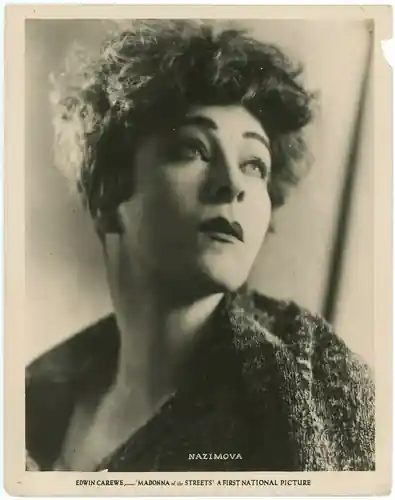
At the heart of the film’s magnetic pull is Alla Nazimova. By 1924, Nazimova was already a legend, known for her avant-garde sensibilities and her refusal to be pigeonholed. In Madonna of the Streets, she plays Mary Carlson with a nuanced complexity that defies the 'vamp' stereotype common in the era. Mary is not a monster; she is a survivor of a patriarchal system that left her with nothing but her wits and her beauty after the death of her benefactor. Her initial motivation—revenge and the reclamation of wealth—is grounded in a logical, if cynical, worldview.
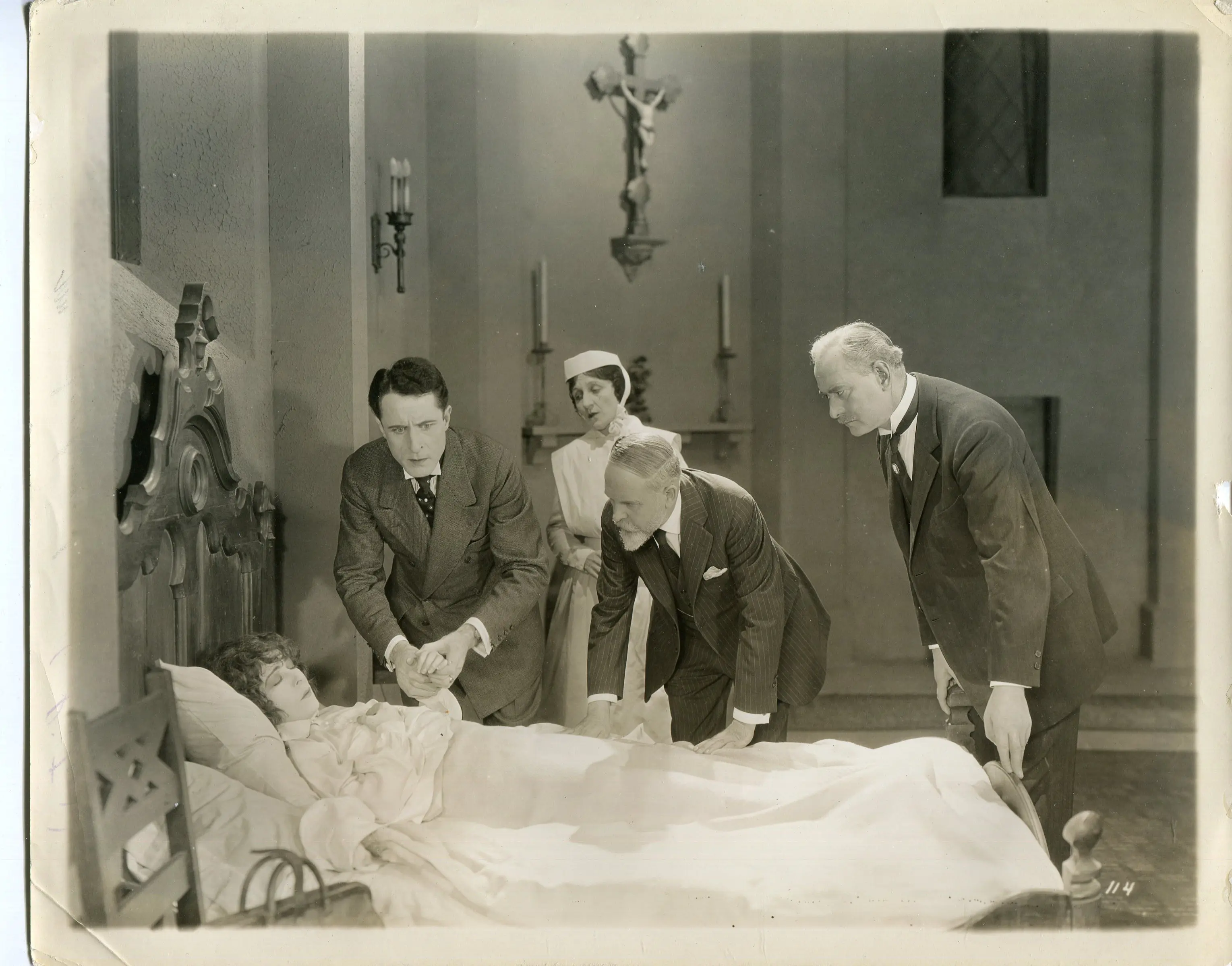
The scenes in which she seduces Morton are masterclasses in subtle manipulation. Nazimova uses her eyes—those legendary, expressive pools of shadow—to convey a hidden agenda while her body language suggests a fragile vulnerability. It is a performance of layers. When she tires of the missionary life, we see the cracks in her facade. The 'night out' with the secretary isn't just a plot device; it's an act of rebellion against the stifling piety Morton represents. Unlike the more straightforward romantic entanglements in Bucking Broadway, the relationship here is a psychological chess match where the stakes are nothing less than the characters' souls.
The cinematography of Madonna of the Streets deserves particular commendation. The Limehouse district is rendered as a purgatorial space, filled with deep shadows and billowing mists. This aesthetic choice heightens the melodramatic stakes, making the mission feel like a lonely lighthouse in a sea of moral ambiguity. The use of chiaroscuro lighting emphasizes the internal conflicts of the characters—Morton’s face often half-hidden in shadow as he grapples with his feelings for Mary, and Mary herself emerging from the darkness into the harsh light of the mission.
This visual density is a far cry from the open-air simplicity of films like Up in the Air. Here, the environment is claustrophobic, reflecting the 'enslavement' that Morton’s uncle suffered and the spiritual cage Morton builds for himself. The river, a recurring motif in London-set narratives, represents both a threat of oblivion and a site of baptismal cleansing. When the police rescue Morton from the water, it is a moment of rebirth that precedes his final financial sacrifice.
The film’s conclusion is perhaps its most daring element. In a standard melodrama, Mary might have died as penance for her sins, or Morton might have returned to his wealthy parish, chastened. Instead, Madonna of the Streets offers a synthesis. Morton signs away his last penny, realizing that his wealth was the primary barrier between him and the people he sought to serve. This act of radical poverty restores his influence, proving that his 'preaching' only has value when backed by personal sacrifice.
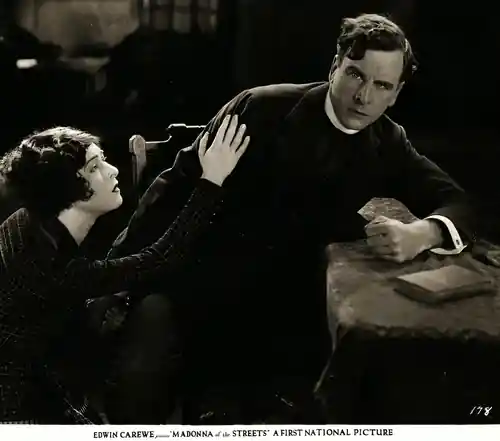
But it is Mary’s return that provides the emotional crescendo. Her 'miraculous revival' after being declared dead is a bold narrative stroke that pushes the film into the realm of the spiritual. It suggests that her transformation is not merely social or moral, but metaphysical. She returns to Morton not as the mistress or the siren, but as a partner in his labor. This ending subverts the tragic expectations of the 'fallen woman' trope, offering a rare glimpse of genuine redemption in a genre often preoccupied with punishment.
To understand the impact of this film, one must place it alongside its contemporaries. While The Blue Streak or The Discard dealt with themes of reputation and social standing, Madonna of the Streets elevates these concerns to a cosmic level. The writers—including the Hattons and William Babington Maxwell—crafted a script that balances the prurient interests of the 'siren' plot with a genuine philosophical inquiry into the nature of charity.
The supporting cast, including a young Wallace Beery and the reliable Tom Kennedy, provides a textured backdrop to the central drama. Beery, in particular, brings a sense of grounded menace that prevents the film from drifting too far into abstract sentimentalism. The interplay between the different strata of society—from the 'fashionable parish' to the dockside pubs—is handled with a sophistication that avoids the caricatures often found in films like Why Smith Left Home.
Ultimately, Madonna of the Streets is a film about the failure of idealism and the triumph of grace. John Morton’s journey is a cautionary tale about the arrogance of the benefactor, while Mary Carlson’s arc is a celebration of the resilience of the human spirit. The film’s ability to weave these disparate threads into a coherent, emotionally resonant whole is a testament to the artistry of the silent era.
For the modern viewer, the film offers more than just a historical curiosity. It is a masterclass in visual storytelling, where every frame is saturated with meaning. Whether it is the contrast between the velvet gowns of Mary’s past and the simple wool of her future, or the way the London fog seems to swallow the characters' doubts, the film remains a potent piece of cinema. It stands tall among its peers, far more substantial than the lighthearted fare of Jumping Beans or the episodic nature of Join the Circus.
As we look back at the career of Nazimova, Madonna of the Streets serves as a crucial bridge between her more experimental stage-inspired work and the commercial demands of Hollywood. It shows a star at the height of her powers, capable of carrying a complex narrative through the sheer force of her screen presence. The film’s final image—a miraculous awakening—serves as a fitting metaphor for the experience of watching it: a sudden, startling return to life after a journey through the shadows.
Reviewer's Note: This 1924 First National production remains a seminal example of the 'social gospel' subgenre of silent film, blending high-stakes melodrama with a genuinely provocative critique of class-based philanthropy.
IMDb —
1917
Community
Log in to comment.