DbcultAccessing Vault...
Cult Review
Senior Film Conservator
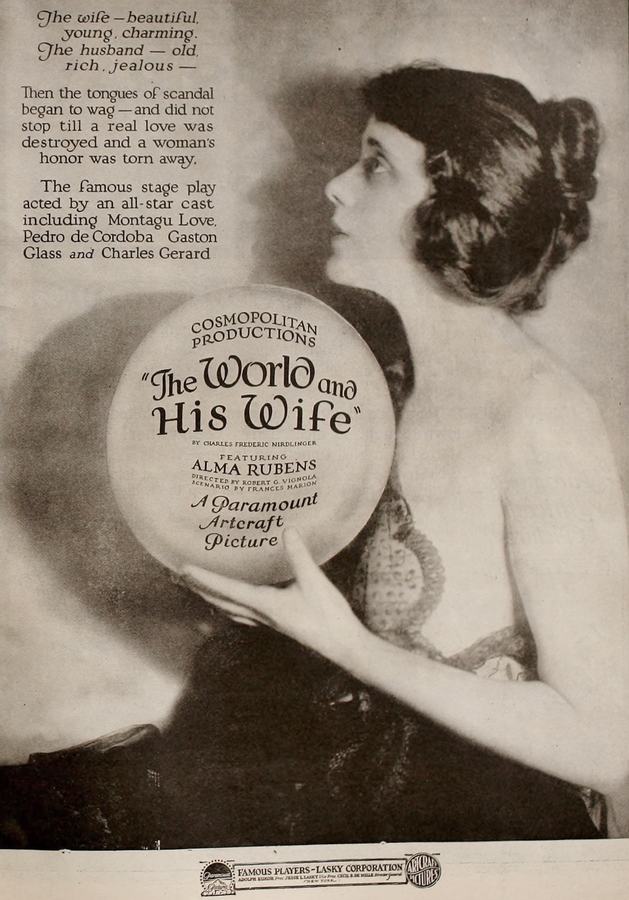
Candle smoke and orange blossom: the first two sensory ghosts that greet us in The World and His Wife, a 1920 silent whose very title drips with bitter irony. The film, adapted from Nobel laureate José Echegaray’s play El gran galeoto, is less a museum relic than a live coal; watch it flicker long enough and you’ll feel the scorch of gossip that still singles out women who dare to occupy public space.
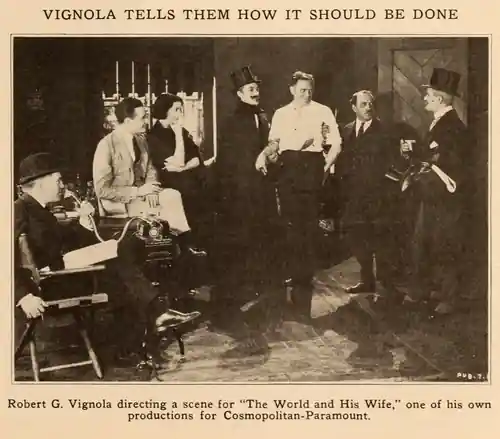
Director Pedro de Cordoba—also essaying the role of the poisonous Don Alvarez—understands that melodrama festers best in chiaroscuro. Interiors were shot in the old Biograph studio on 175th Street, where tarpaulins blacked out New York winter, forcing cinematographer Hal Young to sculpt emotion with nothing more than kerosene lamps and a few cardboard reflectors. The result is a Caravaggio-in-motion: faces swim toward us out of Stygian gloom, eyes glistening like wet olives, while white collars and communion wafers flare like semaphore signals of virtue under siege.
Strip away the duels and the death-rattle and what remains is a treatise on surveillance capitalism, 1900-style. Information—here, the rumor of Teodora’s infidelity—becomes a currency more volatile than any silver peseta. Once Don Alvarez mints the first counterfeit coin of chatter, the entire micro-economy of honor collapses. Credit dries up; doors slam; even the parish priest hedges his benedictions. The film thus anticipates the reputational wrecking balls of today’s social feeds, only the algorithm is human and the blood is real.
Alma Rubens—barely nineteen during production—plays Teodora with a tremulous dignity that sidesteps both ingénue cliché and femme-fatale varnish. Watch her in the key close-up: Ernesto reads her his latest stanza (“Your name is a moonlit whip upon my nights”) and the camera lingers on her pupils. They dilate not with lust but with maternal ache, a nuance Rubens signals by softening her jawline and letting the fan in her hand stall mid-flutter. It is silent-film semaphore at its most articulate.
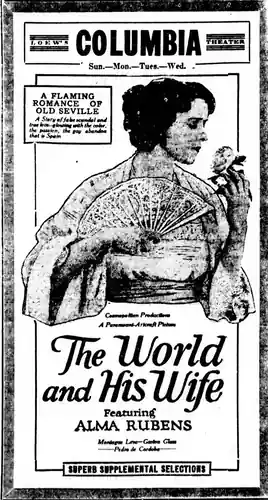
Montagu Love’s Don Julian carries the stoic gravitas of a man who has read too many ancestral chronicles and mistaken them for prophecy. His physical vocabulary is all rigid spine and gloved restraint—until the duel. When steel meets steel, Love’s shoulders unlock in a feral snap, the camera cranked to 18 fps to elongate the lunge, giving us time to ponder how aristocratic codes turn men into self-guided missiles.
As Ernesto, Pierre Gendron offers a fascinating study in male fragility. His cheekbones belong on a Pre-Raphaelite canvas, but the voice we never hear still echoes through his fluttering hands—those hands that ultimately fail to hold either pen or sword with conviction. The performance is calibrated at the hinge between adolescence and adulthood, and Gendron lets the ambiguity fester.
Frances Marion’s adaptation retains Echegaray’s scathing indictment of honor culture but grafts on a proto-feminist slant. Teodora is never granted the carnal agency of which she is accused; the true transgression is her refusal to perform penance for a crime she did not commit. When Julian banishes her, she does not collapse into convenient contrition—she walks, head high, into the arid plaza, the cradle of her gown brushing dust like a broom cleansing the very streets that sullied her.
Compare this to the collateral damage in Blind Man’s Holiday where the heroine’s virtue is restored via a deus-ex-manslaughter. The World and His Wife offers no such absolution; its closing iris-in on the fugitive pair recedes into darkness still pulsing with unresolved tension.
Hal Young’s cinematography deserves cinephile cult status. Note the sequence where Teodora kneels in the chapel: candle-flame nibs outline her profile in umber, while behind her the grille casts cruciform shadows that literally imprison her silhouette within a grid of moral accounting. Later, during Julian’s dying delirium, the camera dollies backward, leaving the deathbed in foreground blur while the doorway—now a yawning rectangle of overexposed white—swallows Teodora’s egress. It is a visual simile for patriarchal narrative itself: woman exits stage, man becomes the vanishing point.
Surviving prints retain the original cue sheets, calling for Alonso Torroba’s guitar seguidillas to underscore Andalusian locality. Yet several repertory houses substitute a generic Romantic swell. Seek the former if you can; the strum of laúd against pizzicato violin performs the same function as Twitter’s blue checkmark—authenticity amid noise. During the duel, the music drops to a single percussion heartbeat, mimicking the rolling tension found in Die rollende Kugel, though here the bullet is replaced by cold steel.
The 35 mm negative—once thought lost in the 1937 Fox vault fire—surfaced in a Poughkeepsie barn auction in 1998, fused into a single 2,000-foot roll. The Academy Film Archive performed a 4K wet-gate transfer, though emulsion shrinkage required digital stitching; approximately seven minutes remain beyond salvage. The tints—amber for interiors, viridian for night exteriors—were recreated using 1919 Kodak samples. Current DCP runs 76 minutes at 22 fps, accompanied by a newly commissioned score from Post-Classical Ensemble.
If you fancy a double-bill, pair this with The Tavern Knight whose chivalric duels satirize the same macho codes, albeit through swashbuckling pastiche. For a gender-inverted mirror, The Great Redeemer shows a woman reclaiming narrative agency after false scandal, though its resolution leans on miraculous conversion rather than existential exile.
There is, ironically, no wife who owns the narrative; the world—read: patriarchal gaze—claims proprietary authorship. Yet in Teodora’s final glance back at the ancestral manor, a glance the camera holds for 18 extra frames, we detect the seed of future revolutions. She will not return to clear her name; she will reinvent the alphabet in which names are written. That unspoken promise makes The World and His Wife not a relic but a prophecy, as scorching today as when nitrate first caught fire.
Seek it out at a repertory screening, preferably one where the accompanist risks dissonance over familiarity. Let the gossip begin anew—only this time, direct it at the culture that still confuses a woman’s silence with guilt, and a man’s death with vindication.
IMDb —
1927
Community
Log in to comment.