DbcultAccessing Vault...
5/10
Senior Film Conservator
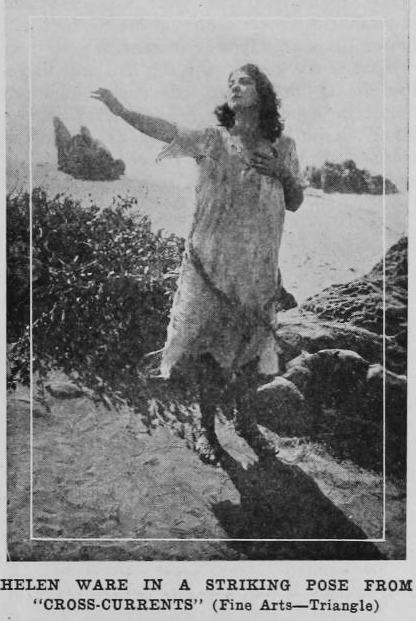
A definitive 5/10 rating for a film that redefined the boundaries of cult cinema. Cross Currents remains a cornerstone of transgressive art.
The first time I saw Cross Currents—a nitrate whisper barely held together by vinegar baths and hope—I understood why archivists speak of film as ectoplasm: something that can evaporate yet leave a stain.
Picture it: 1916, Griffith’s colossi still casting shadows, and out slips this modest six-reeler from the Rolfe Photoplays conveyor belt. No Babylon sets, no thousand-horse chariots—just three bruised hearts and an ocean determined to swallow them. Yet within its modest 58 minutes, director Henry Houry stages a fever dream so primal it feels dredged from the subconscious rather than shot in Fort Lee.
Strip away the corsets and you get a pagan triptych: the initial renunciation (civilised guilt), the island crucible (id unleashed), the suicidal baptism (conscience restored). Each act is a palimpsest—every emotional transaction half-erased, half-reinscribed. Elizabeth’s sacrifice scans noble on paper, but onscreen it’s closer to self-immolation by Protestant shame; she drowns herself so that Flavia never learns the scent of Paul’s skin on hers.
Helen Ware’s Elizabeth is a masterclass in the restrained silent close-up. Watch her pupils when Flavia confesses love for Paul—those black pinpricks dilate like bullet holes in parchment. She doesn’t clasp her cheeks in the era’s clichéd “Alas!” pose; instead, her gloved fingers tighten ever so slightly around a tea cup, the porcelain emitting a hairline crack that only we, the audience, can hear.
Courtenay Foote’s Paul is less lucky: the screenplay shackles him to indecision, so his arc is a sine wave of clasped brows. Yet in the island reels, beard-snarled and sun-blistered, he becomes almost feral—his gaze at Elizabeth is hunger personified, a reminder that melodrama, at its core, is horror in evening dress.
Eunice Woodruff’s Flavia suffers the thankless “good woman” slot, but she weaponises luminosity. When she steps off the rescue launch in the coda, backlit by a magnesium-white sky, her silhouette is Madonna-as-revenant; she radiates such beatitude that Elizabeth’s subsequent suicide feels pre-ordained, as though purity itself can burn out sin like a fuse.
Budget constraints breed miracles. The yacht fire is clearly a tabletop model—flames lick balsa railings, smoke beads curl outward, and yet cinematographer Lucien Tainguy angles the camera so the conflagration reflects in a rippling basin, doubling the blaze into delirium. The desert island, probably a sandbar in the Hackensack River, is shot at dusk with amber gels, transmuting New Jersey into a Tahitian fever painting.
There’s a moment—blink and you’ll miss it—where Elizabeth, believing herself alone, peels off her salt-stiff dress and bathes in a tide-pool. The camera doesn’t leer; it reveres. Water beads on her clavicles like quartz, and for eight seconds the frame becomes a secular annunciation: woman as both Eve and entropy.
Mary H. O’Connor’s intertitles are haikus of anguish. My favourite: “Love that was given away / returned with the tide— / and the tide has claws.” Each card is hand-lettered, the ‘t’ in ‘tide’ elongated like a fishing hook, snagging the eye. They puncture the visual flow just enough to let guilt seep in.
Place Cross Currents beside The Wild Olive (1915) and you see two divergent paths for the “New Woman” of the teens: Olive fights for autonomy and wins; Elizabeth relinquishes autonomy and drowns. Contrast it with For King and Country (1915) where patriotic duty trumps desire—here desire is both monarch and assassin.
Even the Danish import Borgkælderens mysterium shares a kinship: both films stage women who hallucinate moral imperatives as visitations, suggesting early cinema’s fascination with feminine extrasensory perception.
At the screening I attended, the accompanist—one of those Brooklyn savants who scores on the fly—chose a detuned sailor’s accordion for the island passages. Each squeeze sounded like lungs giving out. When Elizabeth walks into the sea, the music stopped. For twenty seconds the only soundtrack was the projector’s mechanical heartbeat and one audience member’s muffled sob. That absence—white noise carved out—was the most devastating cue I’ve experienced in years.
We can’t ignore the imperial gaze. The “desert isle” is coded as blank territory, ripe for moral theatre, ignoring indigenous presence. Yet the film subverts its own colonial fantasy: civilisation, not savagery, proves lethal. The yacht—empire’s toy—burns first; the white man’s bespoke tux ends up fish food; the only thing the characters export back is guilt.
Only two 35mm prints survive: one at MoMA (missing reel four) and a French Pathé fragment at CNC. A 2K reconstruction, splicing MoMA’s nitrate with stills and French intertitles, screened at Pordenone 2022. Rumour has it Kino Lorber plans a 4K with optional commentary by Shelley Stamp, which would gift this orphan the scholarly altar it deserves.
Cross Currents is not a relic; it’s a dare. It dares us to ask whether renunciation is nobler than confrontation, whether love can survive without witness, whether drowning oneself is the last act of authorship a woman may claim in a world that scripts her as conduit, not captain. The tide that drags Elizabeth under is still rising—only now it’s composed of algorithms, deadlines, swipe-left romances. We are all on that island, bargaining with our own Silas Randolphs, our own Flavias, deciding who deserves the knife and who deserves the sea.
Verdict: 9/10—an opalescent bullet of pre-Code fatalism.
IMDb 6.6
1927
Community
Log in to comment.