DbcultAccessing Vault...
4/10
Senior Film Conservator
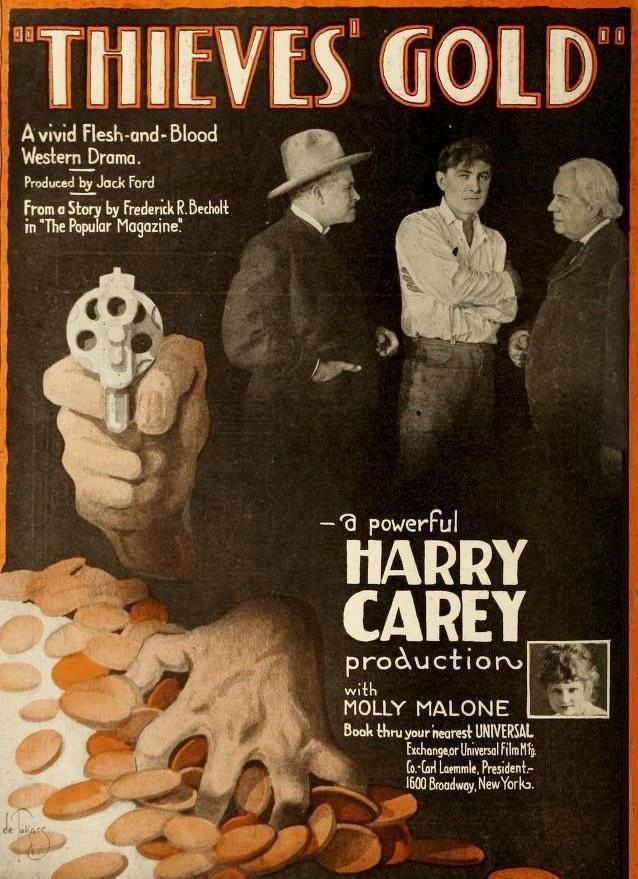
A definitive 4/10 rating for a film that redefined the boundaries of cult cinema. Thieves' Gold remains a cornerstone of transgressive art.
In the annals of early cinema, particularly within the nascent yet rapidly evolving genre of the Western, certain films emerge not merely as historical artifacts but as enduring testaments to the power of narrative and human drama. 'Thieves' Gold' stands as one such compelling entry, a silent picture that, despite its age, resonates with a raw, visceral energy, exploring themes of loyalty, morality, and the inescapable consequences of one's actions against the rugged, unforgiving backdrop of the American frontier. Directed with a keen eye for tension and character, this film, penned by the collaborative talents of Frederic R. Bechdolt and George Hively, offers a nuanced portrayal of outlaw life that transcends simple good-versus-evil dichotomies, delving into the complex ethical quandaries faced by those living on the fringes of society.
'Thieves' Gold' plunges its audience directly into a narrative fraught with peril and profound moral weight. At its heart lies the strained, yet undeniably potent, bond between two outlaws: Cheyenne Harry, portrayed with a weary gravitas by Millard K. Wilson, and his volatile companion, Padden. The inciting incident is stark and brutal: Padden, in a fit of drunken recklessness, commits a murder, shattering any semblance of peace or anonymity they might have harbored. This act propels the narrative forward, transforming a life of quiet desperation into a frantic, high-stakes flight from justice. Harry, despite Padden's evident flaws and the perilous nature of his crime, feels an unwavering pull of loyalty, a code of the West that dictates one stands by his kin, even when that kin is demonstrably undeserving.
The film meticulously chronicles Harry's increasingly desperate attempts to shield Padden from the law's long arm. This isn't a story of glorious banditry or heroic escapes; it is a gritty, often agonizing portrayal of a man burdened by an oath he cannot easily break. Harry's efforts are not born of a shared criminal ideology but rather a deep-seated, perhaps misguided, sense of responsibility. He knows Padden is dangerous, unpredictable, and ultimately self-destructive, yet he commits himself to this impossible task. This inherent conflict forms the dramatic backbone of the film, creating a palpable tension that permeates every frame. The landscape itself, vast and indifferent, mirrors the internal wilderness Harry navigates, offering no easy sanctuary, only further challenges.
The narrative’s strength lies in its refusal to simplify the characters. Padden is not merely a villain; he is a tragic figure whose own impulsiveness and lack of self-control seal his fate. Harry is not a hero in the conventional sense; he is a man caught in a moral vise, his actions driven by a complex mix of friendship, tradition, and perhaps a fatalistic acceptance of his lot. This nuanced approach to characterization elevates 'Thieves' Gold' beyond a typical Western potboiler, imbuing it with a psychological depth that was remarkably sophisticated for its era. The screenwriters, Frederic R. Bechdolt and George Hively, deserve considerable credit for crafting a story that prioritizes human motivation and consequence over simplistic action sequences, though the film certainly doesn't skimp on thrilling pursuits and confrontations.
In the silent era, the onus of conveying emotion, intent, and character rested squarely on the shoulders of the actors' physical performances and facial expressions. Millard K. Wilson, as Cheyenne Harry, delivers a masterclass in understated intensity. His portrayal is a study in weary resignation, his eyes often betraying the profound internal conflict raging within him. We see the weight of his impossible task in his slumped shoulders, the flicker of hope and despair in his gaze. He communicates Harry's fundamental decency, even as he aids a killer, making his predicament all the more poignant. Wilson avoids theatricality, opting instead for a grounded, believable performance that anchors the film's emotional core.
The supporting cast, including Molly Malone, John Cook, L.M. Wells, Martha Mattox, Harry Tenbrook, Helen Ware, Vester Pegg, and Harry Carey, each contribute to the rich tapestry of this frontier world. While specific roles might be brief, their collective presence builds an authentic sense of community, or lack thereof, around the central figures. Molly Malone, for instance, often brought a compelling blend of strength and vulnerability to her roles in silent Westerns, and here, her presence likely serves as either a moral compass or another layer of complexity to Harry’s isolated existence. These actors, through their skilled use of pantomime and expressive physicality, ensured that the narrative’s emotional beats landed with precision, even without the aid of spoken dialogue. The film's ability to elicit genuine empathy for Harry, despite his complicity, is a testament to Wilson's nuanced performance and the overall strength of the ensemble.
The stark visual language of silent cinema, particularly in the Western genre, often relied on exaggerated gestures, but 'Thieves' Gold' seems to lean into a more naturalistic approach where possible, allowing the raw human emotion to dictate the pace and intensity. The silent screen demanded a particular kind of artistry, and the cast of 'Thieves' Gold' rises to the occasion, crafting characters that feel authentic and deeply human, despite the limitations of the medium. Their performances are instrumental in building the narrative's inexorable momentum towards its tragic climax, making the audience feel every desperate decision and every crushing blow of fate.
As the story progresses, the tension between Harry's steadfast loyalty and Padden's inherent volatility escalates to an unbearable pitch. The very act of protecting Padden becomes a crucible, forging a deeper understanding of his destructive nature for Harry. The film masterfully builds towards its inevitable confrontation, a clash not just of fists or bullets, but of conflicting moral codes and irreconcilable personalities. It’s a classic Western trope – the showdown – but here, it’s imbued with a profound sense of tragedy rather than triumph. The fight between the two mismatched friends is not a moment of heroic justice, but a somber realization of a bond that has become toxic, a loyalty that has demanded too high a price.
Padden's death, while a violent conclusion, feels less like an external imposition and more like the natural, tragic culmination of his own choices and character. His drunken impulsiveness at the outset sets in motion a chain of events that only ends with his demise, a stark reminder of the unforgiving nature of the frontier and the irreversible impact of a single act of violence. This film, in its stark portrayal of consequence, resonates with a similar fatalism found in films like 'Fate's Boomerang', where characters are often caught in the inescapable currents of their past actions. The finality of Padden's end underscores the film's gritty realism, refusing to offer a saccharine resolution or a last-minute reprieve.
The screenplay by Frederic R. Bechdolt and George Hively is a testament to the power of succinct, impactful storytelling required in the silent era. They understood that without dialogue, every scene, every intertitle, every character's action had to advance the plot and deepen the emotional resonance. Their narrative construction for 'Thieves' Gold' is lean and purposeful, devoid of unnecessary subplots, focusing intently on the central conflict between Harry and Padden. They skillfully weave a tale that is both an exciting Western adventure and a profound character study, allowing the audience to engage with the moral complexities without being explicitly told what to think.
The writers' ability to craft distinct personalities for Harry and Padden, despite the limitations of the medium, is particularly commendable. Harry's stoicism and internal struggle are beautifully contrasted with Padden's erratic, self-destructive tendencies. This duality drives the narrative, making their eventual confrontation not just a plot point, but an emotionally charged inevitability. Their work, much like the thematic explorations in 'Forbidden Paths', delves into the difficult choices individuals face and the often-grim repercussions of those choices, particularly when navigating the harsh realities of a lawless land. The unfolding tragedy feels organic, rooted in the characters' very beings, a hallmark of strong dramatic writing.
'Thieves' Gold' exists within a rich tradition of early Westerns, a genre that was rapidly defining its conventions and archetypes. While it shares elements with other films of its period, such as the rugged outdoor settings and themes of lawlessness found in 'The Lair of the Wolf', it distinguishes itself through its sharp focus on the psychological toll of loyalty and the moral ambiguities of survival. It's a film that eschews simplistic heroism for a more grounded, human portrayal of its characters, reminiscent of the gritty realism seen in films like 'The Last Chapter', where life's harsh realities often dictate the final outcome.
The dilemma faced by Cheyenne Harry, forced to choose between personal loyalty and the broader implications of Padden's crime, touches upon universal themes that transcend the Western genre. This internal struggle, this truant soul of Padden dragging Harry down, could be seen as a precursor to more complex character studies in later cinema. The film’s ability to evoke sympathy for an outlaw, while simultaneously condemning his companion's actions, speaks to its sophisticated narrative approach. It’s a far cry from the more straightforward moral tales, offering a glimpse into the evolving complexity of storytelling in the early 20th century. While films like 'A Mexican Mine Fraud; or, The Game That Failed' might have focused more on external plot devices, 'Thieves' Gold' roots its drama deeply in character conflict.
Moreover, the film's depiction of a man's misguided sense of duty leading to his ultimate downfall echoes the struggles of characters in other dramatic works of the era, where the weight of circumstance and personal code often shaped destiny. It showcases a kind of common sense Brackett, where Harry's pragmatism continually clashes with Padden's recklessness, driving the narrative to its tragic conclusion. It's a powerful reminder that even the strongest bonds can be severed by fundamental differences in character and morality, leading to an inevitable and sorrowful end.
'Thieves' Gold' is more than just a relic from the silent era; it is a film that speaks to the enduring human condition. Its exploration of loyalty, betrayal, and the harsh realities of justice in a lawless land remains as potent today as it was upon its initial release. The film’s stark beauty, its compelling performances, and its unflinching narrative combine to create a cinematic experience that transcends its historical context. For enthusiasts of classic Westerns and silent cinema, or anyone interested in the foundational narratives of American film, 'Thieves' Gold' offers a rich and rewarding viewing experience. It is a powerful reminder that even without spoken words, cinema can convey profound truths and stir the deepest emotions, etching characters and their struggles indelibly into the viewer's consciousness.
The film leaves a lingering impression, not just of a thrilling chase or a violent confrontation, but of the quiet despair of a man whose loyalty ultimately became his greatest burden. It serves as a compelling example of how early filmmakers were already pushing the boundaries of storytelling, using the nascent language of cinema to explore complex moral landscapes. In an era where many films were simpler in their thematic scope, 'Thieves' Gold' stands out as a sophisticated and emotionally resonant piece, cementing its place as a significant, if often overlooked, contribution to the Western genre.
IMDb 6.7
1935
Community
Log in to comment.