DbcultAccessing Vault...
Cult Review
Senior Film Conservator

From the silent era, when narratives often bore the profound weight of societal upheaval and personal struggle, emerges Three of Many (1918), a film that, despite its vintage, resonates with an astonishingly modern sensibility. Penned by the prolific C. Gardner Sullivan, whose storytelling prowess shaped countless early cinematic ventures, this picture transcends mere melodrama to deliver a potent commentary on the human cost of conflict and the enduring power of interpersonal bonds. It’s a testament to the era’s filmmakers that such complex emotional tapestries could be woven without the benefit of spoken dialogue, relying instead on the nuanced performances of its cast and the evocative power of visual storytelling.
The narrative commences in the pre-WWI tranquility of a New York boarding house, a microcosmic melting pot where the world’s disparate cultures converge. Here, we are introduced to Paul Cardoza, portrayed with a compelling earnestness by George Fisher, an Italian immigrant striving for success, and Emil Vorstman, an Austrian, brought to life by Charles Gunn, whose charm and ambition mirror Paul’s own. Their friendship, born of shared struggle and a mutual allegiance to their adopted American home, defies the historical animosities between their native lands. This initial setup is crucial, establishing a foundation of genuine camaraderie that will be rigorously tested by the cataclysmic events to follow. It’s a poignant reminder of a time when personal connections could, for a brief spell, eclipse the looming specters of national identity and geopolitical tension. The ease with which these men from potentially opposing backgrounds forge such a strong bond speaks volumes about the hopeful, unifying promise of America, a theme often explored in films of this period, much like the aspirational undertones found in The Ninety and Nine, which also celebrated the spirit of American ingenuity and perseverance.
Into this idyllic, if temporary, harmony steps Nina Antinni, played with captivating grace by Clara Williams. Nina, an Italian by birth, becomes the focal point of both Paul and Emil’s affections. Her dilemma, caught between the dark-complexioned Paul and the blond-haired Emil, is not merely one of romantic preference but symbolizes a deeper, unspoken tension. Her hesitation to choose, leading to what the film beautifully terms a “trinity of friendship,” underscores the precarious balance of their shared existence. It’s a dynamic that could easily devolve into jealousy, yet Sullivan’s script, and the actors’ interpretations, maintain an admirable sense of mutual respect and shared devotion. This initial romantic entanglement is handled with a delicate touch, emphasizing the profound respect that binds the trio, a far cry from the more overtly dramatic love triangles seen in films like Rose of the World, which often leaned into heightened emotional declarations.
The narrative takes an abrupt, seismic turn with the declaration of war. The world, once a place of shared dreams and individual aspirations, suddenly fragments into nationalistic allegiances. The cosmopolitan residents of the boarding house are inexorably drawn back to their respective homelands, a poignant echo of the mass mobilizations that swept across continents. Emil Vorstman, the Austrian, is the first to answer the call, his departure a harbinger of the impending storm. Soon after, Italy’s challenge to Austria reclaims Paul Cardoza. Before Emil’s ship sails, he places his fate, and perhaps his heart, in Nina’s hands. Yet, as the old adage goes, blood proves thicker than water, and Nina ultimately chooses Paul, a decision rooted in shared heritage and perhaps an instinctive gravitation towards the familiar in a world turned upside down. This moment, while solidifying the romantic pairing, remarkably does not shatter the profound friendship between the three. This resilience of their bond, even in the face of romantic rivalry and nationalistic division, is a central, compelling theme that elevates Three of Many beyond a simple wartime romance.
As the conflict escalates, Nina, a trained nurse, dedicates herself to the Italian Red Cross, embodying a selfless spirit amidst the unfolding tragedy. Her journey takes her to a small northern Italian village, a sanctuary of healing amidst the carnage. The cruel fortunes of war, however, conspire to keep the three comrades apart, scattering them across the vast, brutal landscape of the front. This separation amplifies the personal stakes, transforming the global conflict into a deeply intimate struggle for survival and reunion. The film skillfully uses these narrative beats to highlight the widespread impact of war, not just on soldiers, but on civilians and the fabric of society itself. The emotional toll is palpable, even without dialogue, conveyed through the powerful visual language of silent cinema, where a single glance or gesture could convey volumes of unspoken grief or determination.
The first truly dramatic convergence of their fates occurs when Nina, diligently tending to the wounded, receives word from Paul Cardoza that the village must be evacuated. This fraught meeting between the now affianced lovers is charged with a quiet intensity, a fleeting moment of personal connection amidst the overwhelming chaos of military operations. Paul and his troops depart, but in the ensuing confusion of the retreat, Nina is tragically left behind. This narrative twist is a masterstroke by C. Gardner Sullivan, immediately plunging Nina into peril and setting the stage for the film’s most gripping confrontation. Her isolation, surrounded by the echoes of battle, underscores the vulnerability of civilians in wartime. It’s a scenario that evokes the desperate circumstances depicted in other war-themed silent films, where individual fates often hung precariously in the balance against a backdrop of grand, impersonal conflict.
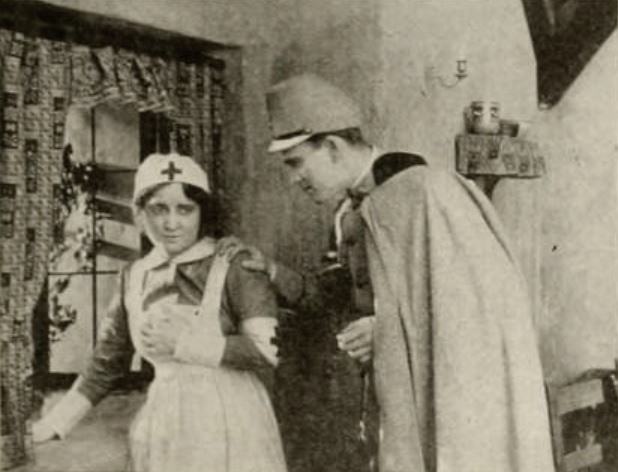
The tension ratchets higher as Austrian forces pound into the village. As Nina bravely strives to aid the persecuted peasants, a chilling recognition washes over her: the Austrian captain in command is none other than Emil Vorstman. This moment is the narrative’s zenith, a collision of past and present, friendship and enmity. Emil, hardened and perhaps brutalized by the campaign, now holds his first love at his mercy. For a brief, agonizing moment, he is poised to cast aside honor, swayed by the intoxicating power of his secure triumph. It’s a powerful exploration of how war can corrupt even the noblest of souls, forcing individuals into roles that betray their true nature. Charles Gunn’s portrayal of Emil in this scene must have been particularly compelling, conveying the internal struggle between newfound ruthlessness and the lingering echoes of his former self. His internal conflict mirrors the broader moral dilemmas often presented in wartime narratives, where the lines between right and wrong become tragically blurred. One might draw parallels to the moral quandaries faced by characters in films like The Fighting Hope, where individuals grapple with difficult choices under extreme pressure.
Yet, the enduring memory of their old, loyal friendship, and the stirrings of his better nature, prevail. Emil’s moment of weakness passes, replaced by a profound sense of decency that transcends the uniform he wears. This act of moral fortitude is the film’s beating heart. It’s a powerful statement on the potential for humanity to endure even in the most inhumane circumstances. When the returning, now triumphant Italian army reclaims the village, Emil is able to look his old comrade, Paul, directly in the face, a testament to his rediscovered honor. The weight of their shared past, the unspoken bond, allows for a moment of quiet understanding that defies the roaring cannons and national anthems.
The film culminates in an extraordinary act of magnanimity. Paul, not to be outdone in generosity, aids Emil to escape, even at the grave risk of his own life and military standing. This final, selfless gesture elevates Three of Many from a mere wartime drama to a profound meditation on the essence of human connection. It suggests that true friendship, forged in peace and tested by conflict, can ultimately triumph over the divisive forces of nationalism and war. George Fisher’s portrayal of Paul here is critical, conveying not just bravery, but an almost spiritual commitment to a bond that predates and transcends the current hostilities. It’s a powerful, almost utopian vision, suggesting that individuals can rise above the collective madness, a theme that perhaps resonated deeply with audiences weary of global conflict. This conclusion differentiates it sharply from films that might prioritize patriotic fervor above all else, offering instead a more nuanced, humanistic perspective akin to the moral complexities explored in A Case at Law, where personal ethics often clash with established systems.
The performances across the board are commendable, especially considering the constraints of silent film. Clara Williams as Nina embodies both vulnerability and strength, her expressions conveying the profound emotional shifts she undergoes, from innocent devotion to wartime nurse and survivor. Her ability to project inner turmoil and resilience without uttering a single word is a testament to her skill. George Fisher brings a steadfast sincerity to Paul, making his ultimate act of self-sacrifice believable and deeply moving. He is the quiet anchor of morality in a turbulent world.
From a technical perspective, C. Gardner Sullivan’s script is a masterclass in narrative economy and dramatic pacing. He introduces characters efficiently, establishes their relationships with clarity, and then masterfully escalates the stakes, using the war as a powerful, inescapable catalyst. The plot points, while grand in scope, always remain tethered to the personal journeys of Paul, Emil, and Nina, ensuring that the audience’s emotional investment remains high. The use of parallel narratives – the initial friendship, the romantic triangle, the separation by war, and the climactic reunion – is expertly handled, building suspense and ultimately delivering a deeply satisfying, albeit bittersweet, resolution. Sullivan, a prolific writer of the era, consistently demonstrated an ability to craft stories that resonated with popular sentiment while also exploring deeper human truths, much like his contemporaries who penned emotionally rich narratives such as The Return of Eve, which delved into personal transformation and societal expectations.
The film’s enduring relevance lies in its timeless themes. It speaks to the arbitrary nature of nationalistic divides, reminding us that beneath the banners and uniforms, individuals often share common hopes, fears, and a capacity for profound loyalty. The depiction of war, while not graphically violent, effectively conveys its destructive power through its impact on personal relationships and moral choices. It’s a nuanced exploration of honor, redemption, and the extraordinary lengths to which individuals will go to protect those they care about, even across the chasm of declared hostilities. In an age where global tensions continue to simmer, Three of Many serves as a powerful reminder of our shared humanity and the potential for empathy to bridge even the deepest divides. The film’s message is particularly profound given its release during or shortly after the very conflict it depicts, offering a glimmer of hope and reconciliation amidst widespread trauma and loss. It stands as a testament to the idea that narratives, even those from a century past, can still offer vital insights into the human condition and the perennial struggle between conflict and coexistence. This exploration of complex human relationships against a backdrop of societal conflict is a hallmark of compelling storytelling, much like the intricate character dynamics found in Audrey, albeit in a different genre.
In conclusion, Three of Many is far more than a historical artifact; it is a meticulously crafted drama that delves into the very core of human nature. It champions friendship, challenges the destructive force of nationalism, and ultimately celebrates the profound capacity for generosity and forgiveness. The film’s ability to evoke such powerful emotions and explore such weighty themes through the silent medium is a testament to the artistry of C. Gardner Sullivan and its talented cast. It remains a compelling watch for anyone interested in the foundational narratives of cinema and the timeless stories that continue to resonate with audiences today.
IMDb 5.8
1936
Community
Log in to comment.