DbcultAccessing Vault...
Cult Review
Senior Film Conservator
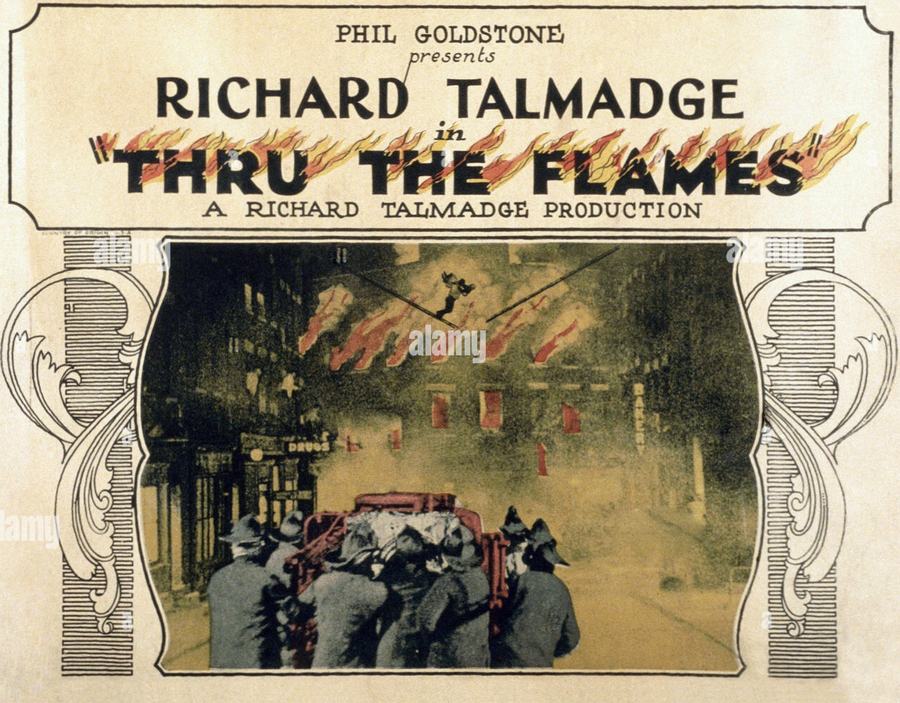
When the silver screen of the Roaring Twenties flickered with tales of daring, *Thru the Flames* emerged as a modest yet resonant ode to valor, sacrifice, and redemption. Directed by the industrious George H. Plympton, the film stitches together the visceral spectacle of fire‑fighting with the cerebral intrigue of a crime caper, all while navigating the tender undercurrents of a doomed romance.
At its core, the story orbits Dan Merrill (portrayed with stoic intensity by George Sherwood), a fireman whose physiological limitation—an acute inability to endure smoke—forces his premature dismissal. This premise, though seemingly a narrative contrivance, blossoms into a meditation on the paradox of strength and vulnerability. Merrill's physical frailty is juxtaposed against his moral fortitude, a duality that the screenplay exploits with deft subtlety.
The antagonist cadre—an organized gang that cloaks thefts in incendiary chaos—functions as a metaphorical embodiment of societal corruption. Their modus operandi, igniting conflagrations to obscure robberies, mirrors the era’s anxieties about rapid urbanization and the thin line between progress and peril. The film’s climax, wherein Merrill outsmarts the pyromaniacs and extinguishes both literal and figurative flames, offers a cathartic resolution that affirms the triumph of integrity over subterfuge.
George Sherwood delivers a performance that oscillates between restrained melancholy and fierce determination. His eyes, often narrowed against imagined smoke, convey an internal battle that words seldom articulate. Edith Yorke, as the steadfast Mary Fenton, provides a nuanced counterpoint; her portrayal is neither mere damsel in distress nor melodramatic heroine, but a grounded figure whose love is tempered by pragmatic skepticism.
The supporting ensemble—Richard Talmadge’s agile antagonist, Bud Geary’s hulking henchman, and the ever‑reliable Pal the Dog—injects kinetic energy into the chase sequences. Notably, Talmadge’s acrobatic stunt work, captured without the safety nets of modern cinema, lends authenticity to the film’s high‑octane moments.
Cinematographer unknown (records are sparse) employs chiaroscuro lighting to accentuate the interplay between darkness and firelight. The black‑and‑white medium, though limited in hue, exploits contrast to evoke the oppressive heat of the infernos and the stark moral binaries at play. The camera often tracks Merrill’s silhouette against roaring flames, a visual metaphor for his struggle to remain visible in a world that threatens to consume him.
Set pieces—particularly the climactic warehouse blaze—are orchestrated with practical effects that, by today’s standards, appear rudimentary yet retain a visceral punch. The crackling embers, captured through in‑camera techniques, create a tactile sense of danger that modern CGI sometimes sterilizes.
The film’s 70‑minute runtime is judiciously partitioned into three acts: the ignominious discharge, the investigative pursuit, and the redemptive showdown. Plympton’s screenplay maintains a brisk tempo, rarely lingering on superfluous subplots. However, the transitional moments—particularly Merrill’s solitary contemplation in a smoke‑filled alley—are granted sufficient breathing room, allowing the audience to empathize with his internal turmoil.
Comparatively, the narrative economy mirrors that of *The Symbol of Sacrifice*, where thematic depth is achieved without sprawling exposition.
As a silent film, *Thru the Flames* relies on intertitles and live musical accompaniment. Contemporary screenings often pair the film with a piano score that underscores the tension with low, rumbling chords during fire sequences, and lifts to a hopeful melody when Merrill’s resolve solidifies. The absence of synchronized sound amplifies the visual storytelling, compelling viewers to read the characters’ emotions through gesture and expression.
Released in 1925, the film arrives at a juncture when America was still grappling with the aftermath of World War I and the onset of Prohibition. The depiction of a fire department—an emblem of public service—resonates with contemporary audiences yearning for stability. Moreover, the film’s subtle critique of criminal enterprises that exploit public fear anticipates the noir sensibilities that would dominate the 1940s.
Its thematic lineage can be traced to later works such as Beware!, where law‑enforcement protagonists confront organized malfeasance cloaked in everyday hazards.
When juxtaposed with The Bright Shawl, which leans heavily on romantic melodrama, *Thru the Flames* prioritizes action‑driven narrative while still preserving an emotional core. Its balance of spectacle and sentiment mirrors the tonal hybridity found in Her Lucky Day, albeit with a darker visual aesthetic.
Though not as celebrated as the era’s marquee titles, *Thru the Flames* enjoys a cult following among silent‑film aficionados. Its restoration in the early 2000s, undertaken by the National Film Preservation Foundation, has allowed contemporary scholars to reassess its contribution to the action‑drama hybrid genre. Critics now laud its pioneering use of fire as both a literal obstacle and a symbolic device.
In academic circles, the film is frequently cited in discussions of early 20th‑century masculinity, especially regarding the portrayal of a hero whose physical limitation does not diminish his moral agency—a narrative choice that prefigures later cinematic explorations of disabled protagonists.
*Thru the Flames* stands as a testament to the silent era’s capacity for storytelling that is simultaneously visceral and cerebral. Its deft interweaving of fire‑fighting bravado, detective intrigue, and romantic fidelity yields a film that, while rooted in its time, possesses a timeless resonance. For cinephiles seeking a glimpse into the genre‑blending experiments of 1920s Hollywood, this work offers both entertainment and scholarly intrigue.
Keywords: Dan Merrill, fire department drama, silent film analysis, 1925 cinema, George Sherwood, Edith Yorke, crime caper, fire stunts, silent era hero, film restoration.
IMDb 5.3
1935
Community
Log in to comment.