DbcultAccessing Vault...
Cult Review
Senior Film Conservator
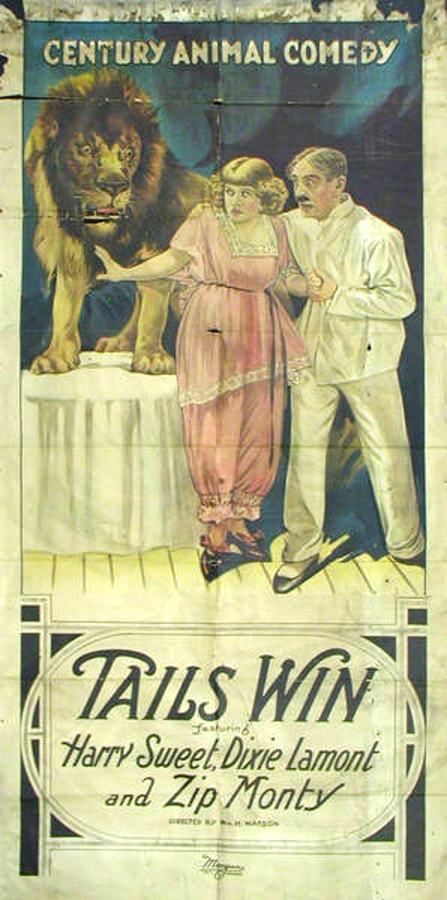
Listen closely and you can almost hear the celluloid sizzle.
In 1929, when the talkie tsunami was busy washing away the iris-in dreamscapes of the silent age, Tails Win arrived like a vaudeville heckler throwing peanuts at a coronation. Produced on poverty-row budgets but drunk on champagne audacity, the picture dispenses with haunted houses and instead installs a dozen full-grown lions in a drawing-room comedy, daring propriety to blink first. The result is a delirious carnival where claw meets claw-foot tub, and every roar feels like a pre-code protest against the very concept of private property.
William Watson’s script, lean as a lion’s shoulder blade, wastes no time on inheritance red tape. One cut and Dixie Lamont’s unnamed heroine—only ever called “Missus” by the intertitles—receives a telegram announcing her uncle’s death and bequeathing “the entirety of the Sawyer & Sawyer Spectacular.” Cut again: a freight siding at dawn, a flatcar stacked with crates that breathe. The camera, jitterbugging with handheld excitement, ogles each slat as though it were a burlesque fan. Something inside thumps; sawdust leaks like cheap perfume. You half expect the Marx Brothers to pop out, but instead the crate collapses and a tawny wave surges forth—first one shoulder, then another, until the screen is nothing but muscle and mane.
Director Harry Sweet, moonlighting in front of the camera as the frazzled husband, understands that comedy is merely tragedy that happens to somebody else with better timing. He stages the homecoming like a coronation gone feral: the lions, unburdened by rehearsal, pad across Persian runners, sniff at wax fruit, and upend a taxidermied stag whose glass eyes reflect their living counterparts. The effect is both hilarious and faintly sacrilegious, as though nature itself were mocking the stuffed trophies of colonial plunder. Sweet’s camera, tethered to bulky sound-proof blimps, nevertheless sneaks in proto-Steadicam glides, following a lioness who discovers the Victrola; she bats the tonearm with a velvet paw, unleashing a warped tango that underscores the scene with lunatic grace.
Yet the film’s true star is not any single feline but the tension between order and entropy. Each room becomes an arena: the parlor a big-top circle, the staircase a precipice worthy of Keaton. Esther Jackson, playing the couple’s flapper neighbor, arrives in a cloche hat shaped like a calla lily, intent on borrowing sugar; she exits via the chimney, stockings shredded but eyes sparkling with the convert’s glee. Her screams are dubbed by what sounds like a soprano slide-whistle, a deliberate absurdity that reminds viewers sound itself is still a novelty, a toy to be broken.
The human performers respond to their co-stars with the heightened mime of silent veterans, eyebrows semaphore-signaling dread while their bodies refuse to acknowledge danger. Watch Sweet tiptoe across a hallway balancing a silver tray of raw sirloin—his knees rubber, his grin welded on like a death mask—while behind him a male lion yawns, revealing a pink cathedral of teeth. The tension is exquisite because it is genuine: safety protocols were primitive, the lions’ trainer paid in bourbon and cigarettes, the set littered with meat chunks to buy loyalty one bloody second at a time. Every frame hums with the possibility of catastrophe, a thrill no CGI menagerie can counterfeit.
Scholars of pre-code Hollywood often cite gangster pictures for their carnivorous appetites, but Tails Win literalizes the metaphor: here, capital devours itself. The lions stand in for every debt collector, every landlord, every studio boss who ever demanded fealty. When they tear apart a chintz-covered settee, they are not misbehaving; they are enforcing a foreclosure on comfort itself.
Visually, the film is a chiaroscuro fever dream. Cinematographer Frank Zucker bathes night interiors in pools of tungsten that turn lion eyes into molten coins. Shadows stretch like black crepe, swallowing whole portions of the frame so that a tail or paw emerges as though from the void. The effect anticipates the expressionist horrors of German submarine thrillers yet remains tethered to slapstick by the jaunty bounce of intertitles: “She always wanted a cat—FATE granted her NINE HUNDRED POUNDS OF ONE!”
Watson’s screenplay, meanwhile, sneaks in social shivs. A creditor arrives brandishing a ledger labeled “Morality Installments,” only to be chased up a flagpole by a lioness who, in a medium-close-up, appears to smirk. The gag lands as both visceral and ideological: the predator-prey relationship inverted, the rentier class reduced to circus geek. Even the title card winks: “Tails Win—because heads roll.”
Comparisons are instructive. Where His Parisian Wife used continental flirtation to lampoon matrimony, and Widow by Proxy trafficked in inheritance fraud, Tails Win weaponizes the uncanny: the moment when the animal in the parlour becomes the repressed truth of every bourgeois contract. If boxing pictures celebrate the underdog, this film asks what happens when the underdog is literally under a lion.
The sound design—crude, crackling, occasionally out of sync—adds another layer of estrangement. Roars are looped until they resemble industrial grinders; human dialogue arrives in staccato bursts, as though the microphones themselves feared being mauled. In one surreal interlude, a lion pads across a harp, unleashing a glissando that dissolves into radio static. The audience laughs, but uneasily, aware that the boundary between score and sound effect has collapsed into pure sonic anarchy.
Central to the film’s lingering unease is Dixie Lamont’s performance. A veteran of the Ziegfeld Follies, Lamont possesses the angular grace of a Modigliani sketch; her eyes telegraph perpetual calculation even while her mouth forms a perfect O of shock. She navigates the lions with the wary authority of a lion-tamer who has read Nietzsche and decided that God is not only dead but probably hiding under the davenport. In a late scene, she drapes herself across a sleeping male’s flank, murmuring “Nice kitty” while her fingers inch toward a revolver tucked beneath a pillow. The tension—erotic, maternal, existential—feels startlingly modern, a precursor to the dangerous liaisons of post-war melodrama.
Yet for all its savage verve, the picture is not without tenderness. A cub, separated from the pride, curls inside a bowler hat; the husband, discovering it, hesitates—a flicker of paternal instinct before the hat tips and the cub tumbles into his lap. The moment is wordless, scored only by the faint whistle of a kettle somewhere off-screen. It lasts perhaps three seconds but reframes the entire narrative: these are not monsters, merely evacuees from a bankrupt spectacle, refugees of human folly.
This duality—ferocity and fragility—elevates Tails Win above the one-joke premise suggested by its trailer. Yes, lions in a drawing room is inherently absurd, but the film insists that absurdity is the native tongue of modernity. The real joke is not that the lions misbehave; it is that they adapt faster than their human hosts, learning door handles, light switches, even the etiquette of afternoon tea. Civilisation, the film implies, is a coat that never truly fit.
By the time the climactic auction rolls around—creditors circling like vultures in tuxedos—the house has been transformed into a labyrinth of claw-marked walls and toppled statuary. The lions, weary of performance, sprawl across the grand staircase as though posing for a Delacroix canvas. The auctioneer, played by Billy Armstrong with the rapid-fire patter of a carnival barker, attempts to sell “a rare menagerie of exotic guardians” only to be informed that the beasts have already absconded with the deed. The final shot, a slow iris-in on a lion’s eye reflecting the burning house, suggests not defeat but transfiguration: property reclaimed by primal lien, the mortgage of meat and sinew finally paid.
Contemporary critics, blinded by the novelty of talkies, dismissed Tails Win as “a one-roar curiosity.” They were wrong. The film prefigures the anarchic spirit of screwball comedy, the ecological parables of later nature films, even the home-invasion thrillers that would stalk American suburbs during the Cold War. Its DNA can be traced in everything from Bringing Up Baby’s leopard to The Exorcist’s domestic desecration. Yet unlike its descendants, it never moralizes; it simply unleashes, then watches.
Restoration efforts remain spotty. A 16mm print, scarred like a pockmarked lion, surfaced in a Belgian convent archive in 1987; a 4K scan was attempted but abandoned when the nitrate reek overwhelmed the scanning bay. Rumors persist of a complete 35mm negative in a Buenos Aires basement, guarded by a cinephile who claims the lions “still breathe inside the emulsion.” Until that phantom print roars to light, viewers must content themselves with bootlegs on dimly lit forums, the images smeared yet incandescent, the roars attenuated to ghostly growls.
Still, even in tatters, Tails Win retains its savage luminosity. It reminds us that every household is three missed payments from the wilderness, that marriage itself is a cage whose door may spring open at any moment. And when the beasts arrive—whether lions or debts or truths long caged—they will not knock. They will simply pad in, tails twitching, and make themselves at home.
So if you chance upon a flickering copy—perhaps at a repertory house that smells of mothballs and turpentine—go. Sit close enough to feel the heat of the projector. Let the roars crackle through the tinny speakers, let the shadows warp, and when the lights come up, check your lap: you may find a single tawny hair, proof that somewhere, out beyond the reach of deed or decree, the pride still prowls.
—reviewed by a ghost in the reels
IMDb 5.7
1932
Community
Log in to comment.