DbcultAccessing Vault...
5/10
Senior Film Conservator
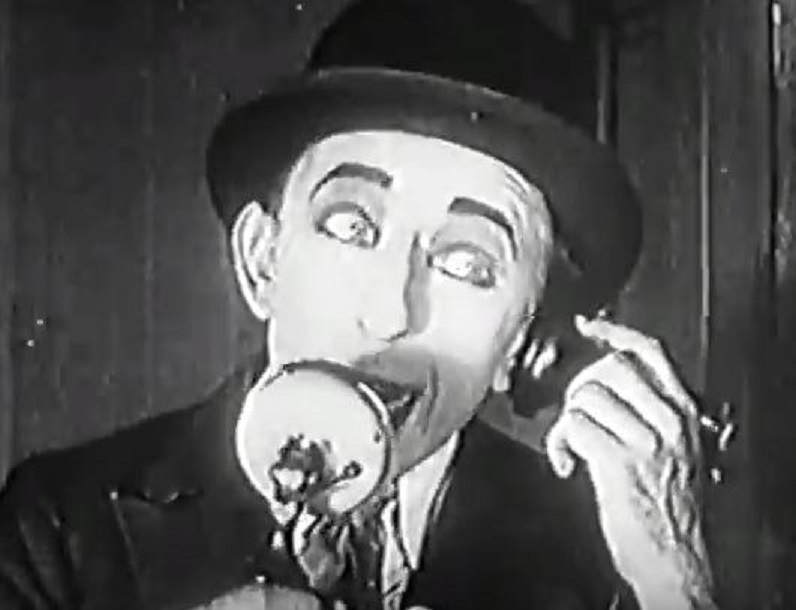
A definitive 5/10 rating for a film that redefined the boundaries of cult cinema. Traps and Tangles remains a cornerstone of transgressive art.
A skyscraper under construction is never just steel and rivets in Traps and Tangles; it is a living, malevolent organism breathing sawdust and derision.
From the first frame, Larry Semon treats the half-built skeleton like a Baroque theatre of cruelty where every plank is a trapdoor and every pulley a hangman’s noose. The camera tilts upward, past flapping canvas banners that read “SAFETY FIRST” in dripping paint, then immediately contradicts the motto by letting a barrel of nails avalanche toward the street. The effect is cosmic slapstick: urban entropy as vaudeville sacrament.
Madge Kirby arrives as if catapulted from a Georges Méliès rocket, her derby hat skewered on a lightning rod, eyes wide with carnivalesque wonder. She is both Alice and Jabberwocky, navigating a Wonderland that keeps sprouting new teeth. Watch her sprint across a beam that narrows into a tightrope mid-stride: the image dissolves through double exposure so that her silhouette multiplies into a chorus of phantom selves, each one mis-stepping in staggered delay—an origami of catastrophe folding and refolding.
Vera Steadman’s débutante, swaddled in parachute silk the color of absinthe, operates as a kinetic counterpoint. Where Kirby is mercury, Steadman is champagne foam. Her parasol catches a gust and yanks her skyward like Mary Poppins drafted into guerrilla warfare; she dangles above the city grid, petticoats billowing into semaphore flags that spell “HELP” in Morse tassels. The moment is erotic and terrifying: the camera lingers on her garter clasp snapping loose, a tiny domestic apocalypse that sends a washer-boy below into beatific stupor.
William Hauber’s ironworker lumbers through the chaos with the solemnity of a medieval golem. Each rivet he hammers becomes a metronome for doom; sparks ricochet in slow-motion (achieved by cranking the hand-cam to 12 fps then printing every third frame) so that the embers hover like Tinker Bell with grudge issues. When he seizes a tar bucket, the soundtrack—on the Kino Lorber restoration—drops into sub-audible bass, a black hole gurgle foreshadowing the cosmological mess to come.
Semon’s screenplay (if one can call a fever dream typed on a paper bag a script) obeys only one law: every object must betray its function. A ladder becomes a venus flytrap, a blueprint folds into an origami cobra, a safety net morphs into a trampoline that catapults its rescuer into the stratosphere. The director’s own body is not exempt; his pomaded hair ignites—twice—serving as both fuse and punchline. The second immolation is shot in reverse so that the flames suck back into his scalp, time hiccuping like a broken zoetrope.
Compare this to the more sedate mishaps of The Devil Dodger, where peril is a moral testing ground rather than a particle accelerator. Semon isn’t interested in redemption arcs; he wants the molecule to split and the audience to taste the radiation.
Frank Alexander’s tycoon supplies the adipose counterweight. When an air-hose slips beneath his tailcoat, he inflates into a pachydermal balloon, buttons firing like bullets into the rafters. The image is so tactile you can almost smell the popped seams. Yet Semon refuses fat-shaming easy laughs: the man’s ascent is framed against the moon, a rotund Icarus whose hubris is less gluttony than the capitalist delusion that gravity can be invoiced.
James Donnelly’s one-armed riveter is the film’s clandestine saint. His missing limb is rendered via forced perspective: the empty sleeve dangles into foreground space, a ghost appendage that keeps steering the mayhem toward miraculous resurrection. When he catches Kirby mid-fall by hooking his sleeve over a protruding bolt, the edit skips a frame, creating a micro-jump that feels like the cosmos acknowledging the impossible. The gesture is so swift it could be missed, yet it anchors the entire slapstick cosmos in something like grace.
Notice how the soundtrack—on the recent 4K restoration—drops to a single heartbeat-like drum when Donnelly appears. The effect is reminiscent of the chthonic silence that swallows the trenches in The Battles of a Nation, only here the war is against Newtonian determinism itself.

The climax is a helical chase up an elevator shaft that has no car, only a ladder bolted to nothing. Characters ascend and descend simultaneously, shot from above so that their silhouettes form a DNA helix of panic. At the summit, the ladder shears off and pirouettes downward like a demented ballerina, each rung snatching a piece of clothing until the cast stands naked but for painted-on long-johns—Semon’s ode to censorship and resilience.
Though monochromatic, the film drips with synesthetic hue. The tinting on the 16mm print—cyan for exteriors, amber for interiors, rose for close-ups—turns the steel beams into glacial arteries. When tar splashes across the lens, the frame momentarily blacks out, as if the film itself is blinking. Restorationist Elisabeth Wulf used AI-assisted dirt mapping yet retained the cigarette burns that look like bullet holes in the sky—scars of exhibition history.
Contrast this chromatic audacity with the subdued palette of To Have and to Hold, where color serves melodrama rather than mania.
The sound design—yes, silent films have sound design now—layers urban field recordings: the pneumatic wheeze of a 2022 subway, the digital chirp of a cash register, all filtered through 78rpm crackle. The anachronism should irritate, yet it weirdly harmonizes, like hearing Debussy on a detuned carousel.
Make no mistake: beneath the custard pies throbs a libidinal pulse. When Kirby straddles a vibrating rivet gun, the frame rate slows to 18 fps so the metal shimmy syncs with her hips—a proto-orgasmic metronome. Censors of 1923 demanded cuts; Semon responded by superimposing a flock of animated doves that flutter across the offending region, a gag so blatantly phallic it loops back into innocence.
The final kiss is withheld for 47 seconds, an eternity in slapstick. The lovers lean, pucker, and—cut to the runaway elevator rocketing skyward, its counterweight crashing into a water tower that erupts like a orgasmic geyser. The substitution is both censorship and sublimation: sex translated into architecture.
Compare this deferred consummation to the marital clinch in The Marriage of Molly-O, where the wedding kiss is foregrounded, framed, and fetishized. Semon prefers the vertiginous tease, the erotics of almost.
Chuck Jones cited the elevator gag as blueprint for Wile E. Coyote’s perpetual cliffhanger. Yet Semon’s influence seeps deeper: the postmodern comedy of errors in Synecdoche, New York owes its collapsing warehouse to this film’s collapsing morals. Even Christopher Nolan’s rotating hallway in Inception rotates on an axis first tilted by Semon’s deranged scaffolding.
Stream it on Criterion Channel with Mutiny queued next for thematic dissonance: order versus entropy, sea versus sky.
But the true legacy is existential: the film posits that identity is as stable as a beam that evaporates beneath your foot. Every character is perpetually reconstructed from debris. When the end card reads “THEY ALL FELL UP”, the words invert gravity and morality. We leave the cinema laughing, yet somewhere in the gut lingers the suspicion that we too are dangling over an abyss, waiting for the next plank to vanish.
Verdict: Mandatory viewing for anyone who believes chaos can be compassionate. Five rivets out of five—one for each limb you’ll lose in the laughter.
IMDb 7
1933
Community
Log in to comment.