DbcultAccessing Vault...
Cult Review
Senior Film Conservator
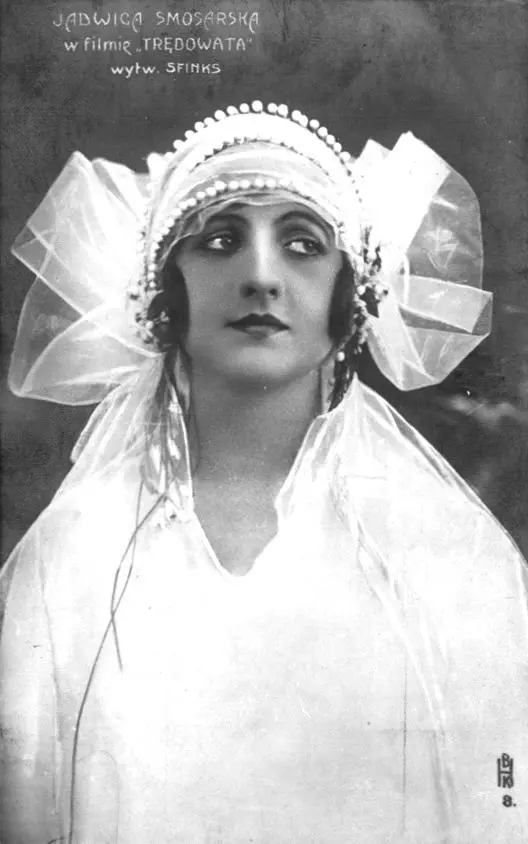
Is Tredowata worth your time nearly a century after its release? Short answer: Yes, but only if you view it as a cultural artifact rather than a modern entertainment piece.
This film is for the dedicated cinephile and the historian of European social structures; it is most certainly not for those who demand the fast-paced narrative economy of contemporary cinema.
1) This film works because Jadwiga Smosarska possesses a magnetic screen presence that makes the internal agony of her character visible without a single spoken word.
2) This film fails because the supporting aristocratic characters are often written as one-dimensional monsters, lacking the complexity found in contemporary dramas like Camille.
3) You should watch it if you want to understand the origins of Polish melodrama and how silent film used visual metaphor to represent class warfare.
Tredowata, or 'The Leper,' is not a film about disease, though the title suggests a biological contagion. Instead, it is a film about the perceived infection of 'common blood' entering an aristocratic circle. Director Mieczysław Krawicz manages to capture the claustrophobia of high-society ballrooms better than almost any other Polish director of the era. When Stefcia enters a room, the camera doesn't just watch her; it observes the way the other characters recoil, as if her presence were a physical assault on their dignity.
The film relies heavily on the source material by Helena Mniszkówna, a novel that was once the most mocked and most read book in Poland. In this 1926 adaptation, the melodrama is dialed up to eleven. There is a specific scene involving a grand ball where the lighting—primitive as it may be—highlights the isolation of Stefcia against a sea of dark suits and glittering jewels. It is a visual representation of a woman drowning in a sea of privilege.
The pacing is deliberate, perhaps to a fault. Unlike the more kinetic energy found in American films of the same year, such as The Show-Off, Tredowata lingers on glances and social slights. It demands that the viewer feel the weight of every silent insult. It works. But it’s flawed. The runtime can feel bloated when the central conflict is established so early on.
Is Tredowata a must-watch for modern audiences? For fans of historical melodrama, the answer is a firm yes. It offers a rare window into the social anxieties of early 20th-century Poland. However, casual viewers may find the silent-era theatricality difficult to digest. If you are looking for a deep exploration of how class functions as a cage, this is essential viewing.
Jadwiga Smosarska was the undisputed queen of Polish silent cinema, and Tredowata is perhaps her most defining role. Her acting style is remarkably restrained compared to some of her peers. While others might resort to wild gesticulation, Smosarska uses her eyes to convey the transition from hopeful lover to crushed victim. In one pivotal sequence where she realizes the depth of the Michorowski family's hatred, her subtle shift in posture tells the audience more than any title card could.
Contrast this with the performance of Józef Węgrzyn, who plays Waldemar. Węgrzyn is all bravado and aristocratic posturing. The chemistry between the two is palpable, but it is a chemistry built on the impossible. Their scenes together feel like a brief respite from the predatory environment surrounding them. It reminds me of the tragic tension in The Forbidden Lover, where the external world is the primary antagonist.
The cinematography in Tredowata is surprisingly sophisticated for the mid-20s in Eastern Europe. The use of depth of field in the manor house scenes creates a sense of a world that is vast but unreachable for the protagonist. The camera often places Stefcia in the foreground, with the 'judges' of society blurred or looming in the background, creating a constant sense of surveillance. This isn't just a romance; it's a horror movie where the monster is a social code.
The film also makes excellent use of location. The sprawling estates and manicured gardens aren't just backdrops; they are symbols of the Michorowski legacy. They are beautiful, yes, but they are also cold and exclusionary. This contrasts sharply with the more intimate, albeit lower-budget, aesthetics of films like The Pinch Hitter.
Pros:
Cons:
One could argue that Tredowata falls into the trap of being 'too much.' The suffering is relentless. The villains are too cruel. The hero is too noble. However, this is the essence of the genre. In 1926, cinema was still finding its feet between the exaggerated movements of the stage and the subtle realism of the lens. Tredowata leans into its theatrical roots, and while that might feel dated to some, it gives the film an operatic quality that is undeniably powerful.
When compared to other films of the era like Sold at Auction, which also deals with the commodification of women, Tredowata feels more grounded in a specific cultural trauma. It isn't just about money; it's about the soul of a nation stuck between its feudal past and an uncertain future. The film captures a moment in time when the old world was screaming its last defiance against the inevitable change of the 20th century.
"The aristocracy depicted here isn't just snobbish; it's predatory. They don't just want Stefcia gone; they want her erased."
This predatory nature is best seen in the character of Helena Sulimowa’s Baroness. Her performance is chilling. She doesn't need to shout; her silence is a weapon. It is this psychological warfare that elevates the film above standard romance. It is a battle of wills where the person with the most 'history' always wins, regardless of the truth.
Tredowata is a haunting, if occasionally exhausting, look at the cruelty of the human spirit when it is wrapped in silk and title. It is a essential piece of Polish cinematic history that proves some social wounds never truly heal. While it lacks the technical polish of modern cinema, its emotional core is raw and recognizable. It is a tragedy in the truest sense of the word—not because of a twist of fate, but because of the choices people make to protect their own perceived superiority. Watch it for Smosarska, but stay for the scathing critique of a world that no longer exists, but whose echoes we still hear today.
IMDb 5.4
1915
Community
Log in to comment.