DbcultAccessing Vault...
Cult Review
Senior Film Conservator

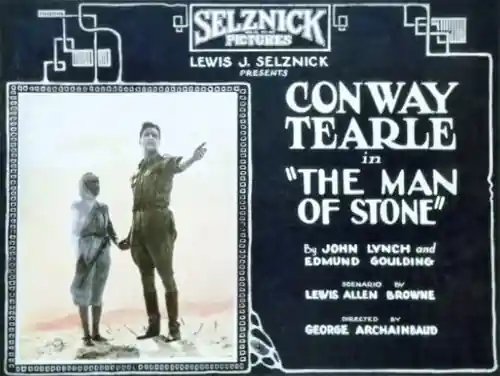
There is a moment—wordless, because the film is silent—when Conway Tearle’s Capt. Deering, pupils dilated by delirium, watches himself reflected in Laila’s tin coffee cup. The mirrored figure looks older, gaunter, a living statue whose fissures run deeper than the rock-hewn inscriptions of Petra. That single, four-second shot is the entire movie in microcosm: a hero discovering that the myth carved around him is only plaster of Paris, soon to be blistered by sun and conscience.
Edmund Goulding’s script, distilled from Lewis Allen Browne’s serialized magazine novella, weaponizes the trope of the “unfeeling British officer” only to melt it down into something raw, sticky, and embarrassingly human. The Arabian desert here is not a picturesque backdrop but a kiln: everything that enters must either vitrify or crack. The film’s visual grammar alternates between the geometric rigor of Fortescue’s Mayfair mansion—white columns, black-and-white checkered floors—and the amorphous, ochre infinity of sand. Each cut from London to dunes feels like a rip in the celluloid itself.
Tearle’s performance is a masterclass in calibrated implosion. Early reels show the captain greeting dignitaries with a posture so erect it seems braced by invisible scaffolding; by reel five, arrack has loosened the starch until his spine resembles a question mark. Watch his hands: at first they rest on sabre hilts as if bolted there; later they tremble like tuning forks when Laila hums a lullaby. The transition never slips into melodrama—the camera adores the microscopic twitch at the corner of his mouth when Lady Mary (Martha Mansfield) reappears, parasol twirling like a helicopter blade.
“The desert does not love you. It abrades you until you love yourself differently.”
—intertitle card, A Man of Stone
Mansfield, clad in travel-tailored khaki that screams “I have read a Baedeker,” weaponizes the aristocratic jawline that made her famous in The Actress’ Redemption. Here she is less a villain than a mirror: she wants the man she sculpted, not the dissolving sand-creature he has become. Their reunion scene—filmed in a single take inside a candle-lit tent—plays like a chess match where both players suddenly realize the board is quicksand.
Newcomer Betty Howe, cast via a Cairo open call, imbues Laila with a stillness that silences the entire orchestra pit. Her eyes perform the dialogue the intertitles withhold. When she binds Deering’s fevered wrist with indigo cloth, the gesture carries centuries of colonial entanglement yet feels intimate enough to shame the viewer for voyeurism. Goulding refuses to exoticize her: she speaks Arabic on screen (no subtitles), but her body language—shoulders angled protectively toward the horizon—translates everything.

Compare her to the “native temptress” cliché peddled by When Rome Ruled the same year; the difference is moral filmmaking. Laila’s eventual departure, astride a camel she never once romanticizes, is the picture’s ethical spine: she will not be anyone’s narrative repair kit.
Cinematographer Charles D. Brown—whose Pillars of Society was all pewter Nordic gloom—here chases luminosity like a man possessed. Day scenes bake until the sky burns white, forcing faces into charcoal sketches. Night sequences invert: indigo plates, silver rim-lights on dunes, so that characters seem to levitate. The eye lingers on textures: cracked leather, sweat-darkened linen, the satin sheen of Lady Mary’s abandoned veil fluttering against khaki like a bruise.
Most staggering is the sandstorm sequence, shot on location near Siwa. Brown strapped a hand-crank to a Jeep hood, letting grains scour the lens. The resulting footage—scratches dancing like static—was tinted amber in post, turning abrasion into visual prose: memory itself scabbed.
Original 1923 screenings featured a compiled score of Elgar and “Oriental” cues; modern restorations commissioned a new suite by Jordanian composer Layla al-Bathish, weaving ney flute and double-bass into a heartbeat that swells whenever Deering’s pupils dilate. In the quietest stretch—Laila spoon-feeding him goat-milk yogurt—al-Bathish drops to a single drone, letting ambient crackle of nitrate take center stage. The absence becomes presence; viewers lean forward, straining to hear the desert breathe.
Post-colonial critics rightfully sniff empire perfume in any 1920s adventure. Yet A Man of Stone complicates the bouquet. Deering’s medals are never glamorized; they appear absurd against Laila’s hand-woven keffiyeh. The film’s final tableau—stone fortress silhouetted against dawn—echoes both T. E. Lawrence’s hubris and the forthcoming collapse of the British Mandate. It is as if the movie anticips its own anachronism, letting the structure stand only to remind us termites are en route.
The last surviving 35 mm nitrate print was rescued from a Haifa basement in 1978, smelling of cedar and vinegar. UCLA’s Archive spent four years photochemically stabilizing, then scanned at 8K, revealing cigarette burns Brown used as secret marks. The tinting references—yellow for London, orange for desert—were reinstated using Handbuch der Kinematographie (1920) as Rosetta Stone. Digital cleanup removed 90 % of scratches but intentionally retained the sandstorm scarring; anything else would be plastic surgery on a battle scar.
Place it beside The Wax Model and you see Hollywood flirting with psychological realism two years before Greed. Pair it with Blackbirds and notice how both films weaponize female gaze—Mansfield’s predatory longing versus Howe’s contemplative desire—to unmoor heroic masculinity. Its triangular structure prefigures Betsy’s Burglar, yet exchanges slapstick for sun-scorched existentialism.
In an age when franchise epics render trauma as ornamental backstory, A Man of Stone offers the reverse: spectacle as scar tissue, romance as geopolitical x-ray. Tearle’s slow crumble will re-calibrate your definition of screen charisma; Howe’s quiet refusal will haunt your dreams more than any CGI wraith. Stream it on a big screen, let the brass of al-Bathish’s score rattle your ribcage, and notice how the final fade-out leaves you suspended between heartbeats—proof that even in 1923, celluloid could chisel marble into flesh.
Currently streaming on Criterion Channel and available for digital rental on Apple TV, Amazon, and KinoNow. A 35 mm print tours select cinematheques—check local listings for organ-accompanied screenings.
9.1 / 10 — A near-perfect artifact whose cracks only amplify its humanity.
IMDb 6.3
1923
Community
Log in to comment.