DbcultAccessing Vault...
9.6/10
Senior Film Conservator
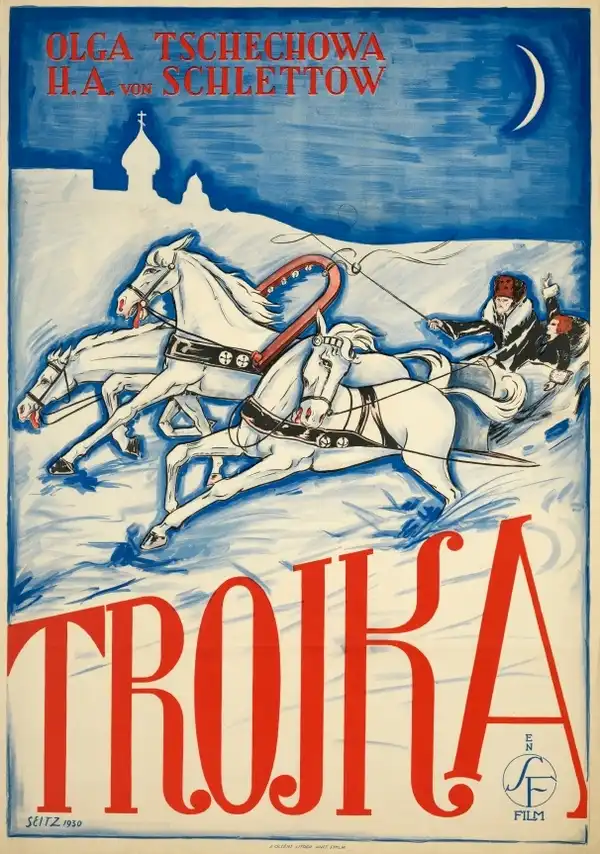
A definitive 9.6/10 rating for a film that redefined the boundaries of cult cinema. Troika remains a cornerstone of transgressive art.
If you have a rainy Sunday and a high tolerance for people staring intensely into the middle distance, Troika is probably for you. It is one of those early sound movies that hasn't quite figured out how to talk yet.
It is definitely worth watching if you care about acting history or if you just like the aesthetic of heavy fur coats. People who need fast-paced action will probably hate this within five minutes. ❄️
The movie is set in Russia, but it's a German production. It has that weird, hybrid feeling where everyone is trying very hard to be 'Russian' in that soul-crushing, poetic way.
I mainly watched it because of Michael Chekhov. He is the guy who basically taught everyone in Hollywood how to act later on, but here he is just... being the character.
His eyes are absolutely massive on screen. There is a moment where he just looks at a glass of vodka and you can feel his entire life falling apart without him saying a single word.
The plot is a bit of a tangle, kind of like The Tangle, but way more snowy. It’s a love triangle that feels doomed from the very first frame.
Olga Tschechowa plays the woman at the center of it all. She has this way of wearing a hat that makes her look like she’s keeping a secret that could destroy a small village.
Honestly, the pacing is a bit of a mess. Some scenes feel like they were edited with a bread knife, just hacking away at the flow until it stops.
But then you get these shots of the troika—the three-horse carriage—blasting through the snow. 🐎
The camera work during the carriage rides is actually pretty impressive for 1930. You can almost feel the cold wind hitting the lens, and the horses look genuinely exhausted.
I noticed one extra in the background of a tavern scene who looked like he was completely lost. He just stood there holding a plate for about thirty seconds too long.
It’s little things like that which remind you this was the early days of sound. They were still figuring out where to hide the microphones and how to keep people from tripping over cables.
There is a sequence in a village that feels very much like a stage play. The lighting is super dramatic, casting these long, jagged shadows across the wooden walls.
It reminded me a bit of the atmosphere in Der Zarewitsch, but maybe a bit more grimy. Everything feels damp and heavy.
The sound quality is... well, it's 1930. There is a constant hiss that sounds like the movie is being projected through a radiator.
But weirdly, the hiss adds to the mood. It makes the whole experience feel like you're uncovering a ghost story from a dusty attic.
I found myself focusing on the textures of the costumes more than the dialogue. The wool, the fur, the shiny buttons on the uniforms—it’s all very tactile.
There is a scene where a character is writing a letter, and the camera just lingers on the ink drying. It felt like it lasted five minutes, but it was probably only twenty seconds.
That kind of slowness is something we just don't see anymore. We are so used to quick cuts that a long shot of a pen feels like a radical political statement.
If you’ve seen Redemption, you might recognize some of the same heavy-handed emotional beats. It’s that specific brand of misery that only 1930s cinema can provide.
I think I actually fell into a light trance during one of the long snow sequences. It was strangely hypnotic, watching the white blur and hearing the rhythmic thump-thump of the horses.
The movie doesn't really have a 'villain' in the traditional sense. It’s more like the weather and the social expectations are the things killing everyone's happiness.
Is it a masterpiece? Probably not. It’s too clunky and the acting styles clash in a way that’s sometimes distracting.
One actor is doing full-blown silent movie pantomime, while another is trying to be natural and modern. It's like they are in two different movies at the same time.
Yet, I can't stop thinking about the ending. It’s not happy, obviously. It’s Russia in 1930. 🥀
It has that same tragic weight you find in The Woman and the Law, where you just know things are going to end badly for everyone involved.
I’d say give it a shot if you can find a decent print. Even if you don't follow every beat of the romance, the look of it is enough to keep you occupied.
Just don't expect a happy ending or a coherent explanation for why everyone is so sad all the time. They just are. It's the vibe. 🎬
One more thing—the way they filmed the shadows of the horses against the snow is beautiful. It’s the kind of thing you’d miss if you were looking at your phone.
Anyway, I'm going to go drink some tea and think about Michael Chekhov's eyes for a while. That guy was something else.
IMDb —
1925
Community
Log in to comment.