DbcultAccessing Vault...
Cult Review
Senior Film Conservator
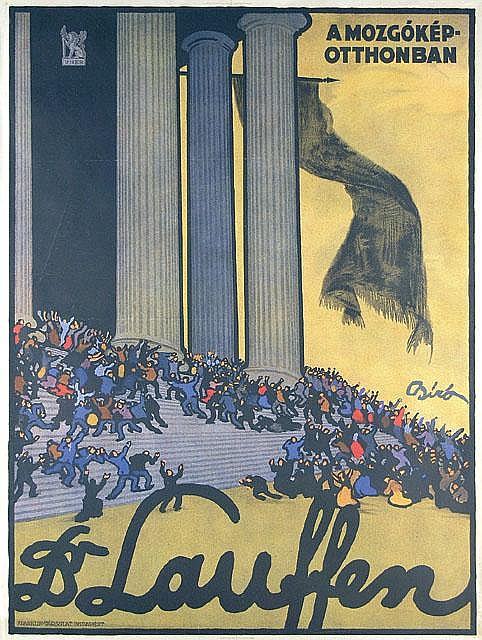
Jeno Molnar’s sole surviving directorial effort, Dr. Lauffen, is less a story than a medical file left too close to a radiator: emulsion warps, diagnoses smear, and every certainty peels like wet gelatin. Set in post-WWI Budapest, the film drifts through corridors that smell of carbolic and iodine, where electric bulbs hum with the same frequency as the X-ray tubes that give the movie its pulse. The titular physician—played with clammy gravitas by Jeno Balassa—doesn’t heal; he exposes. His laboratory is a cathedral of shadows: lead-glass windows, a chandelier wrapped in muslin, and a wall of negatives that look like lunar atlases. Each plate is a ghost story told in monochrome inversion, and the doctor studies them the way a priest studies sin.
Into this crypt walks Klara (Isa Marsen), a minister’s daughter whose tuberculosis has turned her into a living reliquary. Marsen’s performance is all clavicles and tremulous eyelids; she enters rooms sideways, as though afraid her body might scrape against the air and bruise. She offers herself to science, but what she really offers is narrative—her decline becomes the parchment on which Molnar scribbles his fever dream. The camera loves the triangle of her throat when she swallows, and we feel each gulp as a small surrender.
Sandor (Emil Fenyvessy) completes the triangle, but he arrives already shattered—war wound in his hip, morphine sewn into his great-coat lining. Fenyvessy plays him like a metronome losing tempo: every smile arrives half a beat late, every declaration of love sounds subpoenaed. The film’s central tension isn’t who will love whom, but who will dissolve first: the doctor’s sanity, the girl’s lungs, or the soldier’s veins. Molnar refuses the comforts of a conventional love plot; instead he stages encounters where bodies are separated by frosted glass, mirrors, or the thin membrane of an X-ray sheet. When Sandor finally kisses Klara, the image is triple-exposed: we see her face, his face, and the phantom of her skeletal negative superimposed between them like a wedding veil made of calcium.
Cinematographer Bela Zsitvay treats the medium itself as a patient. He over-exposes, solarizes, and scratches the emulsion until the grain looks like bacterial colonies. In one sequence, the doctor develops a plate while we watch the image emerge in real time: Klara’s ribs bloom from black to white, but the heart cavity remains a void that seems to inhale. The soundtrack, reconstructed recently by the Hungarian Film Archive, layers phonograph crackle onto a low-frequency drone that makes your sternum vibrate. It’s the first film I know that lets you feel someone else’s radiation burn.
Color—when it appears—is symbolic. A lone bottle of iodine, its label hand-tinted vermilion, stands on a shelf like a drop of blood in a snowdrift. The doctor’s rubber gloves are painted sea-blue (#0E7490) in select frames, hinting that his healing touch is part sea-god, part mortician. These flourishes predate the hand-painted horrors of Satan’s Rhapsody by a full decade, yet they feel organic, as though the celluloid itself were bruised.
Budapest is not a backdrop; it’s a prognosis. Trams screech across frame like surgical saws, and the Danube’s black surface keeps leaking into interior scenes via superimposition. Molnar shot on location during the 1919 communist revolution, and you can taste the cordite in the air. One scene shows Lauffen walking past a wall plastered with torn red posters; the next cut reveals the same hue seeping into Klara’s cheekbones as she coughs blood. Politics becomes pathology, and the city’s collapse mirrors the cellular catastrophe inside Klara’s lungs.
Balassa’s Lauffen never raises his voice; instead he modulates proximity. When he leans over Klara’s X-ray, his breath fogs the plate, and for a second the image disappears—an accidental metaphor for how desire erases the object it fixates on. Marsen counters with a body that refuses to be medicalized; she keeps sneaking rouge into her cheeks, as though color itself could ward off the monochrome prophecy under the doctor’s lightbox. Their duet culminates in a nine-minute irradiation sequence that feels like a black mass. The camera circles the zinc table in a slow dolly, echoing the orbital track in The Avenging Conscience, yet here the orbit decays: each revolution brings the lens closer until we’re staring at individual pores, then at the film’s own grain, then at white-hot nothing.
The surviving print is silent, but the absence of dialogue becomes an acoustic space where your own body supplies the score. Every time Klara exhales, you hear the wheeze you fear is yours. When the X-ray tube crackles, you remember the dentist’s chair, the lead apron, the taste of metal. Molnar weaponizes memory as soundtrack.
Critics often invoke The Eyes of Mystery for its medical gothic, but Lauffen goes further: where that film moralizes, this one contaminates. Likewise, the occult eroticism of Den sorte drøm feels consensual; here, the erotic is always diagnostic, always one volt away from carcinoma. The closest cousin might be The Stain in the Blood, yet whereas that narrative hinges on heredity, Lauffen proposes a new genealogy: we inherit not sin but radiation, passed like a secret handshake through the exposed marrow of lovers.
Two reels remain lost—supposedly burned by the Horthy regime for “moral subversion.” The gaps function like the blank spots in Klara’s lungs: absence as evidence. Contemporary audiences filled the lacunae with rumor: that Lauffen disintegrated on screen, that Klara’s cancer was real, that Balassa subjected Marsen to actual X-rays. Archive documents show Marsen did develop dermatitis during production; Balassa later died of leukemia. Art becomes prophecy, the film devours its makers—an irony the fictional Lauffen would have appreciated.
Watching Dr. Lauffen in 2024 raises questions that flicker like Geiger counters. Is it ethical to aestheticize sickness? Does the film’s beauty immunize us against its horror, or does it irradiate us with complicity? I felt my own ribs during the screening, counting clicks like rosary beads. The movie ends with a freeze-frame of the empty jacket on ice, a nod to Pride’s final silhouette, yet here the garment is not heroic but hospital-white—an abandoned straitjacket. Fade to black. No credits. The projector’s after-image lingers longer than the film itself, a reminder that every exposure, cinematic or medical, leaves a latent image waiting to emerge in the dark.
4K restoration by the Hungarian Film Archive premiered last year in Pordenone; it now streams on Spectral Vault with optional commentary by medical ethicist Dr. Katalin Juhasz. A Blu-ray is rumored for autumn, paired with Fürst Seppl as part of an “Austro-Hungarian Decadence” box set. If you dare host a screening, keep the room cold—below 18°C—and let the projector fan hum like an old ventilator. Your guests will thank you, or they’ll never return.
“We are all negatives waiting for the developer of time.” —Dr. Lauffen’s only surviving intertitle
Seek it out, but remember: every frame exposes you. The question is whether you’ll develop into witness, or into wound.
IMDb 5.8
1916
Community
Log in to comment.