DbcultAccessing Vault...
Cult Review
Senior Film Conservator
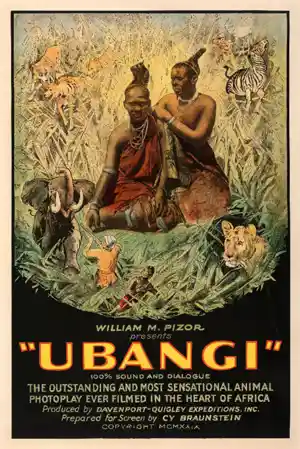
Alright, so let's talk about Ubangi. Is this worth watching today? Honestly, for most folks, probably not. This isn't a film you 'enjoy' in the usual sense. If you're a serious film historian, or really into the messy, complicated early days of documentary filmmaking and colonial-era ethnography, then maybe. But if you’re hoping for a standard, engaging watch, or anything remotely comfortable, you'll likely find it a tough sit. It's less a movie, more a raw, sometimes shocking, piece of history.
The film follows a 1920s expedition into what was then the Belgian Congo. We meet the scientists: Dr. Louis Neuman and Dr. Jacques Maus from Belgium, and Dr. Daniel Davenport representing both the U.S. and Canada. The opening sets a tone, kind of grand, but then you just see them… there. Like they just showed up.
A lot of the early footage is what you'd expect from a travelogue of the era. Sweeping shots of the landscape, people moving through dense jungle, the whole bit. The camera is often a little shaky, a bit rough, which just adds to that feeling of being right there, right when it happened. It’s not polished at all.
What really sticks out, though, are the moments focusing on the local Ubangi people. The narration (or intertitles, I forget which exactly for a moment there, it blurs) talks about them, about their customs. But you can't help but feel this enormous distance, like the camera is always an outsider looking in, always observing, never truly connecting. There’s a scene where they're carrying equipment, and the sheer labor involved for them is just so apparent. It makes you think about the whole setup, the 'expedition' itself. 😬
The pace of the film is what you'd call… meandering. It just sort of happens. You follow the group as they move from one place to another, sometimes stopping to observe wildlife. There's a certain raw beauty to some of the shots of the Congo River, or the vast open spaces. Then there are these close-ups of specific plants and animals, almost like a biology lesson snuck in.
But then, everything changes. The film takes a sharp, brutal turn. We see a rhinoceros, huge and charging. It's fast, sudden. And then it cuts. We don't see the impact itself, not the exact moment Dr. Neuman is hit. That would have been too much, even for back then, I guess. But what they *do* show, later, is his mangled body. Just… there. It’s incredibly stark. A real gut punch.
You can almost feel the collective gasp, even a century later. To include that footage. It makes you wonder about the person behind the camera, the one who kept filming, or the decision-makers who put it in the final cut. Was it a grim testament? A warning? A moment of raw, unedited reality for the audience back home?
It’s not just the sight of it, but the *implication*. This isn't staged. This is a real person, part of the film's own crew, dying right there on this expedition. It makes everything before and after feel different, heavier. The earlier scenes, the 'adventure' bits, suddenly seem so fragile. It really hits home how dangerous these early explorations were, how high the stakes.
The film just kind of… continues after that. Not really, but the overall journey feels changed. The sense of adventure is replaced by something more somber. The scientists, Maus and Davenport, they keep going. You see their resolve, maybe a touch of shock, still etched on their faces. It’s a very human reaction, played out on an old film reel.
Interestingly, Neuman himself is credited as a writer here, along with Maus. It makes the whole rhino incident even more haunting, knowing he had a hand in shaping this story, his own story, which ended so tragically. It adds a layer of almost poetic, dark irony.
There aren't really 'performances' to speak of, not in the dramatic sense. These are real people, doing real (and sometimes, tragically, fatal) things. Davenport, in particular, seems quite stoic throughout, even after the accident. Maus too. They carry on with their work, which feels very… era-specific, I suppose. The job had to be done.
The lasting impression of Ubangi isn't about beautiful cinematography or a gripping plot. It's about witnessing a raw, unvarnished piece of history. It's about the uncomfortable ethics of observation, the sheer grit of early explorers, and the sudden, brutal unpredictability of the natural world. And yeah, that rhino scene? It stays with you. 🐘
Didja notice?
IMDb 4.5
1920
Community
Log in to comment.