DbcultAccessing Vault...
6.5/10
Senior Film Conservator
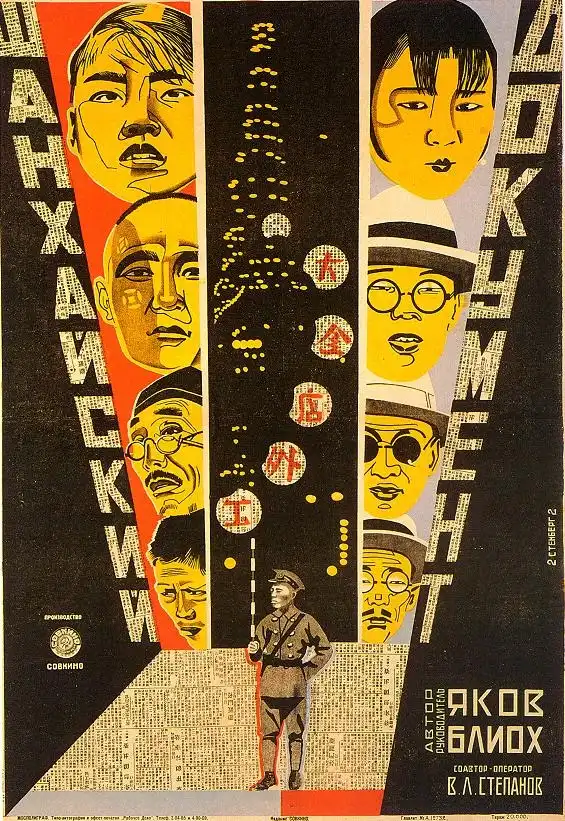
A definitive 6.5/10 rating for a film that redefined the boundaries of cult cinema. Shanhkayskiy dokument remains a cornerstone of transgressive art.
If you have about an hour and want to see what a city looks like right before it explodes, you should watch this. It’s for anyone who likes street photography or those old 'city symphony' films, but specifically for people who don't mind being yelled at by a Soviet director from 1928. If you want a relaxing historical tour, you’ll hate it. It’s angry.
Shanhkayskiy dokument (or Shanghai Document) isn't trying to be objective. Yakov Bliokh, the director, basically uses his camera like a weapon. He spends the first half showing you the 'International Settlement'—the British, Americans, and French living in this weird, bubble-wrapped version of China. There are lots of shots of people in very stiff white suits playing tennis and drinking tea. They look incredibly bored, honestly. There’s a shot of a woman fanning herself that goes on just long enough to make her look ridiculous.
Then the movie pivots. It stops being about tea and starts being about the docks and the factories. The transition isn't subtle. One minute you're looking at a fancy car, the next you're looking at men hauling massive crates on their backs while literally dripping with sweat. The film grain makes the sweat look like oil.
There is this one specific moment that stuck with me—a shot of a small child, maybe six or seven, working in a textile mill. The kid is just a blur of motion. The camera doesn't zoom in for a 'sad' close-up like a modern documentary would; it just stays wide, showing how small the kid is compared to the machinery. It’s actually more upsetting because it feels like the camera is just observing a fact, not begging for your sympathy.
The editing is very 'Soviet Montage'—fast, rhythmic, and occasionally a bit jarring. Sometimes a cut happens so fast you blink and miss the connection. It’s not as polished as something like Man with a Movie Camera, but it has this raw, handheld energy in the street scenes that feels almost modern. You can tell Bliokh was just sticking his lens into people's faces. You see people looking back at the camera with this 'What is this guy doing?' expression. It breaks the fourth wall in a way that makes the history feel less like a museum and more like a real Tuesday afternoon in 1927.
I did find some of the 'rich people' scenes a bit repetitive. We get it—they eat a lot and they like dogs. There’s a sequence involving a dog show that feels like it lasts ten minutes. I think it was supposed to show the decadence of the West, but after the fifth pampered terrier, I just wanted to get back to the harbor shots. The pacing drags there. You start checking how much time is left on the progress bar.
The titles are also very aggressive. They don't just say 'The Docks,' they say things like 'THE SLAVES OF CAPITALISM.' It’s a bit much, but that’s the genre. It’s interesting to compare the energy here to something like Laughing Gas from a similar era. Where the Western films were often obsessed with individual antics and slapstick, this is obsessed with the crowd, the mass, the sheer volume of people moving through a city. There’s no 'main character' here other than the class struggle itself.
One weird detail: the Sikh policemen in the British sector. The way they are filmed makes them look like statues. They stand perfectly still while the chaos of the city moves around them. It’s a strange visual choice that highlights how much the colonial powers were trying to impose this rigid, artificial order on a place that clearly didn't want it.
The film is dirty. Not the print quality (though that’s rough too), but the world it captures. You can almost smell the coal smoke and the river water. There’s a shot of the Yangtze river crowded with boats that is genuinely overwhelming. It’s not 'pretty' cinematography. It’s dense. Every frame is packed with laundry hanging from windows, crates, smoke, and bodies. It makes you realize how sanitized our modern period pieces are. No costume designer would ever make clothes look as genuinely lived-in and grimy as the shirts on these workers.
The ending gets very political, focusing on the 1927 uprising. It gets a bit chaotic here. The editing speeds up to a point where it’s hard to follow exactly what’s happening if you don't know the history, but the *feeling* of panic is there. It stops being a documentary and starts being a protest. It’s messy. I think a lot of people will find the ending frustrating because it doesn't really 'conclude' anything; it just boils over.
Is it a masterpiece? Maybe not in the way people usually use that word. It’s too lopsided and the propaganda is too thick. But as a piece of 'you are there' filmmaking, it’s incredible. It captures the exact moment when the old colonial world was starting to rot from the inside. Just ignore the dog show part.
IMDb 5.7
1932
Community
Log in to comment.