DbcultAccessing Vault...
Cult Review
Senior Film Conservator

In the vast, often overlooked archives of early 20th-century cinema, certain works emerge not just as historical artifacts but as vibrant testaments to artistic ambition and cultural identity. Luiz de Barros’s 'Ubirajara' stands as one such luminous example, a daring and deeply resonant adaptation of José de Alencar’s celebrated novel. This isn't merely a film; it's an archaeological excavation into the soul of a nascent nation, rendered with a visual poetry that belies its era. Released at a time when cinema was still finding its voice, 'Ubirajara' chose to speak in the powerful, ancient tones of Brazil's indigenous heritage, setting it apart from many of its contemporaries, particularly those from European and North American studios that often favored urban dramas or light comedies. While films like The Hand at the Window or The Adventures of a Madcap titillated audiences with contemporary thrills or farcical escapades, 'Ubirajara' plunged into the mythic past, offering a profound exploration of honor, love, and the intricate dynamics of tribal life.
The heart of 'Ubirajara' beats with the pulse of the Amazon, a lush, unforgiving, and utterly magnificent backdrop for a tale of human courage and conflict. Our protagonist, Ubirajara, portrayed with a compelling blend of strength and quiet dignity by Alvaro Fonseca, is more than just a chieftain of the Araguaia tribe; he is the living embodiment of their ideals. His very name, signifying 'lord of the spear,' is a prophecy fulfilled in every frame, every gesture. De Barros, with his writerly collaborator Alencar's vision as his guide, meticulously crafts a world governed by ancient customs, where respect for the land is paramount and tribal honor is a currency more valuable than gold.
The narrative’s inciting incident, a seemingly innocuous hunting expedition, quickly escalates into a profound cultural clash. Ubirajara’s accidental trespass into the sacred hunting grounds of the rival Tocantins tribe precipitates a face-off with Jutaí, their equally formidable warrior. This isn't a mere brawl; it's a ballet of strength and strategy, a prelude to the deeper conflicts that will define the film. The initial skirmish, deftly choreographed, concludes with Ubirajara’s magnanimous gesture of sparing Jutaí, a moment that speaks volumes about the Tupi code of conduct. Yet, this act of grace, rather than diffusing tension, sows the seeds of a more complex rivalry, one rooted in pride and the delicate balance of power between indigenous nations.
Into this volatile tableau steps Aracy, a figure of serene beauty and profound wisdom, brought to life with understated power by Otília Amorim. Hailing from the neutral Tapuia tribe, her presence acts as both a balm and a catalyst. Her lands lie as a precarious buffer between the Araguaia and Tocantins, mirroring her role as a potential bridge between warring factions. The burgeoning romance between Ubirajara and Aracy is rendered with a delicate sensitivity, a testament to de Barros’s nuanced direction. It’s a love story unfolding amidst the looming threat of war, a symbol of hope and unity struggling to take root in a landscape scarred by ancient enmities. The intertwining of personal affection with geopolitical tension elevates the film beyond a simple adventure, infusing it with a tragic romanticism reminiscent of grand operatic narratives.
Luiz de Barros, a veritable titan of early Brazilian cinema, demonstrates a directorial prowess that transcends the technological limitations of his era. Working with a predominantly silent medium, de Barros relies heavily on visual storytelling, a technique he mastered across his prolific career. The cinematography, though black and white, captures the breathtaking grandeur of the Brazilian landscape with an almost painterly quality. Wide shots of rolling rivers, dense forests, and expansive skies imbue the film with an epic scope, making the natural world an active character in the drama. Close-ups, though used sparingly, are impactful, revealing the raw emotion etched onto the faces of his cast, particularly Alvaro Fonseca's stoic intensity and Otília Amorim's gentle resilience.
The pacing is deliberate, allowing the audience to luxuriate in the unfolding narrative and absorb the cultural nuances. De Barros understands that the power of Alencar’s original text lies not just in its plot, but in its evocation of a specific way of life, a spiritual connection to the land. He translates this understanding into a cinematic language that is both poetic and visceral. The tribal ceremonies, the hunting sequences, and especially the climactic 'turé' combat are choreographed with an authenticity that speaks to meticulous research and a deep respect for the subject matter. Unlike some melodramas of the period, such as God's Law and Man's, which often relied on exaggerated gestures and overt emotionalism, 'Ubirajara' employs a more restrained yet equally powerful visual vocabulary, allowing the inherent drama of the situation and the gravitas of the characters to shine through.
The ensemble cast, a mix of seasoned actors and new faces for the time, delivers performances that are both earnest and impactful. Alvaro Fonseca, as Ubirajara, anchors the film with a performance that radiates quiet authority. His Ubirajara is not merely a strong warrior but a thoughtful leader, burdened by the weight of his people's destiny. Fonseca conveys complex emotions through subtle shifts in his gaze, the tension in his posture, and the controlled power of his movements. He is a truly magnetic screen presence, capable of conveying fierce determination and tender affection with equal conviction.
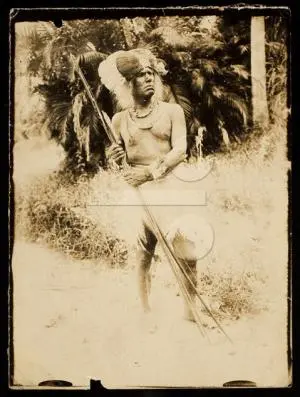
Otília Amorim's portrayal of Aracy is equally compelling. She brings a serene strength to the character, embodying the wisdom and resilience of the Tapuia people. Her interactions with Fonseca are charged with an undeniable chemistry, making their burgeoning romance feel genuinely earned and deeply poignant. Teixeira Pinto, as Jutaí, provides an excellent foil to Ubirajara. He imbues Jutaí with a fiery pride and a fierce sense of honor, ensuring that the character is not a mere antagonist but a worthy adversary, driven by his own set of deeply held beliefs. The conflict between Ubirajara and Jutaí is thus elevated beyond a simple good-versus-evil dynamic; it becomes a clash of two equally valid, albeit opposing, worldviews.
The supporting cast, including António Silva, Adhemar Gonzaga, and João de Deus, contribute significantly to the film's rich tapestry, each bringing a distinct presence to their respective tribal elders, warriors, and community members. Their collective performances create a believable and immersive indigenous society, lending weight and authenticity to the narrative. Luiz de Barros himself, a multi-hyphenate talent, even features in a small role, demonstrating his deep immersion in the project. While the nuances of silent film acting can sometimes appear over-the-top to modern audiences, the performances in 'Ubirajara' possess an earnestness and a theatricality that perfectly suit the epic scale and dramatic intensity of the story. Unlike the more stylized, almost theatrical performances seen in some European films of the era, such as Das Modell, 'Ubirajara' maintains a grounded, organic feel, even in its most dramatic moments.
At its core, 'Ubirajara' is a profound meditation on themes that resonate far beyond its specific cultural context. Honor, duty, love, and the often-tragic beauty of a disappearing way of life are explored with a gravitas that elevates the film to the realm of high art. Alencar’s original novel was a foundational text in Brazilian Romanticism, seeking to define a national identity through its indigenous roots. De Barros’s adaptation carries this torch with remarkable fidelity, translating the literary aspirations into a compelling visual narrative.
The film’s portrayal of inter-tribal conflict is particularly nuanced. It avoids simplistic good-versus-evil dichotomies, instead presenting a complex web of traditions, pride, and survival instincts. The climactic 'turé' between Ubirajara and Jutaí is not merely a fight to the death; it is a spiritual contest, a ritualized assertion of dominance and courage, observed by both tribes with a solemn reverence. This scene, a masterful blend of action and cultural exposition, is a highlight of the film, showcasing the raw power of silent storytelling.
The introduction of an external threat during the duel is a stroke of narrative genius. Whether interpreted as a predatory jaguar, a natural calamity, or a subtle foreshadowing of colonial encroachment, this shared danger forces the rival chieftains to unite. This moment of shared sacrifice, where Ubirajara and Jutaí fight side-by-side, transcends their individual grievances, revealing a deeper, shared humanity and a common bond to their ancestral lands. It's a poignant commentary on the ephemeral nature of human conflict when faced with larger, existential forces. This powerful message of unity in the face of external threats makes 'Ubirajara' incredibly relevant, even a century after its creation.
'Ubirajara' holds a significant place in the annals of Brazilian cinema. It represents an ambitious attempt to craft a truly national epic, drawing from indigenous folklore and literature rather than merely imitating European or American cinematic trends. While many contemporary films, such as The Pretenders or Dull Care, focused on more universal, often less culturally specific narratives, de Barros boldly embraced Brazil's unique identity. This commitment to cultural authenticity makes 'Ubirajara' a pioneering work, laying groundwork for future generations of Brazilian filmmakers to explore their own rich heritage.
The film’s ultimate conclusion, a fragile peace forged in shared adversity, is not presented as a definitive resolution but rather as a moment of hope, a poignant reflection on the enduring power of love and understanding amidst the relentless cycles of conflict. It leaves the audience with a sense of the majestic, yet vulnerable, spirit of the indigenous peoples, a spirit that continues to contend with an ever-changing world. It’s a testament to the fact that even in its nascent stages, cinema possessed the power to capture grand narratives, explore complex human emotions, and reflect the very soul of a nation.
To view 'Ubirajara' today is to embark on a journey through time, not just to the early days of cinema but to a pivotal moment in Brazil’s cultural self-definition. It reminds us of the enduring power of storytelling, the universal appeal of honor and love, and the profound beauty of a land and its people. For any serious student of film history, or indeed anyone with an appreciation for sweeping, character-driven epics, 'Ubirajara' is an essential viewing experience, a vibrant, eloquent whisper from the past that still resonates with remarkable clarity and emotional depth in the present. It stands as a powerful counterpoint to many of the more conventional narratives of its time, offering a glimpse into a world both ancient and timeless, a world that Luiz de Barros and José de Alencar brought to vivid, unforgettable life.

IMDb 5.8
1928
Community
Log in to comment.