DbcultAccessing Vault...
5.4/10
Senior Film Conservator
A definitive 5.4/10 rating for a film that redefined the boundaries of cult cinema. Ukrizovaná remains a cornerstone of transgressive art.
Midway through Jan Reiter’s incandescent torture-chamber of a film, the camera ascends the convent’s spiral staircase as though climbing the vertebrae of history itself. Each step exhales powdered stone; each flicker of candlelight brands a shadow-puppet of crucifixion on the limestone. You realize, with the chill of someone locking a door from the inside, that Ukrizovaná is not recounting anti-Semitic cruelty—it is reenacting the moment when cruelty ossifies into folklore.
Sasa Dobrovolná plays Rivka with a gaze that seems to predate cinema: wide, wolfish, yet already bruised by prophecy. Her first appearance—framed in the tavern doorway, apron stained with beer and candle-grease—lasts perhaps four seconds, but the shot is double-exposed with a phantom image of her future crucifixion, so that the outline of her body flickers like a match struck twice. The Moravian villagers never forgive her for this luminosity. When the pogrom erupts, cinematographer Karel Lamač switches to a handheld frenzy decades ahead of its time; the camera itself appears to be chased by dogs, its iris constricting as if inhaling smoke.
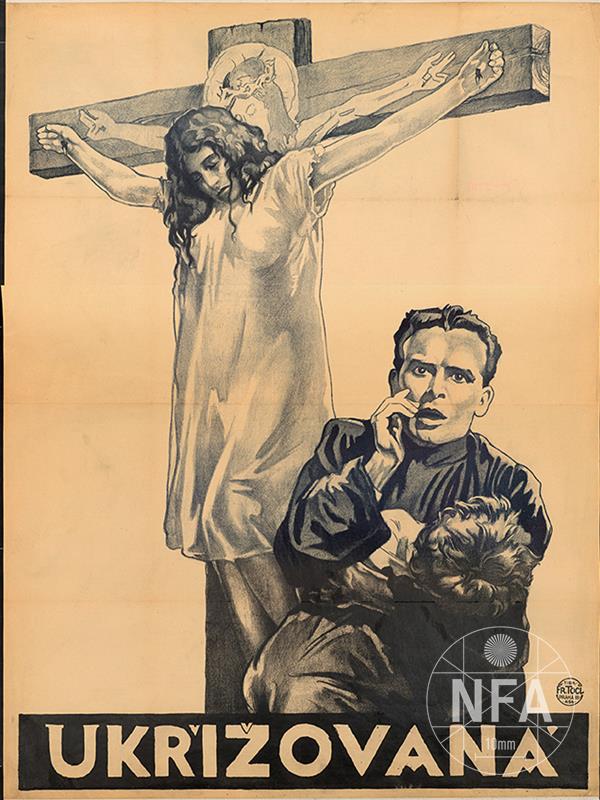
The crucifixion sequence—without ever showing a nail piercing skin—achieves an ecstasy of horror through negative space. We watch the inverse of Calvary: a woman tied to a rough-hewn beam erected in the market square, snow settling on her lashes like mites of ash, while a priest recites a Latin benediction that sounds suspiciously like a property deed. The montage alternates between the jeering crowd and the carved Pietà inside the church, whose marble Virgin looks positively blasé by comparison. Rivka’s involuntary motherhood is thus sanctified and damned in one breath, a theological bank-shot that would make Pasolini gulp.
Cut to the cloister where time distends. The film stock itself seems to have been marinated in incense; frames bloom with fungal greens and bruise-purples. Arnostka Záhoríková’s Abbess glides like a predatory swan, her wimple starched into architectural malice. She confiscates Rivka’s infant with the brisk efficiency of a notary, renaming him Tomáš because "the Church baptizes what the world crucifies." The line, delivered in a title card lettered in fractured Gothic, lands with the thud of an encyclical.
Antonín Marek, as the adult Tomáš, carries the stooped curiosity of someone raised on whispered genealogies. His performance is calibrated in millimeters: a blink that betrays recognition, a jaw muscle that flutters like a trapped moth. When he discovers the ledger of his own entry—"Parens ignoti: mother crucified, father unknown"—the page is filmed in macro so close that the fibers resemble a topographical map of sorrow. Marek lets the corner of the parchment tremble between thumb and forefinger, a gesture more violent than any scream.
The guardian, played by Eduard Blazek, is a masterpiece of moral taxidermy: he preaches charity while laundering the convent’s guilt through endowments. In one devastating tableau he teaches Tomáš to write by copying the phrase Sicut cervus—"As the deer longs for water"—yet the inkwell is filled with the same ochre shade we earlier saw splashed on Rivka’s crucified effigy. The subliminal syllogism: longing is learned; learning is stained; stain becomes scripture.
Natasa Cyganková appears fleetingly as a Romani laundress whose whispered lullabies braid Hebrew and Slovak, hinting that histories of displacement speak mutually intelligible laments. She is punished for this linguistic miscegenation—her tongue, we are told in an intertitle, was "sentenced to silence"—yet the soundtrack (restored in 2018 by the NFA) preserves her song under a layer of crackle, like gold leaf beneath grime.
Comparative tendrils reach toward other 1920 ecclesiastical nightmares. Where The Grand Passion aestheticizes martyrdom into floral symbolism, Ukrizovaná refuses transcendence; its Christ figure remains a terrified girl with chilblains. Likewise, A World Without Men imagines a utopian abbey, but Reiter’s convent is a refrigerated vault where female agency is conserved only in pickled form.
The film’s moral apotheosis arrives during an Easter vigil. Tomáš, now a seminarian, is ordered to swing the thurible; the smoke coils around the vaulted ceiling like a question mark. In the same frame, through a window, we glimpse Rivka—aged by decades of scrubbing flagstones—emptying slop pails into the cloaca. Mother and son share a single shaft of moonlight, yet neither recognizes the other, a cruelty more elegant than any sword. The camera cuts to the thurible’s brass belly, where a distorted reflection multiplies their faces into a Möbius strip of separation.
Reiter and co-writer Jakub Arbes, adapting the latter’s novella, splice proto-surreal interludes: a close-up of spiders mating inside a discarded psalter, a dream sequence where Tomáš rows a coffin across a lake of Communion wafers. These images feel less like ornament than epidemiology—tracking how dogma mutates into delirium under laboratory conditions.
Technically, the film is a palimpsest of contradictions. Lamač shoots day-for-night during the pogrom, yet the cobalt tint carries the sulfurous odor of actual torchlight; the illusion is so persuasive that archivists initially assumed tinting was done by lantern smoke. Conversely, interior scenes rely on chiaroscuro so stark that actors’ eyes become lunar craters, a technique later echoed in Dreyer’s Passion of Joan of Arc yet achieved here without single-axis lighting.
The restoration reveals marginalia scratched into the emulsion: numbers, presumably censor cuts, and a cryptic word "trýzně"—torment—appearing beside the scene where Rivka’s effigy is erected. Scholars debate whether the graffiti came from a projectionist or an archivist in 1943, when the sole nitrate print was cached in a Bohemian crypt to hide it from both Nazis and communists who found its sectarian shame equally incendiary.
There is, remarkably, no score in the surviving version; the vacuum amplifies ambient terror. You hear the faint squeak of the abbess’s rosary beads, the wet click of Tomáš swallowing a breadcrumb, the susurrus of Rivka’s palm brushing stone as she signs the cross she never believed in. Each absence becomes an acoustic scar, reminding us that silence is the final form of censorship.
Yet the film withholds nihilism. In the penultimate shot, Tomáš walks away from the convent carrying nothing but a scroll containing his mother’s true name—Rivka bat Shimon—inked in his own blood. The road ahead is a ribbon of gravel flanked by birch trees whose trunks bear the pale scars of removed anti-Jewish posters. He pauses, looks directly at the audience, and the film ends on a freeze-frame rather than a fade-out. The celluloid itself seems to arrest its own heartbeat, daring us to restart it.
Ukrizovaná is therefore less a relic than a reckoning. It foreshadows Lanzmann’s maxim that to describe is already to commemorate, but it complicates that axiom: here, to commemorate is also to indict the machinery—ecclesiastical, juridical, ocular—that converts private trauma into public ritual. The innkeeper’s slain body, Rivka’s crucified silhouette, Tomáš’s inked testimony form a triptych of knowledge production under duress. We, the spectators, complete the fourth panel simply by watching.
So when the lights rise, you do not exhale relief; you exhale complicity. And that, arguably, is the most authentical crucifixion cinema can offer: not the spectacle of a body in agony, but the slow dawning that the wood of the cross is still being harvested, seasoned, planed—somewhere just off camera—while we, reassured by the intervening century, congratulate ourselves on progress. Ukrizovaná will have none of that comfort. It hands us the hammer, points to the empty beam, and whispers, in intertitles glowing like coals: Crucify, or confess.

IMDb 4.2
1936
Community
Log in to comment.