DbcultAccessing Vault...
7.1/10
Senior Film Conservator
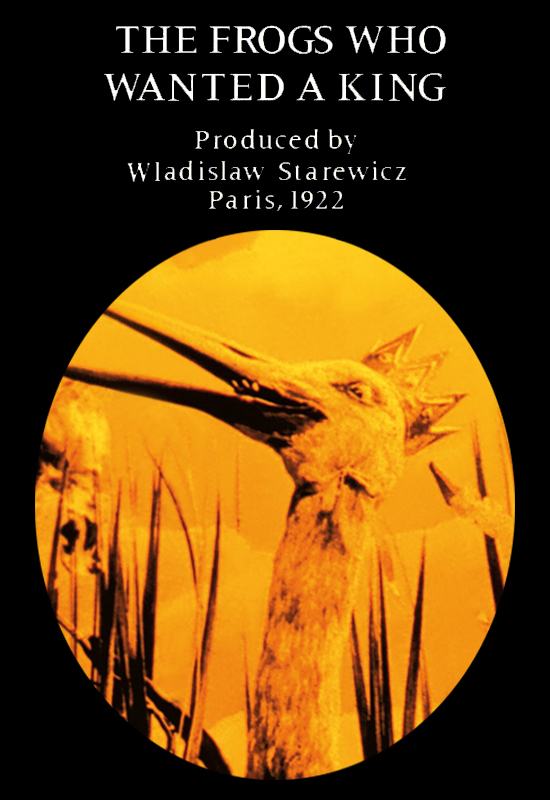
A definitive 7.1/10 rating for a film that redefined the boundaries of cult cinema. The Frogs Who Wanted a King remains a cornerstone of transgressive art.
A log crowned by nocturnal drizzle, a stork sharpening its beak on moonlight—these are the sceptre and guillotine of Władysław Starewicz’s miniature kingdom.
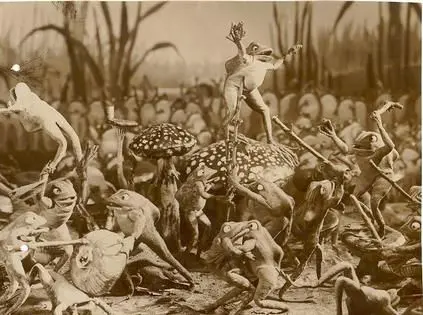
There is a moment—roughly forty-five seconds in—when the camera hesitates above the marsh like a dragonfly unsure where to lay its iridescent eggs. That tremor, barely perceptible, announces the film’s governing conceit: even landscapes can be undecided. From this tremulous tableau emerges the first amphibian delegation, their articulated tin armatures bending with the furtive grace of courtiers who suspect their silk gloves hide iron claws. Starewicz, ever the puppet-master-polymath, refuses to anthropomorphize in Disney’s plush vernacular; instead he lets the frogs remain obstinately batrachian—throats ballooning, pupils dilating into black coins of appetite. The result is an uncanny valley of cold blood, a satire that feels like it was written on a lily pad by Machiavelli and then translated into rusted wire.
Viewers weaned on the sentimental linearity of Flying Pat may find themselves pole-axed by the film’s refusal to tuck its moral into a bedtime parcel.
The plot, mythic yet abrupt, unfolds in two royal acts: the Log and the Stork. The first monarch is a chunk of driftwood, bark still clinging like scorched parchment. He arrives without ceremony, thudding into ooze that quivers like aspic. The frogs’ disappointment ricochets through cattails; their tiny mandible-painted faces register a cocktail of boredom and insult. One expects them to kick the log, perhaps curse Olympus in fluent ribbit. Instead they stare—an indictment rendered in bulbous eyes—until the screen itself seems to blush with second-hand embarrassment. Starewicz’s genius lies in that stare: it stretches long enough to let the audience taste the frogs’ ennui, yet cuts away before the joke calcifies.
Cut to a thunderhead stitched with stop-motion lightning. The Deity, never fully revealed, manifests via a mailed fist of meteorology—clouds bunching into clenched knuckles. The frogs cower, reeds bow like court servants, and a second regent descends. This time sovereignty arrives with appetite. The stork lands on one leg, an emblem of asymmetrical power; its scarlet throat sac quivers with barely repressed gusto. If the log was passive tyranny, the bird is executive violence incarnate. Cinematic ornithophobia has never been so elegantly staged. Hitchcock’s avian apocalypse feels garrulous beside this silent, methodical slaughter.
Note the editing rhythm: the stork’s first peck snaps on the exact frame where a frog’s throat inflates—air meets beak in a macabre pas de deux.
Violence in The Frogs Who Wanted a King is not catharsis; it is pedagogy. Each snapped vertebra reverberates like a chalkboard ruler wielded by a wrathful pedagogue. By the time the survivors retreat beneath shelf-fungus, the audience—complicit as petitioners—has internalized a curriculum on the hazards of outsourced agency. Starewicz, a Lithuanian émigré who had seen czarist censorship, encodes a veiled warning: revolutions devour their petitioners when slogans outnumber constitutions.
Technically, the film is a palimpsest of contradictions: it is both primitive and avant-garde. Armatures recycled from beetles used in Starewicz’s earlier The Devil’s Wheel squeak beneath latex skin; yet the lighting—achieved with mirrored sunbeams and magnesium flares—produces chiaroscuro worthy of Caravaggio. Depth of field is shallow, but set construction is baroque: reeds are individually threaded through paraffin-coated cork, allowing them to sway in real-time wind, a precursor to go-motion decades before Phil Tippett coined the term.
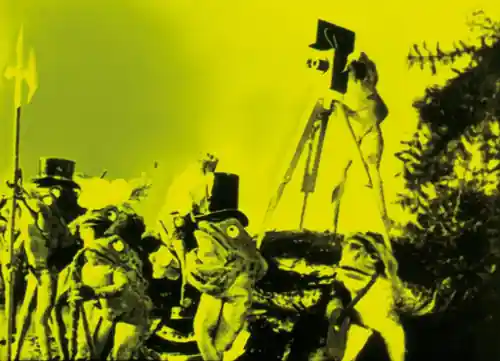
Compare this to contemporaneous satire A Man’s Man, where human actors strain to lampoon oligarchy through exaggerated moustache twirls. Starewicz’s amphibians, limited to six hundred frames of expression, nevertheless articulate political discontent more fluently than any velvet-clad thespian. The secret? Silence. Stripped of dialogue, narrative must lean on plasticity of gesture; every cranial tilt becomes a manifesto. The frogs’ skin—mottled by glycerin and airbrushed cobalt—catches studio lights like bruised metal, underscoring their vulnerability. One forgets they are ten-centimeters tall; they loom as large as failed states.
Sound, though absent on the strip, was part of the exhibition: orchestra pits cued to Rimsky-Korsakov’s “Flight of the Bumblebee,” a musical joke foreshadowing the lethal bird.
Contemporary critics dismissed the piece as a “trifle for children,” a misreading that now feels archaeological. Viewing it after the 20th-century parade of strongmen, the film’s brevity—barely ten minutes—feels like an act of mercy. Contrast with The Law of Compensation, which needs three reels to arrive at a similarly cynical terminus. Brevity here is not constraint; it is surgical. Starewicz’s wit excises the fatty subplots of humanist redemption and leaves only sinew.
Gender, though ostensibly irrelevant in an amphibian polis, sneaks in via visual coding. The loudest petitioner, a frog with saffron under-chin speckles, is framed in low-angle shots that mimic early newsreels of Mussolini. The bird, tall and phallic, penetrates the marsh’s humid femininity with the cold certainty of a fascist column. Such iconographic layering invites intersectional critique without requiring a single intertitle.
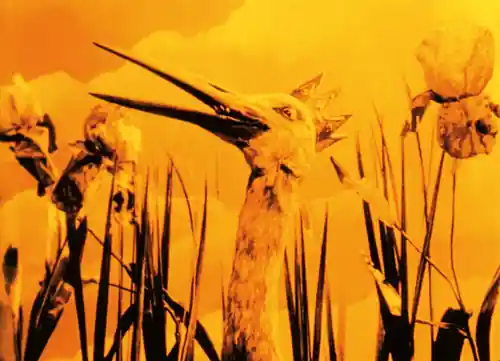
Cinematic lineage? Trace its DNA forward to Švankmajer’s Food and backward to Méliès’s imps; sideways to A Pool of Peaches, where plush decadence likewise masks social parody. Yet Starewicz occupies a liminal node: too macabre for the benevolent naturalism of Disney’s Silly Symphonies, too playful for Soviet agit-prop.
Restoration notes: the 4K scan by Lobster Films reveals previously invisible monofilament wires holding reeds; their shimmer is a ghostly reminder that politics, like illusion, depends on unseen tension.
Reception history forms its own tragicomic subplot. Archivists in 1958 misfiled prints under “juvenile fauna,” leading to nitrate decay in humid Kyiv vaults. Only one reel survived, spliced with Czech intertitles that translated the frogs’ chorus as “We demand amusement!”—a libertine misreading that turned parable into burlesque. The current restoration reinstates Starewicz’s original Russian expletives, restoring the film’s bite.
Is there hope tucked amid the carnage? A blink-and-miss-it final frame shows a tadpole—unmoving tail, comma of potential—beside a shattered eggshell. Read as you will: either the cycle of naïve governance reboots, or art, like spawn, can metamorphose beyond its creator’s intent.
Comparative viewing parties often double-bill it with Not Guilty, another morality tale where justice is a blindfolded stork. Programmers note: the tonal whiplash enlivens both, turning each into the other’s dialectical echo.
Ultimately, The Frogs Who Wanted a King endures because it weaponizes brevity. In the time it takes to steep tea, Starewicz stages the rise and fall of civilizations, the fickleness of crowds, the hubris of demagogues, and the quiet resilience of marshes that outlast empires. Watch it once for the satire; rewatch it for the throat-sac sonata, the reed-whispered requiem, the moment when a beak becomes gavel. Then walk outside, hear distant croaks, and shiver—because somewhere, another electorate is bored.

IMDb 5.7
1936
Community
Log in to comment.