DbcultAccessing Vault...
7.1/10
Senior Film Conservator
A definitive 7.1/10 rating for a film that redefined the boundaries of cult cinema. Umirayushchiy lebed remains a cornerstone of transgressive art.
There are films that narrate a story, and then there are films that fracture a soul—Umirayushchiy Lebed belongs to the latter coven. Shot in the bruised twilight of the Russian Empire, this 1916 phantasmagoria predates Hitchcock’s eroticized dread by decades yet feels eerily post-modern in its interrogation of spectatorship, authorship, and the female body as consumable text.
The camera—yes, even in an age when cameras were shy of shadows—behaves like a breath-fogged mirror, inching so close to Vera Karalli’s clavicle you expect condensation to bead on the celluloid. Karalli, a Bolshoi luminary in life, here embodies a ballerina hollowed by bereavement; her swan-maiden isn’t merely role but reincarnation, each fouetté a seance summoning the dead partner she once lifted into light. Watch her wrists: they tremble like trapped sparrows, betraying the knowledge that every arabesque is an exorcism doomed to fail.
Enter Vitold Polonsky’s artist, a man whose palette has soured since the salons stopped calling. When he first glimpses her rehearsing La Bayadère through the cracked pane of a deserted conservatory, the shot reverse-shot is not a grammar but a transfusion: his gaze injects itself into her bloodstream, her grief leaks back into his pupils. From this moment, the film’s rhythm swaps waltz for arrhythmia. Intertitles vanish; instead, interstitial frames of swirling gouache hemorrhage across the screen, as though the narrative itself has been stretched on an easel and flayed.
Director Zoya Barantsevich, herself a former scene-painter at the Moscow Art Theatre, understands that cinema’s most feral magic lies not in showing but in almost showing. A dissolve transports us from the ballerina’s sweat-slick nape to the artist’s thumb smearing carmine across a rough weave; we feel the rasp of bristle against fiber as if it were tooth against nerve. The color red—crimson, oxblood, vermilion—recurs like a compulsive stutter, culminating in a tableau where the dancer’s discarded pointe shoes are discovered floating in a basin of scarlet water that might be dye, might be plasma, might be both.
Comparison hounds will bay at Les Vampires for shared claustrophobia, or at The Moth and the Flame for combustible artist-muse dynamics. Yet Feuillade’s serial is pulp masked as poetry, whereas Barantsevich inverts the recipe: her film is a sonnet that gnaws bones. Likewise, During the Plague stages contagion as moral metaphor; Umirayushchiy Lebed stages obsession as viral aesthetics—once you have seen the portrait’s eyes follow the dancer, you suspect your own pupils of treachery.
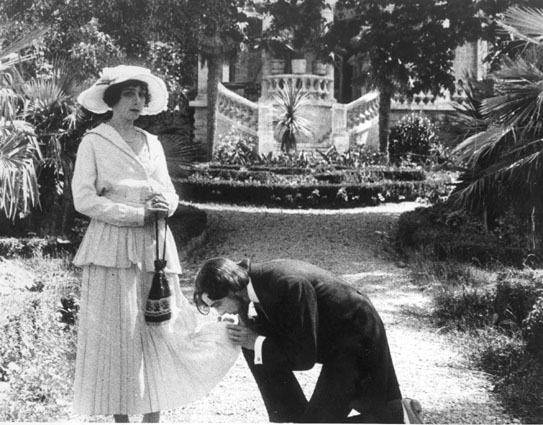
Andrey Gromov’s cinematography deserves a monograph. He mounts the camera on a kiddie-wagon to chase Karalli down a corridor of gas-jets, the resultant footage quivering like a moth in a killing jar. In another sequence, he over-cranks the frame rate so that snowflakes hover mid-air, each flake a frozen witness to the crime of watching. The cumulative effect is that space itself grows carnivorous; every proscenium arch resembles a jawbone, every footlight a bicuspid ready to bite.
Sound, you ask? The premier print toured with a live string quartet instructed to detune mid-performance, mirroring the protagonist’s psychic unraveling. Contemporary restorations layer a spectral score by the duo Kryukov|Volga: prepared piano, bowed cymbal, and the barely audible heartbeat of a kick-drum recorded inside the Lensoviet Theatre’s empty auditorium. Headphones mandatory—preferably after midnight, preferably after absinthe.
The film’s third act abandons language altogether. We watch Karalli dance the Dying Swan on a rooftop skirted by chimney smoke that curls like stage curtain. Polonsky, below, sketches frantically, paper flying over the parapet into the void. A match-cut aligns her collapsing fouetté with his canvas ripping under the violence of charcoal. Time dilates; the sun never rises, yet the snow reddens. When the final intertitle arrives—“The portrait breathed; the dancer did not”—it lands like a coroner's thud, yet the real horror is that we cannot tell which corpse the sentence honors.
Scholars of Russian modernism love to pontificate about the film’s prescient critique of the male gaze, but such discourse often steamrolls its queerest undercurrent: the artist’s obsession is less erotic than ontological. He does not wish to possess her; he wishes to become the hollow her movements sculpt, to inhabit the negative space grief has gutted inside her. Their relationship is a Möbius strip of creator and destroyer, each twist erasing the boundary between pigment and flesh.
Watch how Polonsky’s pupils dilate when Karalli executes an en pointe arabesque penchée—the black of his iris seems to swallow the hazel, suggesting the pupil itself is a canvas absorbing its own image. Barantsevich literalizes the Lacanian gaze decades before Lacan haunted seminar rooms: we are not merely watching a woman being watched; we are watching watching itself metastasize into predation.
Restoration nerds, rejoice: the 2022 4K scan by Laboratorio Elica salvaged two previously lost amber-tinted reels, revealing that the ballerina’s hair is not brunette but blood-auburn, a revelation that re-tinges every prior reading of her as naïve snow-white maiden. The same restoration exposes a hairline fracture running the length of the portrait’s painted neck—implying the canvas itself anticipated decapitation. Metadata on the nitrate reveals Barantsevich scratched the crack herself with a palette knife after reading about the beheading of Holofernes in the Book of Judith. Meta-artistic vandalism has never bled so eloquently.
Performances? Karalli oscillates between porcelain composure and seismic convulsion without the safety net of Method training; her tremors are learned from years of partnering dancers who dropped her during lifts. Polonsky, a matinée idol in pre-Revolutionary Moscow, weaponizes his reputation for suavity, allowing charm to decay into rictus until we fear the smile more than the snarl. In a bravura close-up, his lower lip quivers like a man suppressing laughter or sobs—ambiguation so acute you lean forward expecting drool or confession, unsure which would terrify more.
The censors of 1917, jittery about revolutionary allegory, demanded a tacked-on epilogue where the dancer revives via divine intervention. Barantsevich complied, then burned that reel in Petrograd’s central square, claiming the ashes were needed for pigment. No trace survives; audiences today see the intended finale, ending on a freeze-frame of the portrait’s irises fading to white—an iris-out iris-in, if you will, that blinks the entire film into oblivion.
Streaming? Criterion Channel rotates a 2K version every February, but the full 4K is locked to RetroVision.ru via VPN and a bottle of vodka. Physical media hounds can hunt the Masters of Russian Silence box set, though beware the PAL speed-up that turns the climactic waltz into a danse epileptique. For the adventurous, a 16mm print occasionally tours rep houses with live accompaniment by Post-Sound-Shroud, a collective that samples the dancer’s recorded footfalls and loops them into a techno threnody. Bring earplugs or a crucifix—your call.
Let’s talk legacy: without this film there is no The Reclamation with its painter-as-gravedigger motif; no Conscience with its mirrored interrogation rooms; certainly no Hjertestorme whose snow-blinded finale quotes Barantsevich’s rooftop shot verbatim. Even Hitchcock cribbed the vertiginous stair-descent for Vertigo, though he swapped Orthodox incense for San Francisco fog.
Yet influence is a dull word; what matters is the itch. Days after viewing, you will catch yourself scrutinizing strangers on subway platforms, wondering what shade of ochre their grief would yield if scraped across canvas. You will flex your own ankles, testing for phantom ache. And when the streetlights flicker, you will recall the ballerina’s final bourrée—a flutter of feet so fleet it seems she is running on the snow rather than through it—realizing that to dance is to postpone falling, and to fall is to discover the ground has teeth.
Verdict? Umirayushchiy Lebed is not a museum relic; it is a live round. Approach it as you would a stranger offering a candied apple in a train station—knowing the first bite might contain the razor, and the second, the cosmos.
IMDb 5.7
1937
Community
Log in to comment.