DbcultAccessing Vault...
6.4/10
Senior Film Conservator
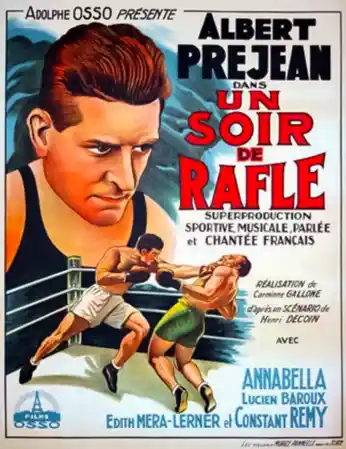
A definitive 6.4/10 rating for a film that redefined the boundaries of cult cinema. Un soir de rafle remains a cornerstone of transgressive art.
If you have about ninety minutes to kill and you like movies where men in very high-waisted pants hit each other, Un soir de rafle is probably worth your time. It’s perfect for people who miss the old-school vibe of 1930s Paris, back when everyone seemed to live in a music hall or a smoky gym. If you hate predictable stories about guys getting distracted by fancy ladies and losing their way, you should definitely skip this one.
The movie starts with a police raid. It’s messy and crowded, and that’s where our hero, a sailor named Modeste, meets Mariette. Annabella plays Mariette, and she has this extremely expressive face that basically carries the emotional weight of the whole film.
Modeste is played by Albert Préjean. He looks exactly like what you’d imagine a 1931 French sailor looks like—strong jaw, slightly confused, and very charming when he smiles.
They end up at a fair. There’s a boxing booth, which feels very authentic to the time. Modeste gets into the ring with a former champ and somehow wins, which is the classic "strong guy from the docks" trope we’ve seen a million times. It reminded me a little of the raw footage in The Official Motion Pictures of the Heavyweight Boxing Contest Between Gene Tunney and Jack Dempsey, though obviously this is scripted and much more melodramatic.
The trainer, played by Constant Rémy, sees dollar signs. Or francs, I guess. He decides to turn this sailor into a professional pugilist.
I really liked the gym scenes. You can almost smell the old leather and the floorboards. There’s a guy in the background of one shot just leaning against a wall eating something, and he looks like he actually works there. It’s those tiny, unpolished details that make these early talkies feel alive to me.
Eventually, Modeste becomes the French champion. And that’s when things get annoying for him, but entertaining for us. Enter Edith Méra as Georgette. She’s the "sultry coquette" the plot summary warned us about.
She wears these hats that are so big they probably had their own zip code. She’s clearly trouble from the second she appears on screen, but Modeste is a sailor, so he’s not exactly known for his great judgment on land. He starts spending money he doesn’t have and hanging out in places where people wear tuxedos to drink water.
Meanwhile, Mariette is off on a singing tour. I felt bad for her. She’s the one who actually liked him when he was just a guy in a dirty uniform.
It’s weird to think that Henri-Georges Clouzot helped write this. If you know his later work, like The Wages of Fear, this feels very light and fluffy by comparison. But you can see some of his cynicism creeping in during the scenes where Modeste is being used by his new "friends."
The middle part of the movie drags a bit. There’s a lot of Modeste looking at his reflection and looking sad but also rich. It’s a lot of lounging. I kind of wanted him to just get back on a boat like the guys in The Flying Fleet.
There is one scene in a nightclub where the music is just a little too loud for the dialogue. I don’t know if that was a technical mistake or a choice, but it made me feel as overwhelmed as Modeste looked. It’s an awkward bit of sound design that accidentally works.
The boxing matches themselves are... okay. They aren't exactly Raging Bull. The camera stays pretty wide, and you can tell they are pulling their punches. But the crowd noise is great. It sounds like a real riot is happening just off-camera.
Modeste gets out of shape. He looks puffy. Not really, because Albert Préjean was probably in great shape, but the movie tries very hard to convince us he’s decaying. He drinks too much champagne, which is the international movie shorthand for "he is failing at life."
The final fight for the European championship is the big climax. He’s "spiritually empty," which is a fancy way of saying he misses his girlfriend and his old life. He looks tired. The lighting gets much darker here, which I liked.
I won’t tell you if he wins or loses, but the ending feels very abrupt. It’s like the film crew ran out of cigarettes and decided to go home. One minute he’s in the ring, and the next, things are just... wrapping up.
It’s a simple movie. It doesn't try to be a masterpiece. It’s just a story about a guy who got a lucky break and then almost choked. Annabella is the real reason to watch it, honestly. Her eyes do more acting than the rest of the cast combined.
Is it a classic? Maybe not. But it’s got a soul. It feels like a real person made it, with all the weird pacing and odd character choices that humans actually make. I’d watch it again on a rainy Sunday afternoon.
One more thing—watch the way Modeste handles his cigarettes. The man smokes like it's his full-time job. It’s very distracting once you notice it.
IMDb —
1936
Community
Log in to comment.