DbcultAccessing Vault...
Cult Review
Senior Film Conservator
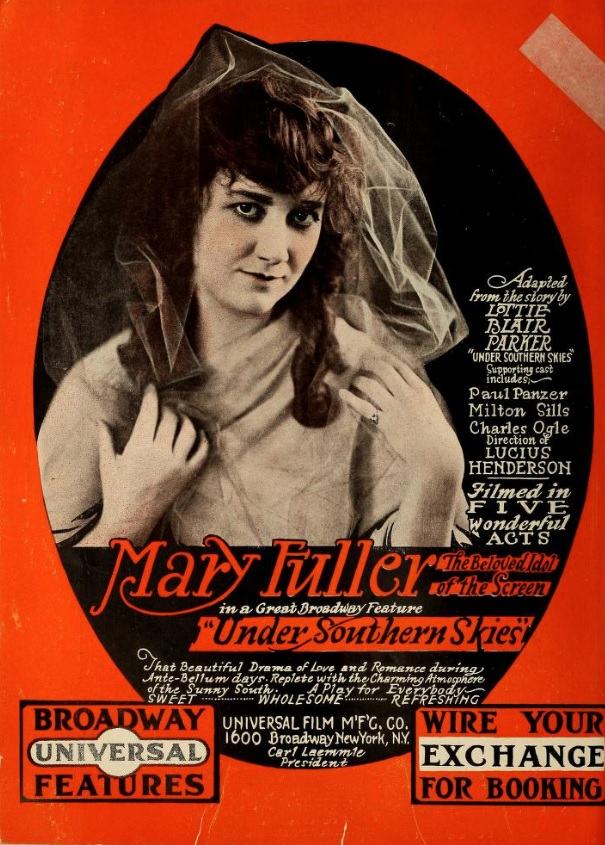
A ghost story disguised as a melodrama—Under Southern Skies seeps into your marrow like river fog.
Most one-reelers of 1910 sprint through plot the way a pickpocket dashes through crowds; this one lingers, lets silence pool, lets candle-flame quiver for an eternity while a mother studies the child she forfeited. The result is an artifact that feels older than its release date, as though the film itself were banished and has only now drifted back, sepia-swathed, smelling of gunpowder and jasmine.
Photographer William Heidloff shoots Louisiana exteriors at that bruised hour when sky and earth share the same hue of mourning-dove grey. He double-exposes a flashback inside a mirror so that the adult Lelia confronts her infant self—an effect achieved by cranking the camera backward and exposing the same negative twice, a sleight-of-hand that anticipates The Italian’s expressionist gambits by a full year. The plantation ballroom sequence is lit only by chandeliers holding sixty tapers; the flutter of moths around the flames becomes a second choreography, a powdered minuet of wings and shadows.
Marie Shotwell plays the absconded mother with cheekbones sharp enough to slice guilt; her first close-up lasts four seconds yet contains a lifetime of self-loathing. Milton Sills, soon to be swashbuckling leading man, here tamps down every impulse toward heroism—his Major Crofton is a study in mortified masculinity, voiceless before the ruin he helped author. When he finally utters “She is your mother,” the line escapes like air from a punctured lung.
As Lelia, Mary Fuller pivots from porcelain entitlement to volcanic empathy without the aid of intertitles; watch her pupils dilate when she realizes the woman groveling at her slippers is not a trespasser but flesh of her flesh. It is a moment of silent-film acting so electrically private you half expect the screen to bow inward from the pressure.
Lottie Blair Parker and William Addison Lathrop adapt the stage hit with a prismatic structure: present-day plantation, twelve-year flashback, Civil War coda. They refuse to villainize anyone outright—even Steve, blackmailer and would-be assassin, is granted a battlefield promotion that hints at squandered valor. Dialogue titles appear sparingly, always after a visual beat, so the audience does the moral stitching themselves. Compare this with The Coward, where intertitles sermonize every cowardly twitch; here ambiguity is left to ferment.
Unlike Where the Trail Divides, which treats the conflict as geographical backdrop, the war in Under Southern Skies is an moral infection. Uniforms arrive like a change in barometric pressure: Steve’s butternut blouse turns him into the predator he only pretended to be in civvies, while Burleigh’s Union blue amplifies his innate clemency. The film’s most harrowing sequence is not the tar-and-feather plot but a cutaway to enslaved workers vanishing into swamp mist—no explanation given, no closure afforded—just the casual apocalypse of history moving on without them.
Lelia’s agency is no anachronistic feminist graft; it is wrested, inch by inch, from the grip of patriarchal silence. She bargains her future for knowledge, retracts the bargain when it curdles into blackmail, and finally rescues her lover at gunpoint—a reversal of the damsel trope executed a decade before Alias Jimmy Valentine flirted with proto-noir gender politics. The mother’s return complicates the catfight schema: two women do not duel over moral turf; they collide like tectonic plates, forging new terrain where forgiveness is the only seismic option.
Shot in a single dusk, the lynch-mob tableau is lit by pine-knot torches whose smoke drifts across the lens, softening focus until figures look like sinners trapped inside a daguerreotype. The gang’s faces remain half-shadowed—no sneering caricatures, just ordinary wrath. When Lelia saws the ropes, the camera tilts up to catch embers spiraling skyward like inverted fireflies, a visual rhyme for the scattering of secrets throughout the narrative.
Contemporary exhibitors were supplied with a cue sheet calling for Lorena during the Savannah flashback and Dixie under the enlistment montage—ironic counterpoint now, but in 1910 a guarantee of audience tears. Modern restorations often substitute Missy Mazzoli’s minimalist strings, letting sustained harmonics seep like groundwater under the images; the effect is eerily contemporary, a ghost-frequency that makes plantation columns feel like prison bars.
The film tiptoes toward the racial chasm without plunging in. Aunt Doshey, the enslaved nurse turned freedwoman, is the moral gyroscope—her cabin becomes confession booth and war-room. When she recognizes the prodigal mother by lantern light, her gaze carries centuries of intimate knowledge, the kind that slavery weaponized and survival preserved. The script never deigns to explain whether Doshey stays or leaves after emancipation; her lingering silhouette on the veranda in the final shot is both loyalty and haunting, a reminder that every Southern reconciliation is built atop unexpiated debt.
Stack it beside The White Terror and you see how race can be either text or subtext; beside L’hallali and you gauge how European feudalism and Southern plantation myth both weaponize honor. The film’s closest blood relative is Strathmore—both hinge on a heroine who excavates a parental scandal only to discover her own complicity in the silence that sustains it.
For decades the only extant print was a 28-minute abridgement housed in a Shreveport attic, vinegar-buckled and reeking of gardenia. A 2018 4K restoration from a 35mm Czech archive negative reinstates four lost intertitles and the original amber tinting of the ballroom sequence. The Library of Congress now streams it gratis, but catch it on 35mm if you can; the projector’s clickety-clack becomes the film’s missing heartbeat.
Under Southern Skies is less a curio than a wound that never quite scabs. It understands that the gravest sins of the South are not the ones shouted under torchlight but those murmured in drawing rooms where chandeliers drip wax like slow confession. To watch it is to inherit the region’s ghosts—some pleading, some jeering, all insisting you remember their names even when the intertitles have crumbled to dust.
Verdict: 9.2/10 — a one-reel miracle that punches above its weight class, still bruising hearts a century later.
IMDb 7
1916
Community
Log in to comment.