DbcultAccessing Vault...
Cult Review
Senior Film Conservator
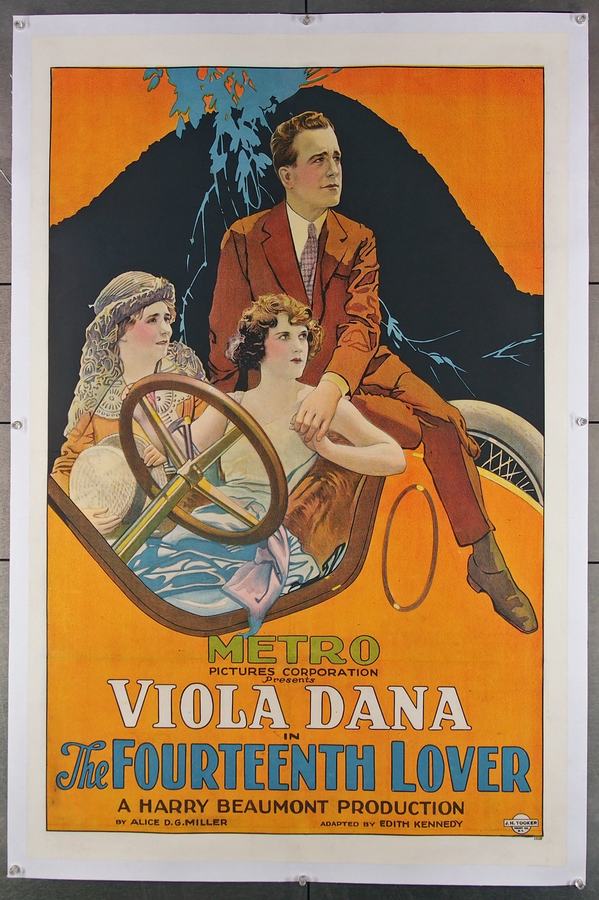
A cigarette ember pulses like a ruby in the midnight hush of Fourteenth Lover, each exhalation a tiny mutiny against the velvet tyranny of drawing-room decorum. Vi Marchmont—played with kinetic mischief by Viola Dana—doesn’t merely break hearts; she fractures the crystal lattice of 1920s social arithmetic, where a woman’s value is tallied in suitors and stock options. The film, helmed by scenario scribes Alice D. G. Miller and Edith M. Kennedy, arrives as a sly, silk-stockinged satire swaddled inside a pastoral idyll, its intertitles crackling with epigrammatic snap: “Romance is a card game—shuffle fast, deal faster.”
From the first iris-in on Vi’s boudoir—mirrors multiplying like guilty consciences—we sense we’re in for more than a routine society-matron comedy. Dana pirouettes through thirteen silk-clad swains, each a caricature of masculine posturing: the polo star who kisses his mallet more than his dates, the poet who rhymes “languid” with “frigid.” Enter candidate number fourteen, a Wall Street colt named Van Ness (Theodore von Eltz), whose smile is as polished as a newly minted nickel and twice as cold. The familial tribunal—father (Frederick Vroom) and the acid-tongued Aunt Letitia (Kate Lester)—convene beneath oil-painted ancestors, decreeing Vi’s romantic market closed for trading. Their weapon? A one-way ticket to convalescence, that time-honored loophole for inconvenient femininity.
Cue the film’s most delicious swindle: Vi’s phantom heart murmur. With the aid of the family sawbones—an amiably corrupt Falstaff in pince-nez—she feigns arrhythmic doom, eyelids fluttering like moth-wings against hurricane candlepower. The diagnosis is “nerves, neurasthenia, and a touch of Venus,” a phrase that deserves resurrection in every medical textbook. Exiled to the countryside, Vi steps off the polished observation car into a world of ochre fields and bruised horizons, cinematographer Fronzie Gunn framing her like a dropped pearl against a vast black-velvet glove.
Enter Richard Hardy—Jack Mulhall in rolled sleeves and soil-stained dignity—whose hands know the Latin nomenclature of every shrub yet tremble when handed a porcelain teacup. Their meet-cute is a thunderclap of hoes and hosiery: Vi’s silk stocking snags on briar rose, Hardy kneels to free her with a pocket-knife whose blade glints like a promise. The scene distills the entire silent era’s erotic grammar—no dialogue needed, only the rasp of breath, the scrape of thorn on flesh. Director Edward Sedgwick (uncredited but stylistically present) lets the camera linger on a bead of perspiration sliding down Mulhall’s temple, a tiny Mississippi of desire.
Of course, the house on the hill cannot abide this chlorophyll-scented courtship. Aunt Letitia, a gorgon in garnets, wields class prejudice like a rapier: “A gardener’s hands belong in dirt, not in the family crypt.” She sacks Hardy, replacing him with a trembling under-gardener who prunes roses into whimpering topiaries. Van Ness arrives in a cream-colored Rolls, whispering poisoned certainties: Hardy already has a wife stashed in Connecticut, a consumptive blonde who haunts seaside sanatoriums. Vi, torn between terror and temerity, chooses a third path—domestic apprenticeship. Cue montage of flour-dusted mornings, copper pots gleaming like captured suns, and Vi’s manicured fingers kneading bread dough until they blister. It’s a training montage worthy of Rocky, kneaded by feminist resolve.
Hardy, resourceful, secures a landscaping post on a neighboring estate whose owner collects rare tulips and even rarer scandals. Yet happiness wilts; he confides in his widowed mother (Alberta Lee), a woman whose face carries topographic maps of immigrant hardship. She treks to Vi’s manor like a pilgrim, bearing strawberry preserves and unspoken benedictions. Their parlor tête-à-tête—shot in chiaroscuro candlelight—feels smuggled from a Dreyer film, all sidelong glances and tremulous half-smiles.
The film’s moral fulcrum tilts on one rain-lashed night. Vi, fleeing a soirée of chinless debutantes, speeds her roadster to Hardy’s cottage. Inside, the air is thick with cedar smoke and unspoken vows. Rather than surrender to convention’s boudoir finale, the couple inverts the paradigm: Vi claims the narrow iron bed while Hardy, stoic as a pilgrim, spends the night reclined in the driver’s seat of her convertible, rain drumming a lullaby on the canvas roof. It’s a scene so achingly tender it retroactively shames a century of macho posturing. Morning finds them side by side in dawn’s pewter light, Vi declaring, via intertitle gem: “I’d rather be your tomorrow than everyone else’s today.” They pledge elopement, the camera pulling back to reveal two silhouettes against a bruised sky—an icon of mutual consent decades ahead of its time.
Viola Dana—a star whose luminescence has unjustly dimmed in pop-cultural memory—delivers a masterclass in calibrated whimsy. Watch her pupils dilate when she spies Hardy’s flexed forearm; witness the micro-twitch of her smile when Aunt Letitia’s back is turned. It’s a performance pitched between champagne fizz and depth-charge longing. Opposite her, Jack Mulhall eschews the era’s standard-issue rugged smirk, opting instead for a slow-burn earnestness, eyes flickering like a lantern unsure of its own flame. Their chemistry ignites not in clinches but in the negative space—hands almost touching, breaths almost shared.
Kate Lester as Letitia could have been a footnote harridan; instead she injects notes of mellifluous melancholy, hinting at her own spinster grief. In one fleeting shot she fingers a daguerreotype of a long-lost fiancé, suggesting that bigotry often germinates from personal famine. Theodore von Eltz imbues Van Ness with oleaginous charm, his smile never fully reaching the eyes—think Gatsby without the dream.
Cinematographer Fronzie Gunn—a name that belongs on a jazz trumpet—frames every scene like a lithograph. Interior parlors shimmer with tungsten opulence, every candelabra a frozen firework. Yet the countryside sequences luxuriate in pastoral noir: gnarled oaks finger the sky like arthrous prayers, and moonlight pools in wagon ruts like spilled mercury. Note the repeated visual motif of hands: Vi’s lace-gloved mitts versus Hardy’s dirt-creased palms, a dialectic of entitlement and labor that transcends didacticism.
The edit rhythms flirt with Soviet-style montage—whip-pans from champagne bubbles to gurgling brook, symbolic menstruation of class divide. Intertitles, often a weakness in silents, here glitter with epigrammatic snap: “Love is a weed; cultivate it and it splits the sidewalk.” One could wallpaper a loft with such koans.
While contemporaneous flapper flicks often copped out with last-minute aristocratic marriages, Fourteenth Lover brandishes a more subversive blade. Vi’s choice of Hardy isn’t mere erotic whim; it’s a repudiation of commodity femininity. By learning to bake bread, she colonizes the domestic sphere on her own terms, turning household labor from patriarchal shackle to liberating credential. The film slyly insinuates that class mobility need not be upward; authenticity can be a horizontal odyssey.
Compare it to Marrying Molly, where nuptials resolve every tension, or to Sleeping Fires, where female desire is punished by exile. Here, exile is self-propelled salvation. The final elopement is no concession to morality clause but a frontier leap—two silhouettes racing toward a horizon that refuses to crystallize into church bells or manor gates.
Surviving prints lack original cue sheets, inviting speculative re-scoring. Imagine a jazz trio—clarinet, muted trumpet, brushed snare—tracing Vi’s capricious orbit, then yielding to solo cello for Hardy’s nocturnal solitude. The shift from syncopated city to legato countryside would mirror narrative metabolism. At the bedside vigil, a faint heartbeat on kettle drum could resonate every twelve frames, an acoustic stethoscope for the audience’s own cardiac metronome.
Unlike The Kentucky Derby with its marquee spectacle, or Il giardino incantato with expressionist pedigree, Fourteenth Lover lacks a hook salable in three words: no horse race, no Expressionist sets, no vampires. Its virtues are granular—nuanced performances, socio-erotic audacity, cinematographic lyricism—qualities that slip through the coarse mesh of mass-market memory. Yet for cineastes fatigued by superhero decibel, the film offers a restorative draught: a reminder that rebellion can whisper, that seduction can reside in withheld touch, that endings can elide altar bells in favor of horizon smoke.
As of this writing, the only known 35 mm nitrate print nestles in the UCLA Film Archive, awaiting crowdfunding for 4K restoration. A 720p bootleg with Portuguese intertitles circulates in the dimmer alleys of the internet; even in degraded form, its glories pierce the fog. Demand festival retrospectives, pester Criterion, bribe your local cinematheque with baskets of brioche—do whatever necessary to resurrect this orphaned masterpiece.
Verdict? 9.2/10. A film that proves silence can be more libidinous than sound, that class warfare can bloom in a rose garden, that the most radical act is sometimes sleeping alone—for principle, for promise, for love.
IMDb —
1925
Community
Log in to comment.