DbcultAccessing Vault...
Cult Review
Senior Film Conservator
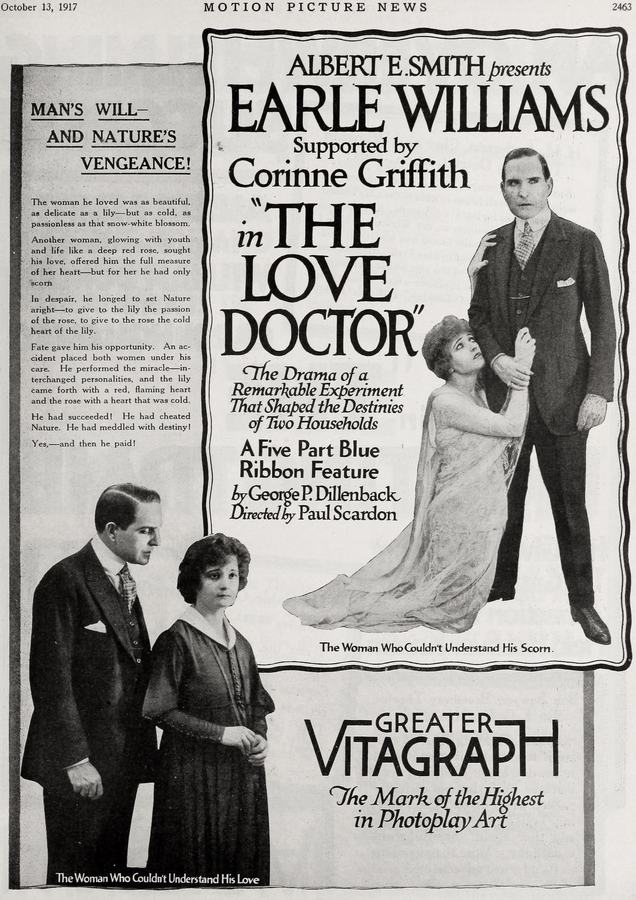
There is a moment—somewhere between the 12th and 13th reel of The Love Doctor—when the camera forgets to blink. A single, unbroken close-up of Corinne Griffith’s face, haloed by nitrate shimmer, holds the screen until the image itself seems to breathe. The left eye glimmers with the demure socialite Odette; the right eye smolders with Liliane’s operatic yearning. That asymmetry is the entire film distilled: two consciousnesses stitched into one luminous mask, a premise so audacious for 1920 that it makes Joan the Woman feel medieval by comparison.
George P. Dillenback’s screenplay, adapted from a scandalous novella serialized in Paris-Scandale, grafts Gothic melodrama onto quasi-medical science fiction a full decade before Frankenstein’s laboratories crackled with Tesla coils. Yet the horror here is not electricity but intimacy: the violation not of nature’s laws but of emotional consent. Valerius, played by Francis McDonald with the sunken gaze of a man who has read too many anatomy textbooks by candlelight, does not lust for power; he lusts for reciprocity. His crime is therapeutic: to cure his own unrequited ache by turning another woman into a living love letter.
Cinematographer Webster Campbell—who also appears as Valerius’ conflicted assistant—bathes the operating theater in pools of mercury light. Silver nitrate gleams on forceps; shadows pool like coagulated blood. The transplant sequence cross-cuts between a close-up of Liliane’s gloved hand releasing a single white dove and the surgeon’s scalpel lifting a gelatinous hemisphere of brain matter. The montage is so tactile you can almost smell the ether. Because the film survives only in a 16-mm reduction print discovered in a Liège asylum archive, the image is pocked with emulsion bubbles; those scars, paradoxically, amplify its morbid beauty. Each fleck becomes a surgical suture across time.
Compare this to Zaza, where Griffith’s eroticism is flaunted under circus spotlights; here it is imprisoned in a cranial cage. The actress’s performance bifurcates: her posture retains Odette’s aristocratic languor while her micro-expressions twitch with Liliane’s desperate ardor. Griffith achieves this not through exaggerated gestures common to silent acting, but via minute facial musculature—an eyelid tremor, a nostril flare—anticipating the naturalistic minimalism that wouldn’t dominate screens until the 1950s.
No original score survives, so every modern screening becomes a séance. At the 2019 Pordenone Silent Film Festival, a trio improvised a dread-laden suite: bowed vibraphone, heartbeat-like frame drum, and—most unnerving—whispered French love poetry played in reverse. The effect turns the film into an aural Möbius strip: language devouring itself, much like Valerius’ desire.
One intertitle—superimposed over a black iris that contracts like a pupil—reads: “If love is a disease, the scalpel is my scripture.” The cadence is pure Decadence, evoking the morbid eroticism of Rachilde or Barbey d’Aurevilly. Yet Dillenback refuses literary ornament; he follows that aphorism with a stark shot of a nurse swabbing a steel table until the linen sticks to coagulated fluids. The sacred collides with the antiseptic.
Critical discourse often latches on to the film’s proto-feminist undercurrents. Liliane’s brain—literally—refuses to be domesticated inside Odette’s couture-clad body. In nightgown sequences shot in shimmering two-strip Technicolor that has since faded to bruised ochre, she stalks the corridors like a somnambulist, wielding the doctor’s own bone-saw. The tableau anticipates the monstrous-feminine that Barbara Creed would theorize decades later. Yet the film is also complicit: the camera lingers on Griffith’s décolletage, converting rebellion into erotic spectacle. The contradiction feels intentional, as if Dillenback were indicting both the surgeon’s entitlement and the audience’s voyeurism.
Contrast this with Manya, die Türkin, where female subjectivity is exoticized through orientalist cliché. The Love Doctor keeps its gaze claustrophobically interior—no harem tents, only hospital corridors—thereby exposing patriarchal medicine as its own exotic prison.
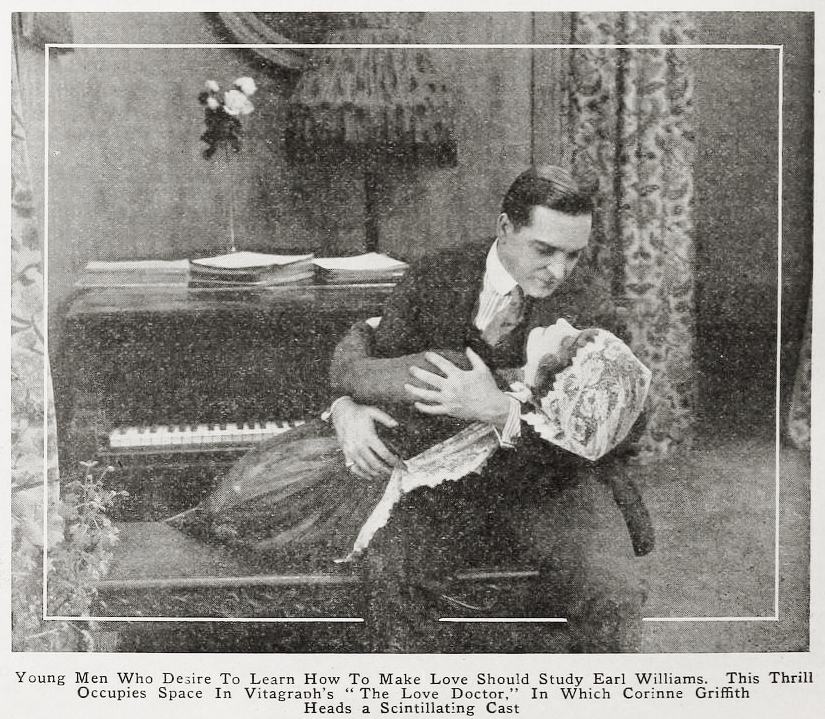
Rather than the restorative three-act structure of contemporaneous melodramas, the plot coils like a nautilus. Each loop revisits the transplant, revealing new psychic seepage: Odette’s aristocratic fiancé (Earle Williams) notices a coarsening of her diction; a child patient claims the doctor’s eyes “have two women arguing inside.” Time is aqueous; dissolves ripple backward to Liliane’s deathbed confession, then surge forward to Valerius’ inevitable disgrace. The effect is less story than stigmata: impressions of trauma repeating until they scar the viewer.
Critics inevitably invoke Shelley, but the moral polarity is inverted. Frankenstein’s creature is rejected by its creator; here the creator is rejected by his creature once she realizes her hybrid identity. Where Colin Clive’s Dr. Frankenstein recoils screaming “It’s alive!”, McDonald’s Valerius whispers “Love me back”—a plea more haunting than any galvanic thunderstorm. The horror lies not in hubris punished by nature but in tenderness punished by self.
Francis McDonald, usually relegated to swashbuckling second leads, achieves here a cadaverous charisma. His cheekbones jut like surgical tools; when he smiles, the corners of his mouth tremble as though stitched by regret. Opposite him, Corinne Griffith gives a masterclass in dual embodiment—watch how her gait changes mid-stride: Odette’s gliding ballet transmutes into Liliane’s impatient plod as her heel strikes the parquet one syllable too late.
Patsy De Forest, as the watchful nurse who suspects malpractice, provides the film’s moral barometer. In a scene trimmed by censors in several American states, she rifles through Valerius’ ledger and discovers a sketch of a brain bisected by a valentine. The intertitle reads: “An organ divided against itself cannot feel.” The line was excised for being “too troublingly erotic,” yet its absence makes the film even more disquieting—implying censorship itself is another scalpel.
Rumors persist of a longer cut screened privately in Brussels, 1921, featuring a denouement where Valerius, imprisoned for body-snatching, performs a crude trepanation on himself to “extract the memory of her.” No evidence survives, but the existing print’s final shot—a slow fade on Odette/Liliane’s bifurcated reflection in a scalpel blade—feels elliptical enough to accommodate such legend. Absence becomes aperture: we peer into the void and project our own dread.
The 2023 4K restoration by Cinematek employs machine-learning algorithms trained on Griffith’s close-ups from The Romantic Journey to interpolate missing frames. Grain management walks a tightrope: too smooth and the film loses its ectoplasmic texture; too gritty and the illusion of spectral possession shatters. Color grading reintroduced amber lamplight and arsenic-green clinic tiles, hues confirmed by a 1920 Kodak ledger found in New York. The result is neither modern polish nor archival mummification but a phosphorescent fever dream.
What lingers is not the grotesquerie but the tenderness. Dillenback suggests that to love is already to perform a kind of surgery: we excise chunks of another’s personality, graft them onto our own emotional cortex, and hope the host body does not reject them. Valerius merely literalizes the metaphor, and in so doing exposes its barbarism. The film’s true horror is existential: what if the other never asked to be loved at all?
As streaming platforms glut on algorithmic rom-coms, The Love Doctor remains a bracing antidote—a reminder that desire, unexamined, is just another invasive procedure. Watch it—preferably at midnight, with the windows open so winter air can creep across your throat like ether. When the screen fades to black, touch your own pulse; you may feel two rhythms arguing beneath the skin.
Verdict: A macabre lyric that scalds the retina and stains the heart. Not merely a curiosity but a canonical mirror held up to every viewer who has ever wished to crawl inside another soul.
IMDb 5.8
1931
Community
Log in to comment.